
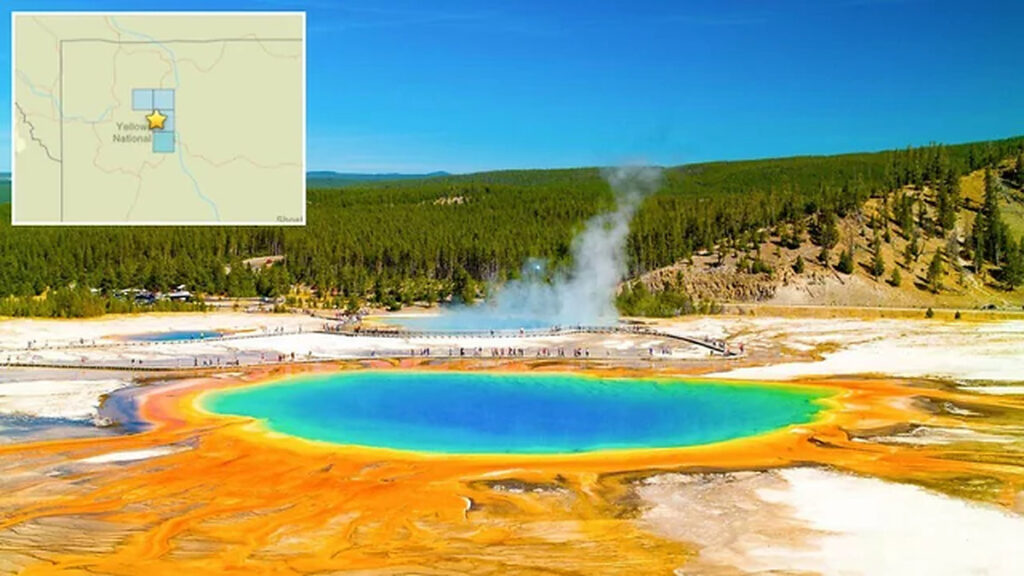
A magnitude 3.3 earthquake struck Yellowstone National Park on Thursday morning, drawing renewed attention to one of the world‘s most closely monitored volcanic regions.
According to the U.S. Geological Survey (USGS), the earthquake occurred at approximately 9:20 a.m. ET along the Yellowstone River within the Wyoming section of the park.
The quake’s epicenter was located roughly seven miles from the Yellowstone caldera, the massive volcanic depression formed by ancient super-eruptions.
While the shaking was classified as light, the event adds to a series of recent seismic occurrences in the area.
Cluster of Recent Earthquakes Keeps Scientists Watching
The latest tremor is one of 11 minor earthquakes recorded around the Yellowstone caldera over the past three weeks.
Yellowstone frequently experiences earthquake swarms, and experts continue to study whether such activity reflects normal geological processes or changing conditions beneath the surface.
Researchers have long linked seismic activity in the region to several natural causes, including underground magma movement, hydrothermal systems, and tectonic forces associated with the Intermountain Seismic Belt—an approximately 800-mile-long zone of active faults extending through Nevada, Utah, Idaho, Wyoming, and Montana.
AI Study Revealed Thousands of Previously Undetected Earthquakes
Interest in Yellowstone’s underground activity intensified after an international team of scientists used artificial intelligence to analyze 15 years of seismic recordings from the national park.
The project uncovered approximately 86,000 small earthquakes that had gone unnoticed by traditional analysis methods—around ten times more than researchers had previously identified.
Scientists believe these tiny quakes offer a much more detailed picture of the region’s complex underground processes, although they do not necessarily indicate that an eruption is approaching.
New Research Refines Understanding of Yellowstone’s Magma System
Recent scientific studies have also improved researchers’ understanding of Yellowstone’s volcanic structure.
A 2025 study conducted by scientists from the Universities of Utah and New Mexico concluded that the upper boundary of the magma chamber lies about 2.3 miles beneath the surface.




Earlier estimates, including work cited by researchers at Rice University, had suggested the top of the magma system could be as deep as five miles.
Although shallower magma can contribute to volcanic pressure and gas production, scientists emphasize that its presence alone is not evidence of an imminent eruption.
The same University of Utah research found that Yellowstone’s volcanic system remains stable, with gases escaping naturally through the park’s famous geysers and hot springs rather than accumulating beneath the surface.
Experts Reject Claims That Yellowstone Is “Overdue”
Yellowstone’s last super-eruption occurred roughly 631,000 to 640,000 years ago, leading to recurring public speculation that another catastrophic event is overdue.
However, the USGS has repeatedly cautioned against interpreting eruption history as a predictable timetable.
The agency notes that Yellowstone experienced three major eruptions approximately 2.08 million, 1.3 million, and 631,000 years ago—an average interval of about 725,000 years.
Scientists stress that calculating future eruptions from only two intervals has little scientific value and should not be used to forecast volcanic activity.
The USGS currently classifies Yellowstone’s volcanic activity as “normal” and notes that no lava has erupted from the caldera in approximately 77,000 years.
Emergency Planning Continues Despite Stable Conditions
Although there is no indication that an eruption is imminent, federal scientists continue to prepare for a range of possible scenarios.
The USGS has developed computer models to understand how a future Yellowstone super-eruption could affect the United States.
One simulation published in 2014 projected that volcanic ash could spread across much of the country if such a rare event occurred.
Areas closest to Yellowstone, including the national park itself, could be buried beneath several feet of ash, while nearby cities such as Denver, Boise, and Salt Lake City could receive enough ashfall to damage buildings and infrastructure.
The model also suggested that ash could reach distant metropolitan areas including Chicago, St. Louis, Kansas City, Los Angeles, San Francisco, and Seattle, though in significantly smaller amounts.
What the Latest Earthquake Means
Despite renewed public interest following Thursday’s earthquake, scientists emphasize that small earthquakes are a common feature of Yellowstone’s active geological environment.
Current monitoring data show no signs that the volcanic system is transitioning toward an eruption, and officials continue to classify conditions as normal while maintaining continuous surveillance of the park’s seismic and geothermal activity.
Summary
A magnitude 3.3 earthquake struck Yellowstone National Park near the Yellowstone caldera, marking the latest in a series of minor tremors recorded in recent weeks.
Although new research has revealed extensive underground seismic activity and refined estimates of the magma chamber’s depth, scientists say the supervolcano remains stable.
The USGS continues to monitor the region closely and maintains that there is no evidence of an imminent eruption, despite ongoing emergency planning for the extremely unlikely event of a future super-eruption.
