
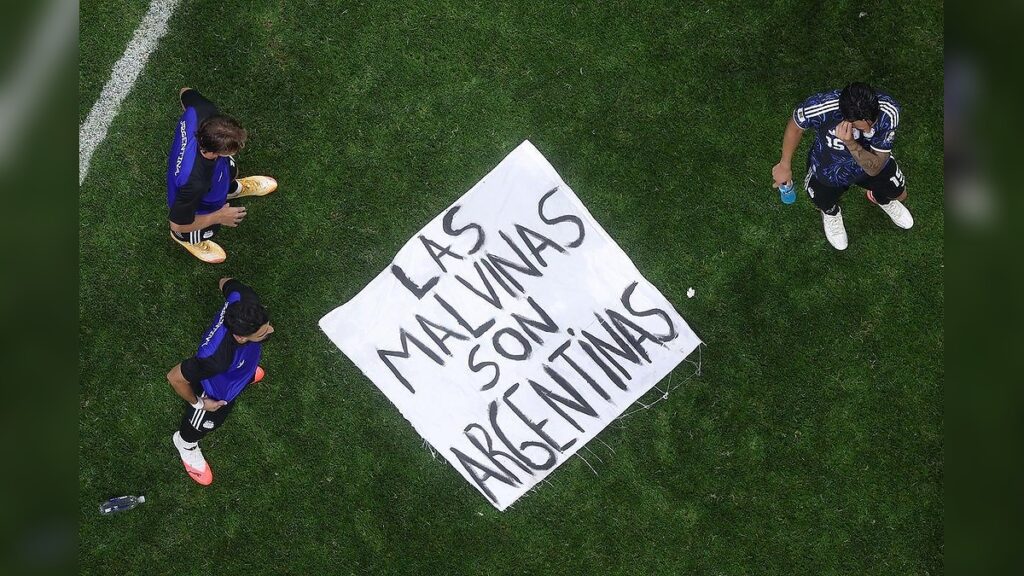
England’s dramatic World Cup semi-final defeat to Argentina has sparked a diplomatic and sporting controversy after members of the victorious Argentine squad celebrated with a banner asserting the country’s claim to the Falkland Islands.
The incident has prompted the UK Government to back calls for FIFA to investigate whether the display breached the governing body’s rules prohibiting political messages during football matches.
No10 Supports Calls for FIFA Action
Downing Street said any disciplinary measures would ultimately be for FIFA to determine but confirmed it supported demands for an investigation into the banner displayed after Argentina’s 2-1 victory in Atlanta.
The Prime Minister’s official spokeswoman echoed comments made by Business Secretary Peter Kyle, who described the post-match celebration as “entirely inappropriate.”
The Government also delivered a pointed political message, insisting that while England had fallen short of reaching the World Cup final, British sovereignty over the Falkland Islands remained unquestionable.
Argentina’s Celebration Sparks Political Storm
Shortly after the final whistle, several Argentine players posed with a large banner bearing the slogan “Las Malvinas son Argentinas” (“The Malvinas are Argentine”), referring to the Falkland Islands by their Spanish name.
Captain Lionel Messi joined teammates during the celebrations, while Premier League players Cristian Romero, Lisandro Martinez and Giovani Lo Celso were among those prominently pictured alongside the banner.
Video footage showed players silencing the crowd before raising the sign, and Lo Celso later placed it on the pitch as celebrations continued.
The display has attracted widespread criticism because FIFA regulations prohibit political statements and symbols during official competitions.
Politicians Across Britain Condemn the Display
The banner drew swift condemnation from politicians across the UK.
Business Secretary Peter Kyle praised England’s conduct despite defeat, contrasting their behaviour with Argentina’s celebrations.
Shadow minister Andrew Griffith argued the stunt violated FIFA regulations and questioned why Argentine players should not face sanctions similar to punishments imposed in previous political incidents.
Scottish Conservative MSP Murdo Fraser declared that the Falkland Islands had never belonged to Argentina and never would, while Conservative leader Kemi Badenoch reaffirmed her party’s commitment to defending British sovereignty.
Reform UK leader Nigel Farage also criticised the players’ actions, although he said strengthening the Royal Navy should remain Britain’s primary priority.
Pressure Mounts on FIFA
Football’s governing body has not publicly commented on the incident, but pressure is increasing for disciplinary action.
Calls have emerged for FIFA to impose tougher sanctions than those handed out in previous cases involving similar banners.




Argentina’s football association was fined around £20,000 in 2014 after players displayed an almost identical slogan before an international friendly, but critics argue that repeating the gesture during a World Cup watched by hundreds of millions worldwide warrants a stronger response.
Supporters have also urged Manchester United and Tottenham Hotspur to take action against Lisandro Martinez and Cristian Romero respectively, while some fans have called for players involved in the demonstration to face suspension.
Diplomatic Tensions Extend Beyond Football
The controversy unfolded against the backdrop of renewed diplomatic friction between London and Buenos Aires.
Argentina recently protested the movements of HMS Medway, accusing the Royal Navy patrol vessel of making an unauthorised passage through waters it considers its own.
British officials rejected the accusation, stating the ship’s transit complied fully with international law under the principle of innocent passage and that Argentina had been informed beforehand.
The Ministry of Defence explained that HMS Medway had been returning to the Falkland Islands after supporting British Antarctic Survey operations in Antarctica.
Argentine Officials Continue Sovereignty Campaign
Argentina’s government has intensified its rhetoric over the Falklands in recent days.
Foreign Minister Pablo Quirno questioned the legitimacy of the islands’ population, claiming residents had been “artificially implanted” and dismissing the 2013 referendum in which 99.8 per cent of voters chose to remain a British Overseas Territory.
Following Argentina’s victory, Vice-President Victoria Villarruel declared on social media that the match represented more than football, insisting the Falklands belong to Argentina and suggesting the country’s claim could not be silenced even if banners were prohibited inside stadiums.
Ahead of the semi-final, she had also described England as “usurping pirates,” adding further political tension before kickoff.
Falklands Dispute Remains Deeply Rooted
The sovereignty dispute dates back centuries but remains most closely associated with the 1982 Falklands War, when Argentina invaded the islands before British forces regained control following a ten-week conflict.
A total of 907 people died during the war, including 255 British servicemen.
Britain maintains that it has exercised sovereignty over the islands since the 19th century and points to the overwhelming 2013 referendum result in favour of remaining a British Overseas Territory as evidence that the islanders’ wishes should be respected.
England’s Semi-Final Collapse Adds to Bitter Night
The political controversy overshadowed what had already been a heartbreaking evening for England.
Thomas Tuchel’s side appeared destined for a first World Cup final since 1966 after Anthony Gordon gave England the lead with only minutes remaining.
However, Enzo Fernandez equalised late in the match before Lautaro Martinez headed Argentina’s winner deep into stoppage time.
Tuchel has faced intense criticism over defensive substitutions made after England took the lead, although the manager defended his tactical decisions, arguing that criticism is inevitable whenever a result goes against a team.
Fans Report Heated Atmosphere After the Match
Some England supporters also complained about the behaviour of Argentina fans as they left the stadium.
Several described confrontational celebrations, claiming flags and shirts were waved aggressively in front of disappointed England supporters, raising fears that tensions could spill over beyond the stadium.
Despite the painful defeat, messages of support quickly arrived for the Three Lions from senior British figures, including King Charles III and outgoing Prime Minister Keir Starmer, both of whom praised the team’s commitment and performances throughout the tournament.
Summary
England’s World Cup semi-final loss has evolved into a broader political controversy after Argentina’s players celebrated with a banner asserting the country’s claim to the Falkland Islands.
Downing Street has backed calls for FIFA to investigate whether the display breached regulations banning political messaging, while British politicians have condemned the celebration and defended UK sovereignty.
The dispute has intensified already strained diplomatic relations between Britain and Argentina, ensuring the fallout from the match extends well beyond the football pitch.
