
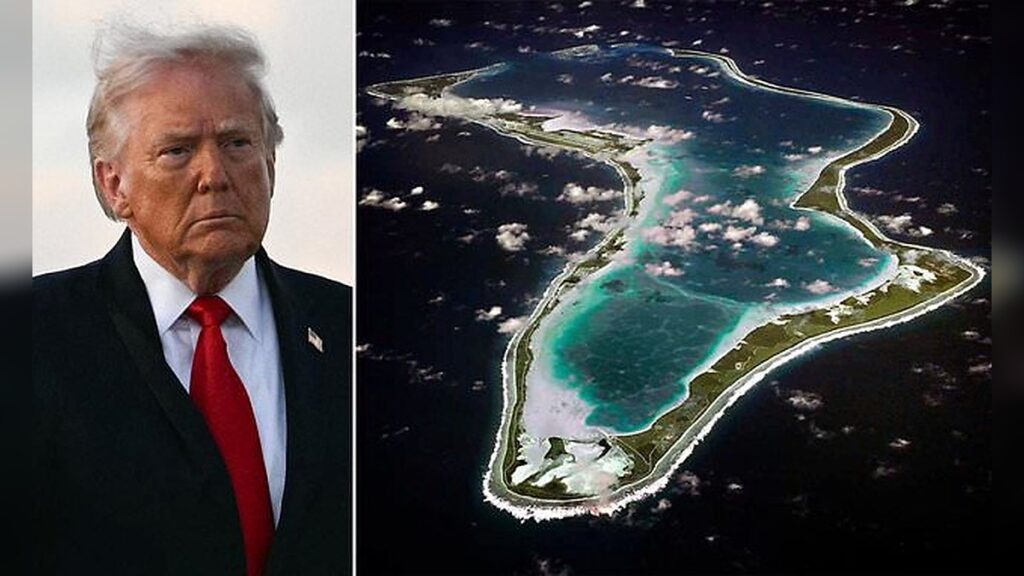
Britain’s long-running plan to transfer sovereignty of the Chagos Islands to Mauritius is facing a new twist, with reports suggesting the United States is exploring the possibility of purchasing the territory outright.
The development comes amid growing opposition in Washington to the proposed handover and renewed debate over the future of the strategically important Diego Garcia military base.
White House Explores Alternative Path for Chagos Islands
Sources familiar with discussions in Washington indicate that American officials have prepared proposals that could allow the United States to negotiate directly with Mauritius for control of the Chagos Islands.
Such a move would bypass Britain’s existing plan to transfer sovereignty while maintaining access to the joint UK-US military facility on Diego Garcia.
The reported proposal is one of several options currently under consideration by the White House as policymakers assess how best to protect American military interests in the Indian Ocean.
A US official emphasized that President Donald Trump has consistently opposed the idea of Britain relinquishing the British Indian Ocean Territory, arguing that the region’s military significance makes any transfer of sovereignty a serious concern.
According to the official, Diego Garcia remains one of the most important strategic assets available to the United States, serving as a critical security platform in a region increasingly shaped by geopolitical competition.
A Deal Once Backed by Trump Faces Reversal
Britain and Mauritius signed a treaty in May 2025 that would have transferred sovereignty over the Chagos Archipelago to Mauritius while allowing Britain and the United States to continue operating the Diego Garcia base under a 99-year lease arrangement.
However, plans to implement the agreement stalled after strong opposition emerged from the United States.
The legislative process required to complete the handover was subsequently paused, with international tensions, including conflict involving Iran, adding further complications.
The delay marked a significant shift from earlier expectations.
The agreement had once received support from President Trump, but that position changed dramatically in January when he publicly criticized the proposal, describing it as an act of “great stupidity.”
His reversal left British officials facing mounting pressure both internationally and domestically.
Why Diego Garcia Matters So Much
At the center of the dispute is Diego Garcia, the largest island in the Chagos Archipelago and home to a major joint military installation used by both Britain and the United States.




The base has played a crucial role in military operations for decades, supporting missions across the Middle East, Asia, and Africa.
Its location in the Indian Ocean provides strategic reach that many defense planners consider irreplaceable.
British ministers previously argued that reaching an agreement with Mauritius was necessary to safeguard the facility’s future.
Government officials concluded that without resolving the sovereignty dispute, a series of international legal decisions could eventually undermine the legal foundations supporting the base’s operation.
Defence Secretary John Healey warned Parliament in May 2025 that failure to secure a settlement could lead to unfavorable legal judgments within weeks and potentially render the base inoperable within a few years.
International Legal Pressure Shaped Britain’s Position
Mauritius has long maintained that the Chagos Islands should belong to it, arguing that Britain improperly separated the territory before granting Mauritian independence.
That position has received support through several international legal and diplomatic rulings.
A major milestone came in 2019 when the International Court of Justice issued an advisory opinion backing Mauritius’ claim.
Subsequent decisions from international maritime tribunals reinforced that legal interpretation.
British officials feared that if those judgments eventually gained binding force, the United Kingdom could face greater risks by retaining the territory than by negotiating a settlement that preserved access to Diego Garcia.
As a result, the government viewed the handover arrangement as the most practical route to securing the military base’s long-term future.
Political Pressure Mounts in Westminster
The uncertainty surrounding the agreement has sparked criticism from across the British political landscape.
Following President Trump’s change of position, several lawmakers urged the government to abandon the transfer plan altogether.
Dan Carden, the Labour MP for Liverpool Walton and leader of the Blue Labour parliamentary group, argued that the lack of support from Washington made it increasingly difficult to justify proceeding with the deal.
Similarly, Graham Stringer, Labour MP for Blackley and Middleton South, criticized the policy as both financially and militarily indefensible, warning that continuing with it could further damage Britain’s credibility.
Former Diplomats Predict the Plan’s Future Is Uncertain
Questions about the viability of the agreement have also been raised by former senior diplomats.
Simon McDonald, a former head of the Foreign and Commonwealth Office who was involved during earlier discussions surrounding the Chagos issue, suggested earlier this year that the proposal had effectively been placed on hold indefinitely.
He noted that Britain’s objectives had been twofold: complying with international law while also strengthening relations with the United States. Once Washington’s support disappeared, however, the government was forced to reassess its strategy.
With the White House now reportedly examining options that include purchasing the islands directly, the future of the Chagos Islands remains uncertain.
What was once viewed as a settled path toward Mauritian sovereignty has become a complex geopolitical dispute involving legal rulings, military strategy, and the evolving relationship between Britain and the United States.
