
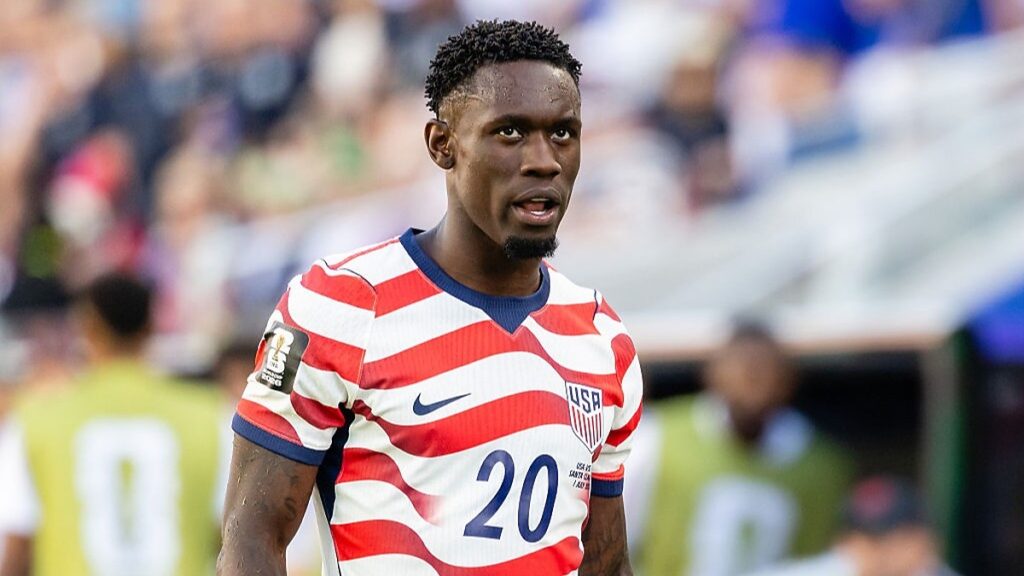
European football governing body UEFA has sharply criticized FIFA after the world governing body allowed United States striker Folarin Balogun to play in the World Cup round-of-16 clash against Belgium despite receiving a red card in the previous match.
Describing the ruling as “unprecedented, incomprehensible and unjustifiable,” UEFA argued that FIFA’s handling of the situation threatens the integrity of football and undermines confidence in the competition’s disciplinary process.
The controversy has intensified just hours before the knockout encounter, with Belgium formally appealing the decision in an effort to have Balogun’s automatic suspension reinstated.
Balogun’s Ban Lifted Before Knockout Match
Balogun was initially expected to miss the Belgium fixture after being shown a straight red card during the United States’ 2-0 victory over Bosnia & Herzegovina in the Round of 32.
However, FIFA later suspended the one-match ban for a one-year probationary period, making the Arsenal forward immediately available for selection. Under the ruling, the suspension will only be activated if Balogun commits another offense of similar seriousness during the probation period.
The decision stunned many across football, particularly after reports emerged that U.S. President Donald Trump had personally contacted FIFA President Gianni Infantino before the disciplinary sanction was reversed.
Belgium Seeks Urgent Reversal
Belgium’s football federation has moved swiftly to challenge FIFA’s decision, arguing that the suspension contradicts the competition’s own disciplinary regulations.
FIFA has reportedly assigned an arbitrator from its Appeal Committee to review Belgium’s complaint, although the process is taking place under significant time pressure with kickoff rapidly approaching.
Belgian officials insist the automatic suspension following a straight red card is clearly established within FIFA’s World Cup regulations and should not be subject to exceptions once a tournament is underway.
UEFA Warns of Dangerous Precedent
In a strongly worded statement released Monday, UEFA said FIFA had crossed “a red line” by intervening in what it considers a mandatory disciplinary process.
According to UEFA, automatic one-match suspensions following red cards are not discretionary sanctions requiring additional approval but are fundamental provisions designed to guarantee equal treatment for every team.
The organization warned that allowing exceptions during the World Cup could create uncertainty for future disciplinary decisions and weaken confidence in the fairness of international competitions.




UEFA also argued that if tournament organizers cannot consistently enforce established regulations, the credibility of both the World Cup and the wider sport could suffer.
FIFA Cites Disciplinary Code
FIFA defended its decision by referencing Article 27 of its disciplinary code, which permits disciplinary measures to be fully or partially suspended under certain circumstances.
In its statement, FIFA confirmed that Balogun’s suspension had been placed on hold for a one-year probationary period. Should the striker commit another infringement of similar nature and seriousness during that time, the original suspension would immediately take effect in addition to any further punishment.
Critics, however, point to Article 66.4 of FIFA’s regulations, which specifies that a player sent off automatically misses the team’s next match, fueling debate over whether the governing body exceeded its authority.
Political Influence Allegations Fuel Debate
The controversy grew further after Donald Trump publicly thanked FIFA for what he described as correcting “a great injustice.”
Posting on Truth Social, the U.S. president praised the organization for reversing the suspension shortly after reports surfaced that he had spoken directly with Infantino regarding Balogun’s eligibility.
Human rights organization FairSquare also questioned the decision, arguing that the disciplinary process appeared to have been altered in a manner benefiting political interests rather than sporting fairness.
Rare Historical Exception Draws Comparisons
Balogun’s case is now being compared with one of the most unusual disciplinary decisions in World Cup history.
Across 189 red cards issued in previous World Cups, only one other player has avoided serving an immediate suspension: Brazilian legend Garrincha in 1962. That case also generated controversy, although automatic suspension rules were not yet part of FIFA’s regulations at the time.
Many observers argue the current case differs because modern disciplinary procedures are clearly defined within the competition’s rulebook.
Belgian Camp Voices Frustration
Belgium’s football federation expressed astonishment over FIFA’s decision, saying it would pursue every available legal avenue to defend the principles of fair play.
Head coach Rudi Garcia questioned the timing of the ruling, joking that the World Cup suddenly felt like April Fool’s Day while emphasizing that his team was standing up for football’s ethics.
Goalkeeper Thibaut Courtois admitted the reversal came as an unexpected development but stressed that Belgium’s players remain focused on defeating the United States regardless of Balogun’s availability.
Football Figures Question FIFA’s Approach
The decision has prompted criticism from several prominent figures across world football.
England manager Thomas Tuchel questioned where disciplinary appeals should begin and end, suggesting the ruling raises broader concerns about consistency in officiating and post-match reviews.
Former FIFA president Sepp Blatter also criticized the move, arguing that red-card suspensions should be determined solely through independent sporting procedures rather than political influence.
Former England captain Wayne Rooney called the decision “an absolute disgrace” and said FIFA President Gianni Infantino should feel ashamed. Rooney also recalled his own disciplinary experience before Euro 2012, revealing he was once offered a reduced suspension after participating in a community training session—an arrangement he believed was inappropriate despite accepting it at the time.
Pressure Mounts Ahead of Crucial World Cup Clash
As FIFA’s Appeal Committee races to examine Belgium’s challenge, the controversy has overshadowed preparations for one of the tournament’s biggest knockout matches.
Regardless of the outcome, the dispute has sparked a wider debate about consistency in football governance, political influence in sporting decisions, and whether disciplinary rules can remain credible if exceptions are introduced during the sport’s biggest competition.
