
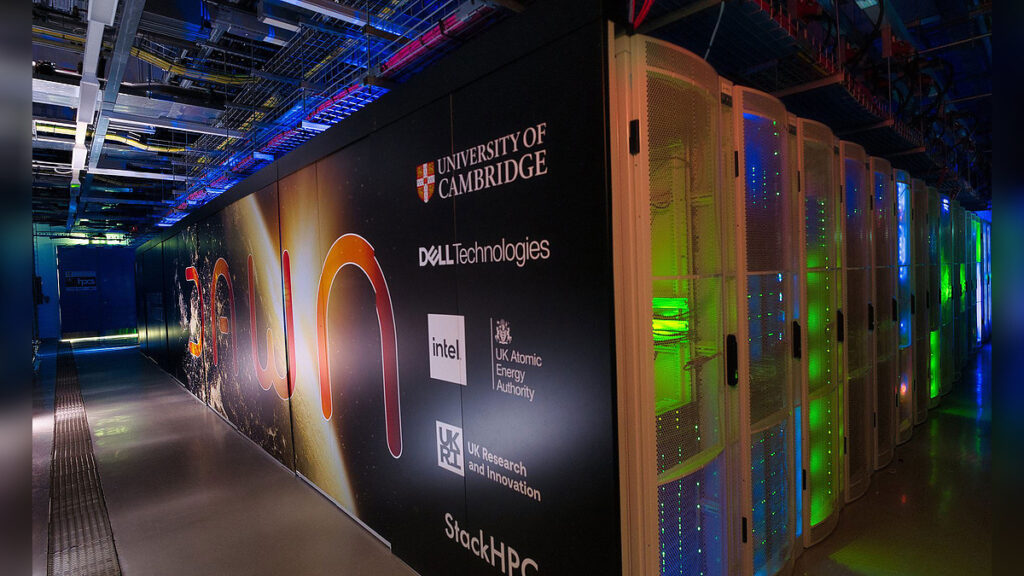
Britain’s record-breaking summer temperatures have highlighted the growing vulnerability of critical research infrastructure after one of the country’s most powerful artificial intelligence supercomputers was forced offline for more than a week because of overheating concerns.
The interruption affected Dawn, a high-performance computing system based at the University of Cambridge, temporarily halting scientific work on projects ranging from climate modelling to cancer research before services were scheduled to resume on Monday.
Cooling Failure Triggered Shutdown During Extreme Temperatures
The disruption began on June 27, when temperatures at the University of Cambridge climbed to around 30°C, placing additional pressure on cooling systems at the West Cambridge data centre where Dawn is housed.
University officials confirmed the machine was taken offline after technical issues emerged during the hot weather.
Staff working at the facility were informed that a major IT incident had been declared following a failure involving the data centre’s cooling infrastructure.
Although cooling capacity has since been fully restored, the incident kept the supercomputer unavailable for researchers for well over a week.
Importantly, the university indicated there was no evidence that the latest spell of hot weather, with temperatures expected to remain in the high 20s, would prevent Dawn from returning to service.
Scientists Pause Research While Waiting for System to Return
The outage temporarily interrupted a wide range of research activities that rely on Dawn’s immense computing capability.
Lennard Lee, director of the University of Oxford’s UK cancer vaccine and AI scientist and supercomputing project, said the shutdown meant research work had effectively been placed on hold.
Despite the interruption, he stressed that the incident did not compromise research data or force scientists to repeat completed calculations, explaining that no information had been lost during the outage.
Supercomputer Powers Breakthroughs Across Multiple Fields
Since entering operation, Dawn has become one of the UK’s most important scientific computing resources.
Researchers have relied on the system to forecast changes in Antarctic sea ice, improve climate simulations and accelerate studies into personalised cancer vaccines.
The machine has also demonstrated the ability to detect signs of kidney cancer in medical scans, earning praise from Cambridge University as a powerful tool for advancing medical diagnosis.
Beyond medical and environmental science, Dawn has supported more than 350 research projects across the UK at no cost, with applications extending to public-sector initiatives such as helping reduce NHS waiting times.




Government Investment Aims to Expand Computing Capacity
Earlier this year, the UK Government announced a £36 million investment to significantly upgrade Dawn’s performance.
The funding is expected to increase the system’s computing power by approximately six times, paving the way for its next-generation successor, Zenith.
The upgraded platform is being developed through a partnership involving Dell, AMD and Stack HPC.
The expansion is intended to strengthen Britain’s artificial intelligence and scientific research capabilities as demand for high-performance computing continues to grow.
Experts Warn Climate Change Creates New Risks for Data Centres
The shutdown has renewed concerns about how increasingly frequent heatwaves could affect critical digital infrastructure.
Simon McIntosh-Smith, professor of high-performance computing at the University of Bristol, noted that cooling systems capable of operating reliably in temperatures approaching 50°C can be built, but doing so requires substantially greater investment.
He warned that disruptions affecting national supercomputers present a particular challenge because such systems serve as essential resources for researchers across the country.
As periods of extreme heat become more common, maintaining reliable operation may require more resilient cooling technologies.
Jonathan Hirst of the University of Nottingham echoed those concerns, saying unusually high temperatures are now occurring more frequently than experts expected only a few years ago.
He suggested that improving software efficiency and smarter data management could reduce heat generation inside data centres during future heatwaves.
Cooling System Supplier Rejects Claims of Equipment Malfunction
The company responsible for Dawn’s cooling technology said its equipment functioned as intended throughout the incident.
Legrand, the French parent company of UK cooling specialist USystems, stated that its cooling infrastructure operated within its designed specifications and did not experience a malfunction during the event.
The comments suggest the shutdown was linked to wider operational challenges associated with the extreme weather rather than a failure of the cooling equipment itself.
Britain Experiences Another Summer of Record Heat
The incident unfolded during one of the hottest starts to summer ever recorded in the UK.
According to provisional figures from the Met Office, June became England’s hottest on record and the second-warmest June across the UK.
A new national June temperature record of 37.7°C was registered at Lingwood in Norfolk on June 26, comfortably surpassing the previous record of 35.6°C, first established in 1957 and matched during the famous 1976 heatwave.
Forecasters are now expecting another spell of intense heat, with temperatures between 31°C and 34°C forecast for London over several days.
Schools in some areas have already adjusted activities by cancelling sports events and relaxing uniform rules to help pupils cope with the soaring temperatures.
Heat-Related Data Centre Disruptions Are Becoming More Common
Dawn is not the first major computing facility to experience problems during extreme summer weather.
During the severe UK heatwave in July 2022, data centres operated by Google and Oracle also suffered outages linked to exceptionally high temperatures.
The latest disruption reinforces growing concerns that climate change is increasing pressure on digital infrastructure, prompting calls for future supercomputers and data centres to be designed with greater resilience against prolonged periods of extreme heat.
