
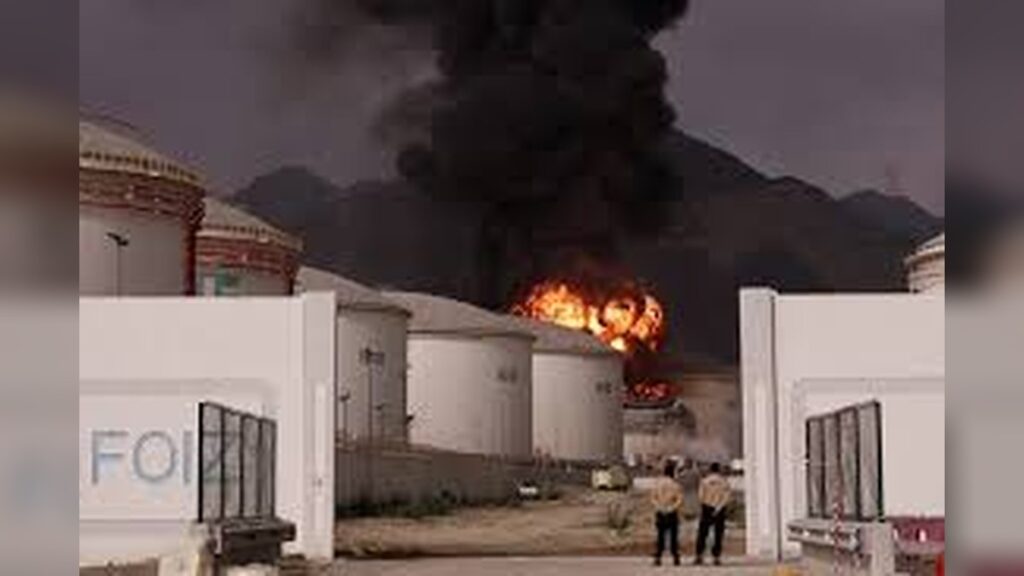
The conflict between the United States and Iran intensified on Thursday as both countries exchanged fresh military attacks, pushing the renewed Middle East confrontation into its sixth day.
The latest wave of strikes centered on the strategically vital Strait of Hormuz, a key global shipping route for oil and natural gas that has become the focal point of the escalating crisis.
US military officials said operations targeted several Iranian military sites, while Tehran responded with attacks aimed at American allies across the Gulf region, raising fears that the conflict could spread even further.
US Targets Iranian Military Infrastructure
According to the US Central Command (CENTCOM), American forces carried out coordinated strikes against multiple Iranian military positions, including facilities in the coastal city of Bandar Abbas.
The military said the objective was to weaken Iran’s ability to threaten commercial and military vessels operating through the Strait of Hormuz.
CENTCOM also confirmed earlier attacks on coastal defense systems and cruise missile installations located on Greater Tunb Island, describing the operations as part of efforts to protect international maritime navigation.
Meanwhile, Iran’s state-run IRNA news agency reported explosions in several provinces, including Lorestan in western Iran and Semnan in the north.
Air defense systems were also activated around parts of the capital, Tehran, as authorities responded to incoming threats.
Gulf Nations Face New Security Threats
Not long after the American strikes, several US partner nations in the Gulf reported fresh attacks.
Kuwait announced that its air defenses intercepted Iranian drones before they reached their targets, while neighboring Bahrain activated air raid sirens as a precaution against possible incoming strikes.
Iran later claimed responsibility for launching drones toward US military facilities in Jordan, describing the operation as retaliation for what it called continued American aggression.
Strait of Hormuz Remains the Flashpoint
The Strait of Hormuz continues to dominate the military and economic dimensions of the conflict.
Iran initially blocked access to the waterway after fighting erupted following US-Israeli strikes on February 28.
Although the passage briefly reopened after a preliminary agreement between Washington and Tehran last month, Iranian officials recently declared that the route would remain closed until the United States halted its military operations.
The renewed restrictions have significantly reduced maritime traffic through one of the world‘s busiest energy corridors.




Naval Operations Expand Across the Region
The US military also revealed that one of its aircraft disabled an unmanned oil tanker attempting to breach the naval blockade surrounding Iranian ports.
Elsewhere in the region, Kurdish security forces reported that the US-led coalition intercepted eight drones carrying explosives over Erbil, the capital of Iraq’s Kurdistan region.
Witnesses reported hearing explosions and seeing smoke near the US consulate.
Although Iraq’s prime minister condemned the drone attack, officials stopped short of publicly identifying those responsible.
Diplomatic Channels Remain Open Despite Fighting
While military operations continue, diplomatic efforts have not been completely abandoned.
President Donald Trump warned that Iran could face even heavier attacks if negotiations fail to resume, saying Tehran would face strikes on major infrastructure, including power plants and bridges.
Iran, however, questioned the future of last month’s agreement.
Senior negotiator Mohammad Bagher Ghalibaf said any memorandum only remains valid if both sides continue to honor its commitments, warning that Iran has little reason to comply if it no longer benefits from the arrangement.
Global Energy Markets Feel the Impact
The renewed instability has already affected global energy markets.
Shipping activity through the Strait of Hormuz remains well below normal levels, with maritime tracking data showing only a small number of vessel transits.
Oil prices also edged higher as investors reacted to concerns that prolonged fighting could disrupt global energy supplies.
At the same time, the United States has reinstated its blockade of Iranian ports, further tightening economic pressure on Tehran.
Civilians Describe Growing Fear
Across Iran, residents say daily life has become increasingly difficult as airstrikes continue.
Khadijeh, a 31-year-old artisan from Qasr-e Shirin, said children in her community have been unable to sleep because of constant explosions and fears of further attacks.
She expressed concern that a prolonged war could leave lasting damage for future generations.
Similar worries are being felt across Gulf countries exposed to Iranian strikes.
Mustafa Mohamed, a Sudanese accountant living in Kuwait, said every morning begins with uncertainty over whether tensions will ease or spiral into a broader regional conflict.
Prisoner Release Offers a Rare Diplomatic Gesture
Amid the escalating violence, one development provided a brief sign of cooperation.
President Trump announced that American citizen Dena Karari, who had been detained in Iran since December 2024, had been released and safely left the country.
He publicly thanked Iran for what he described as a gesture of goodwill.
Casualties Continue to Rise
Iranian officials say the latest round of US attacks has claimed at least 30 lives since renewed military operations began last week.
The country’s military also confirmed that nine service members were killed during Wednesday’s strikes in southeastern Iran.
In the southwestern city of Ahvaz, authorities evacuated a hospital after nearby airstrikes, transferring patients to other medical facilities as emergency services responded to the growing humanitarian challenges created by the conflict.

