
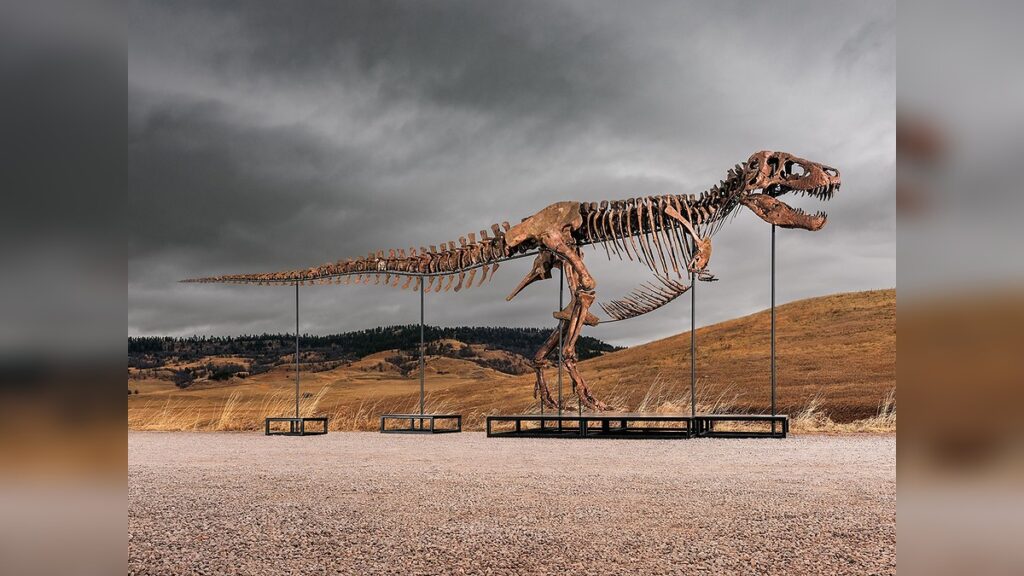
A Tyrannosaurus rex skeleton has become the focus of an international debate after selling for more than $50 million (£37 million) at auction, setting a new record for the most expensive dinosaur fossil ever sold.
While the landmark sale highlights the growing value of rare prehistoric discoveries, many scientists warn that the specimen’s move into private ownership could significantly limit future research opportunities.
Historic Fossil Achieves Landmark Auction Price
The fossil, known as “Gus,” was sold during a competitive bidding process at Sotheby’s, ultimately securing a price exceeding $50 million.
The transaction establishes a new benchmark for dinosaur fossil sales and underscores the increasing demand among wealthy collectors for exceptionally rare natural history specimens.
Standing approximately 12.5 feet (3.8 metres) tall in its mounted form, the skeleton is regarded as one of the largest and best-preserved Tyrannosaurus rex fossils ever uncovered.
Rare Discovery Preserved for Millions of Years
Gus remained buried for around 67 million years in South Dakota’s renowned Hell Creek Formation before being excavated by a private fossil company in 2021.
Researchers describe the specimen as approximately 61 percent complete, featuring an exceptionally well-preserved skull along with evidence of ancient bite marks believed to have been inflicted by another prehistoric predator.
These characteristics have made the fossil particularly valuable to both collectors and the scientific community.
Scientists Warn of Lost Research Opportunities
The sale has prompted widespread criticism from palaeontologists, who argue that scientifically significant fossils should remain accessible through museums, universities and other accredited public institutions rather than private collections.




The Society of Vertebrate Paleontology said specimens of this importance extend far beyond their commercial value, stressing that continued public access allows researchers to study fossils repeatedly as new scientific techniques emerge.
According to the organisation, advances such as high-resolution CT scanning, geochemical testing and molecular analysis have enabled scientists to uncover new information from fossils collected decades—even centuries—ago, demonstrating the long-term research value of publicly curated specimens.
Growing Commercial Market Raises Concerns
The society also expressed concern that soaring auction prices are making it increasingly difficult for museums and universities to acquire scientifically important fossils.
It warned that when exceptional specimens enter private ownership without guarantees of long-term scientific access, future opportunities for research, education and public exhibition may be permanently reduced.
The organisation urged fossil discoverers, auction houses and prospective buyers to work alongside accredited public institutions to ensure significant discoveries remain available for scientific study.
Leading Experts Voice Frustration
Professor Richard Butler, a vertebrate palaeontologist at the University of Birmingham, described the auction outcome as deeply concerning, arguing that fossils held outside recognised museum collections are effectively unavailable for future scientific investigation.
Professor Stephen Brusatte of the University of Edinburgh acknowledged the growing challenge facing researchers, noting that museums and universities struggle to compete financially when exceptionally rare fossils command tens of millions of dollars in private sales.
Sotheby’s Defends the Private Fossil Market
Sotheby’s has defended the sale and the role played by private excavation companies, arguing that many important dinosaur fossils might never be recovered without commercial operators willing to invest in difficult and expensive excavation projects.
Auction specialists also maintained that the record-breaking price reflects both the extraordinary scientific significance of Gus and the considerable expertise, resources and effort required to excavate, preserve and prepare such an exceptional specimen for display.
Ongoing Debate Over Science and Ownership
The record-setting sale of Gus has reignited a long-running discussion over the balance between commercial fossil collecting and scientific preservation.
While collectors continue to drive demand for rare prehistoric remains, researchers argue that discoveries of this magnitude are irreplaceable scientific resources whose greatest value lies in remaining accessible to future generations of scientists and the public alike.
Summary
The Tyrannosaurus rex skeleton known as Gus sold for a record-breaking £37 million, becoming the most expensive dinosaur fossil ever auctioned.
Although Sotheby’s defended the commercial sale and the role of private excavators, palaeontologists have criticised the transfer of such an important fossil into private ownership, warning that it could restrict future scientific research, education and public access.
