
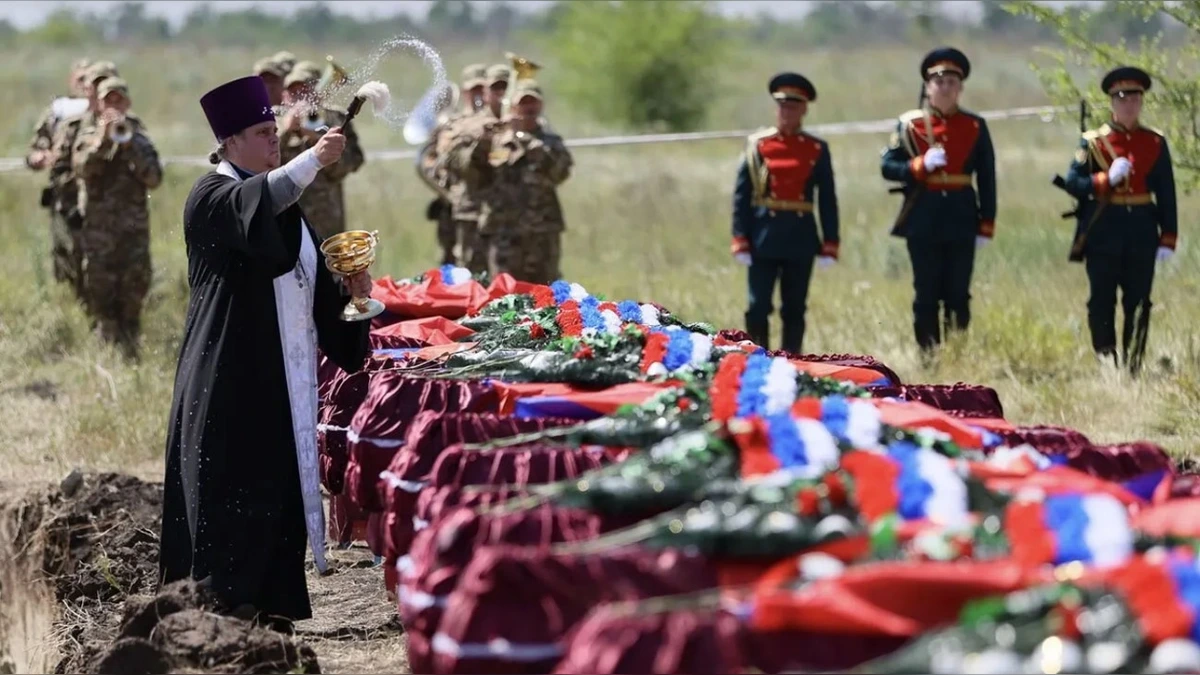
A major data breach involving Russia’s federal statistics agency has revealed that more than 392,700 Russians have died in connection with the war in Ukraine since February 2022, with the death rate reportedly accelerating.
The information was obtained by Belarusian pro-opposition hacking group Cyber Partisans and the Ukrainian cyber operation Silent Crow, which said they had accessed extensive records held by Russia’s Federal State Statistics Service, known as Rosstat.
The leaked documents contain information about Russia’s economy, population and wartime casualties.
Both hacking groups have been designated as extremist organisations and banned in Russia.
According to their analysis, more than 392,700 death certificates issued between February 2022 and late August 2026 explicitly connected the deaths to the conflict.
Death Certificates Include Soldiers and Civilians
The records reportedly contain references to the war through official classifications and handwritten descriptions, including terms such as “military operation”, “shelling” and “drones”.
The figures cover not only Russian military personnel killed in combat but also civilians who died in airstrikes and during Ukraine’s 2024 military incursion into Russia’s Kursk region.
However, the actual death toll could be considerably higher because the leaked information does not include soldiers officially listed as missing in action.
It also excludes an estimated 27,000 foreign fighters believed to have been recruited into the Russian military.
The data further indicates that not every recorded death occurred during combat.
More than 14,000 cases involved soldiers who died from other causes, including illnesses, road accidents and suicide.
Another 32,000 people reportedly died from injuries they had sustained at least a year before their deaths.
Expert Describes Leak as Most Significant Casualty Disclosure
Janis Kluge, head of the Russia and Eurasia division at the German Institute for International and Security Affairs, described the disclosure as the most significant data leak concerning Russian military casualties.
Speaking to The Moscow Times, he said: “This is the most significant leak of data when it comes to Russian casualties.”
He added that the conflict had reached its deadliest point so far.
“I think it’s established as a fact that the war has never been more deadly than it is right now,” Kluge said.
If the figures are accurate, the conflict would rank as Russia’s deadliest war since the Second World War.
Ethnic Minorities in Russia Face Disproportionate Losses
The leaked records also highlight significant differences in casualty rates across Russia’s regions and ethnic communities.
Russia’s ethnic republics appear to have suffered disproportionately from military mobilisation and recruitment, while major cities such as Moscow have recorded a comparatively small share of deaths relative to their populations.
Researcher Maria Vyushkova said the Kremlin’s recruitment policies amounted to the “extermination of entire nations” in the case of some of Russia’s smallest ethnic groups.
The findings also support previous reports that men from poorer regions and minority communities have been recruited through promises of substantial salaries and generous financial benefits.
Russia and Ukraine Exchange Attacks Ahead of Peace Talks
The casualty disclosure comes as fighting continues between Russia and Ukraine, with both countries launching fresh attacks on critical infrastructure.



On Monday, Russia renewed its strikes against Ukraine’s electricity network, while Ukrainian forces targeted another major Russian oil refinery.
The attacks took place just hours before representatives from Moscow and Kyiv were scheduled to meet for fresh US-brokered discussions aimed at ending the conflict.
Nearly five years after Russia launched its full-scale invasion of Ukraine, the two countries remain engaged in a war that has killed hundreds of thousands of soldiers and thousands of civilians, according to analysts and humanitarian organisations.
Neither side has shown signs of abandoning its demands.
Trump Says Moscow and Kyiv Are Close to an Agreement
US President Donald Trump said Russia and Ukraine were approaching an agreement to end the conflict, despite the hostility between their respective leaders.
In an interview with 60 Minutes broadcast on Sunday, Trump said Moscow and Kyiv were “very close” to reaching a deal, although he acknowledged the “tremendous hatred” between Russian President Vladimir Putin and Ukrainian President Volodymyr Zelensky.
He also suggested that Ukraine would have “a little bit different shape” under any eventual settlement but did not provide further details.
Trump has previously made statements about developments in the conflict that have not resulted in the outcomes he predicted.
Russian Strikes Target Four Ukrainian Power Substations
Russia’s Ministry of Defence said on Monday that its forces had attacked four electrical substations in Ukraine’s Kyiv, Dnipropetrovsk, Cherkasy and Vinnytsia regions.
The strikes form part of Moscow’s continuing campaign against Ukraine’s energy infrastructure, which has raised concerns about access to electricity, heating and running water as winter approaches.
Ukraine’s President Zelensky said the European Union had agreed to activate a special emergency mechanism to accelerate financial assistance for repairs to the country’s electricity network.
Ukraine’s Air Force also reported that Russia had launched 317 drones overnight, including 105 jet-powered drones.
Russian aerial attacks have repeatedly caused civilian casualties and extensive damage to infrastructure throughout the conflict.
Last week, a Russian glide bomb strike near the front line in the southern Zaporizhzhia region killed at least 55 people at an aid distribution centre.
Ukrainian Drones Strike Major Russian Oil Refinery
Meanwhile, Ukraine continued its long-range attacks against Russian energy facilities.
Long-range drones developed by Ukraine during the war reportedly started a fire at the KINEF oil refinery near St Petersburg, more than 1,200 kilometres (745 miles) from the Ukrainian border.
Leningrad Governor Alexander Drozdenko confirmed the incident on Monday.
Ukraine had claimed in early October that its long-range attacks had neutralised more than half of Russia’s oil refining capacity, affecting Moscow’s ability to supply its military forces.
The refinery attack represents another strike against Russia’s energy infrastructure as both countries continue targeting facilities considered important to their military operations.
Abu Dhabi Talks to Focus on Security Guarantees
The latest diplomatic discussions are scheduled to take place in Abu Dhabi, with a two-day meeting beginning on Tuesday.
Negotiators are expected to examine the security guarantees that would be acceptable to both Russia and Ukraine.
Moscow regards NATO as a security threat, while Kyiv wants assurances that would prevent another Russian invasion in the future.
The previous three-way discussions in Geneva in February ended without significant progress towards ending the war, despite taking place amid continuing military attacks.
Several circumstances have since changed, including growing pressure on Russia’s public finances and the continued economic strain on Ukraine caused by Russian attacks.
The political situation in the United States is also expected to influence future negotiations, with Democrats set to take control of Congress in January following the US midterm elections.
They could push for increased American support for Ukraine.
Disagreement Over European Involvement in Negotiations
Putin has sought to limit the involvement of European countries in discussions about Ukraine’s future, preferring direct negotiations with Trump.
Moscow has maintained that European officials will not participate in the Abu Dhabi discussions.
However, French Foreign Minister Jean-Noël Barrot said on Sunday that France and other European representatives would be present in the United Arab Emirates.
Kremlin spokesperson Dmitry Peskov said on Monday that the meeting would focus on trilateral negotiations involving Russia, Ukraine and the United States, with Washington acting as mediator.
He acknowledged that the Americans and Ukrainians maintained separate communication channels with European officials.
“You are aware that the Americans have their own channels of communication with the Europeans, as do the Ukrainians, and it appears they are already establishing their own methods of coordination,” Peskov said.
“But, to reiterate, this is a matter of trilateral negotiations.”
The upcoming discussions are expected to address security arrangements and the conditions under which the two countries could reach an agreement, as military operations continue on both sides.
