
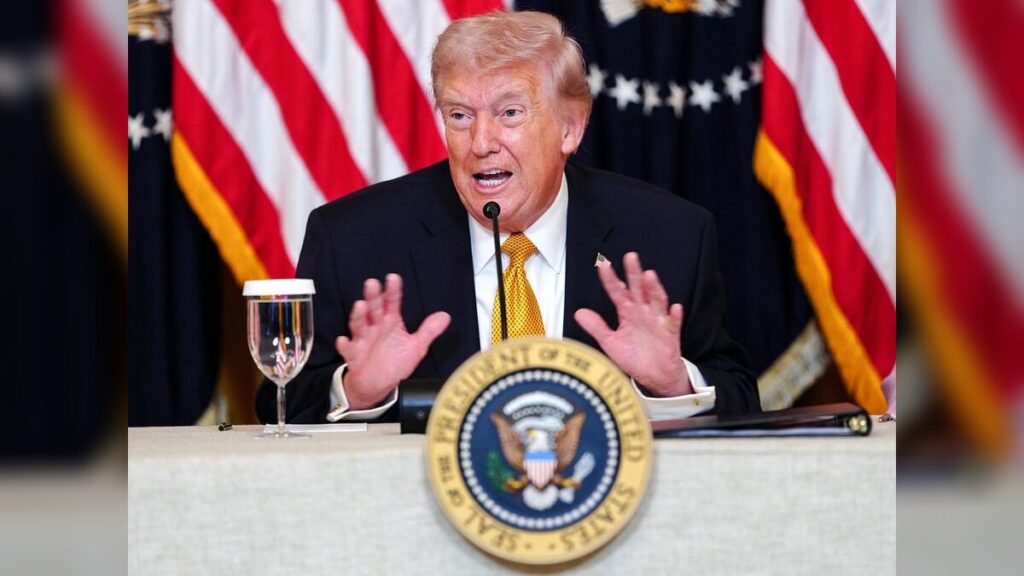
President Donald Trump unleashed a blistering attack on America’s allies after they declined his requests for military support in the escalating conflict in the Strait of Hormuz.
Writing on Truth Social Tuesday, Trump said, “We no longer need, or desire, the NATO countries’ assistance – we never did.”
Trump expressed frustration that allies including the United Kingdom, France, Japan, and Australia have refused to join efforts to secure the vital waterway, despite repeated pleas.
“We will protect them, but they will do nothing for us, in particular, in a time of need,” he added, calling NATO a “one-way street.”
Rising Tensions as Oil Prices Surge
The standoff in the narrow strait, through which roughly a fifth of the world’s oil passes, has driven U.S. gas prices from $2.90 to $3.80 per gallon in just three weeks.
The risk from Iranian mines and missile threats has left commercial shipping in limbo, while global markets scramble to respond.
Israeli forces reportedly killed two high-ranking Iranian commanders overnight, marking another escalation in the region.
Meanwhile, U.S. military losses have mounted, with 13 troops killed and over 200 injured across seven countries connected to the conflict.
White House Faces Tough Choices
Sources close to the White House warn that Trump may soon be forced to commit U.S. troops on the ground in Iran if he hopes to achieve a decisive outcome.
“We clearly just kicked [Iran’s] ass in the field, but, to a large extent, they hold the cards now,” one source told Politico.


Military advisors warn that Iran controls how long the U.S. remains involved, and whether a ground offensive becomes unavoidable.
With midterm elections looming, Trump allies fear that an open-ended conflict could further strain the American public amid rising costs of living.
Internal Divisions Within Trump’s Base
The war has also exposed tensions among Trump’s MAGA supporters.
Prominent figures like Tucker Carlson and Megyn Kelly have clashed with the president over the conflict, reflecting long-standing debates about U.S. involvement in regime-change wars in the Middle East.
Intelligence assessments indicate that despite airstrikes, Iran’s regime is likely to remain in power.
The Islamic Revolutionary Guard Corps is expected to tighten domestic control, analysts warn, while Iran’s leadership remains defiant.
Targeted Strikes Intensify the Conflict
Israeli Defense Minister Israel Katz confirmed the deaths of Ali Larijani, Iran’s security chief, and Gholamreza Soleimani, commander of Iran’s Basij forces, in overnight airstrikes.
Larijani had publicly mocked Trump during a Quds Day rally in Tehran just days earlier.
Iranian Supreme Leader Ayatollah Mojtaba Khamenei has demanded that the U.S. and Israel “be brought to their knees” before any peace negotiations can take place, signaling that Tehran has no intention of backing down.
U.S. Military Reinforces the Region
The U.S. has deployed additional forces, including the USS Tripoli and a 2,000-strong Marine Expeditionary Unit capable of seizing Iranian ports.
While the Pentagon calls the military operation a “tremendous success,” the Navy still cannot guarantee safe passage for commercial oil tankers through the Strait of Hormuz.
Trump has hinted that the conflict could conclude quickly, yet warned that the U.S. is prepared for a prolonged engagement.
Impact and Consequences
- Strained relations between the U.S. and key NATO allies.
- Rising gas prices and global oil supply concerns.
- Potential for escalation into a ground war in Iran.
- Deep divisions within Trump’s political base over Middle East involvement.
- Increased casualties and prolonged regional instability.
What’s Next?
- U.S. may launch a limited ground offensive to secure the Strait of Hormuz.
- Diplomatic efforts with NATO allies could continue amid tensions.
- Iran is likely to maintain internal control and escalate asymmetric actions.
- The conflict could affect domestic politics and the midterm elections.
Summary
Donald Trump’s sharp rebuke of NATO allies highlights rising frustrations over international support amid the Strait of Hormuz crisis.
Escalating oil prices, military losses, and internal political tensions underscore the precarious situation, with potential U.S. ground operations looming.
Both Washington and Tehran appear locked in a high-stakes standoff with no clear end in sight.
Bulleted Takeaways
- Trump says NATO allies “don’t want to get involved” in the Iran conflict.
- Oil prices spike as Strait of Hormuz remains threatened by Iranian missiles and mines.
- Israel kills two top Iranian commanders in overnight strikes.
- 13 U.S. troops killed, over 200 injured across seven countries.
- U.S. military reinforces the region with Marines and naval assets.
- Internal divisions emerge within Trump’s MAGA movement.
- Iran signals no willingness to negotiate peace without U.S. and Israeli surrender.
- Potential U.S. ground operations could escalate the conflict further.
