
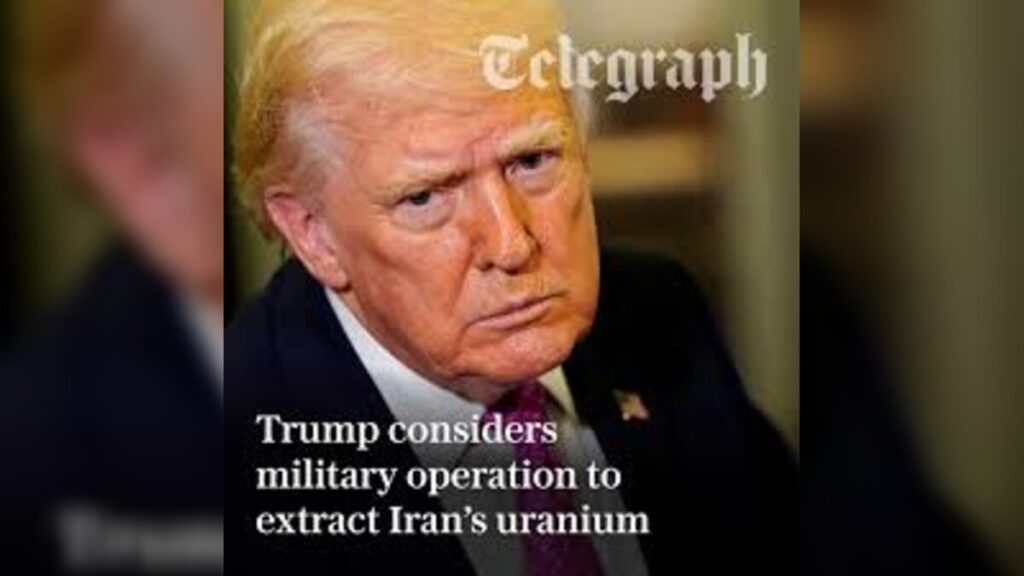
US President Donald Trump is reportedly considering a bold military operation to remove nearly 1,000 pounds of uranium from Iran, according to the Wall Street Journal, citing US officials.
While no final decision has been made, the idea has drawn interest within his administration, though concerns about the risks to American troops remain central to deliberations.
The Challenges of Extracting Uranium
The uranium in question is stored in gaseous form within cylinders, making handling and transport extremely difficult.
Rafael Grossi, Director General of the International Atomic Energy Agency (IAEA), has expressed skepticism about the feasibility of such an operation.
Experts like Richard Nephew, a former nuclear negotiator with Iran, warn that safely moving the material would require specialized transport casks, multiple trucks, and a highly secure perimeter to protect personnel and equipment.
Further complications could include decoy cylinders, booby traps, or mines at the nuclear site.
Engineers would need to bring in heavy-duty extraction and transport equipment, likely under the threat of attack, and a temporary airfield would have to be established to support the operation.
Historical Precedents: Project Sapphire and Beyond
The United States has removed uranium from foreign nations before.
In 1994, Project Sapphire successfully transported uranium from Kazakhstan to the US.




Later, in 1998, the US and UK jointly removed highly enriched uranium from a reactor near Tbilisi, Georgia, and transported it to a nuclear facility in Scotland.
Both operations were peaceful transfers, showing that while technically possible, such missions require meticulous planning and international cooperation.
Trump’s Diplomatic Efforts
According to the Wall Street Journal, Trump has instructed his advisers to negotiate with Iran to surrender the uranium voluntarily.
He has been clear that any resolution must prevent Iran from gaining nuclear weapons capabilities.
Recent discussions through intermediaries have focused on diplomatic avenues to achieve the transfer without military intervention.
US Defense Perspective
US Secretary of Defense Pete Hegseth confirmed that a range of options exists, from diplomatic persuasion to more forceful measures.
While he did not reveal operational specifics, Hegseth acknowledged that Washington is prepared for multiple scenarios, emphasizing that voluntary Iranian compliance would be the preferred outcome.
Impact and Consequences
A military operation to seize uranium from Iran could escalate tensions significantly, potentially triggering retaliation against US forces in the region.
Conversely, a successful extraction could prevent Iran from advancing its nuclear capabilities, safeguarding global security.
Diplomatic efforts, if successful, may achieve similar goals without the risks associated with military action, though failure could complicate negotiations and heighten regional instability.
What’s Next?
- Continued diplomatic pressure on Iran to surrender the uranium voluntarily
- Potential military contingency plans remain under review
- Coordination with allies and assessment of risk to US troops and regional stability
- Monitoring of Iran’s nuclear facilities for security and compliance
Summary
President Trump is considering options to secure nearly 1,000 pounds of uranium from Iran, balancing military risk against the imperative of preventing nuclear escalation.
Experts caution that such an operation would be complex and hazardous, while historical precedents demonstrate the feasibility of carefully planned uranium transfers.
Diplomatic engagement remains the primary focus, but contingency plans for military action are under discussion.
Bulleted Takeaways
- Trump weighing a military operation to remove uranium from Iran
- Uranium stored in gaseous cylinders poses serious extraction challenges
- Historical operations (Project Sapphire 1994; Georgia 1998) show precedent but were peaceful
- Risks include booby traps, decoy cylinders, and potential attacks on US personnel
- Diplomacy prioritized, with Iran urged to surrender uranium voluntarily
- Defense Secretary Hegseth confirms multiple options exist, but specifics remain confidential
- Operation could prevent nuclear proliferation but may escalate regional tensions

