
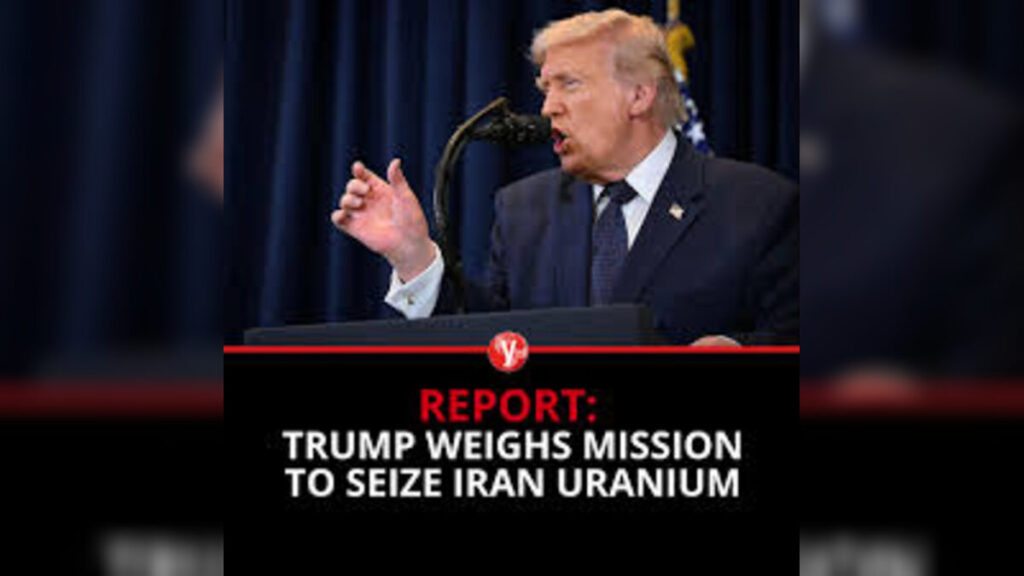
President Donald Trump is reportedly considering a high-stakes military plan to send U.S. special operations forces deep inside Iran to seize enriched uranium stockpiles.
The operation, still under review, could last days and risks dramatically escalating the ongoing conflict in the region.
The Target: Iran’s Nuclear Materials
Officials say the plan would focus on nearly 1,000 pounds of uranium stored at nuclear facilities in Natanz and Isfahan.
The goal is to remove the material entirely from Iranian control, preventing any pathway to a nuclear weapon.
Military experts warn that such a mission would be among the most challenging the U.S. could attempt, requiring troops to operate under potential fire from air defenses and drones.
Troop Buildup Signals Serious Consideration
More than 50,000 U.S. troops are now stationed across the Middle East, including additional forces in Saudi Arabia, Bahrain, Iraq, Syria, Jordan, Qatar, the UAE, and Kuwait.
This includes several hundred special operations troops, Army Rangers, Navy SEALs, Marines, and paratroopers.
Officials say these forces could protect strategic points, such as the Strait of Hormuz or Kharg Island, or be deployed to nuclear sites if needed.
Risks and Complexity of the Mission
Extracting uranium is no simple raid.
The radioactive material is stored in hardened facilities and specialized cylinders that require careful handling and secure transport.




Analysts estimate the operation could take several days, potentially a full week, and might require constructing temporary airfields for extraction.
Retired generals note that even with the current buildup, a sustained ground campaign inside Iran would require far larger numbers of troops.
Diplomacy Remains on the Table
Behind the scenes, Trump has directed advisors to pursue diplomatic efforts, seeking voluntary handover of uranium.
Talks involving Pakistan, Turkey, and Egypt continue, although direct U.S.-Iran negotiations have not yet occurred.
Trump has publicly set an April 6 deadline for Iran to reach a deal, warning that failure could trigger strikes on its energy sector.
The Strait of Hormuz: Strategic Focus
The Strait of Hormuz, a critical passage for roughly one-fifth of global oil supply, has become central to U.S. strategy.
Iran has partially restricted traffic, driving oil prices above $116 a barrel.
Trump has highlighted shipping through the strait as a sign of Iran’s cooperation, while signaling willingness to seize infrastructure such as Kharg Island if diplomacy fails.
Impact and Consequences
- Risk of significant escalation in U.S.-Iran conflict
- Potential disruption of global oil supply, affecting prices worldwide
- Large-scale troop deployment could strain U.S. military logistics
- Possible civilian casualties and regional destabilization
- Diplomatic relations with neighboring countries could be tested
What’s Next?
The Pentagon continues to position forces while awaiting Trump’s decision.
Additional ground troops may be deployed if plans move forward.
Meanwhile, diplomatic channels remain active, aiming to secure uranium handover without military engagement.
Markets and regional leaders are closely watching developments, especially regarding the Strait of Hormuz.
Summary
President Trump is weighing a high-risk military operation to seize Iranian uranium, with U.S. forces already staged across the Middle East.
The plan is complex, potentially lasting a week, and carries enormous geopolitical and logistical risks.
Diplomacy continues in parallel, but the window for a negotiated resolution is narrowing.
Bulleted Takeaways
- Trump considers special ops mission to seize 1,000 pounds of uranium in Iran
- Nuclear sites targeted: Natanz and Isfahan
- More than 50,000 U.S. troops deployed in the Middle East
- Mission could last days or up to a week, requiring careful handling of radioactive material
- Diplomatic efforts continue via Pakistan, Turkey, and Egypt
- Strait of Hormuz remains strategically critical, oil prices surge above $116/barrel
- U.S. military buildup includes Army Rangers, Navy SEALs, Marines, and paratroopers
- April 6 deadline set by Trump for Iran to accept a deal before potential strikes

