
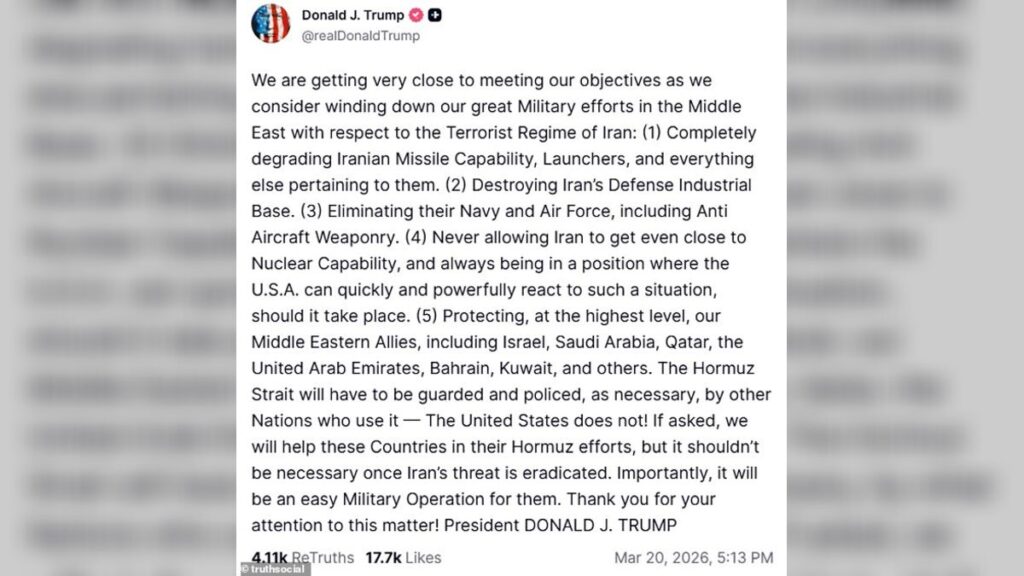
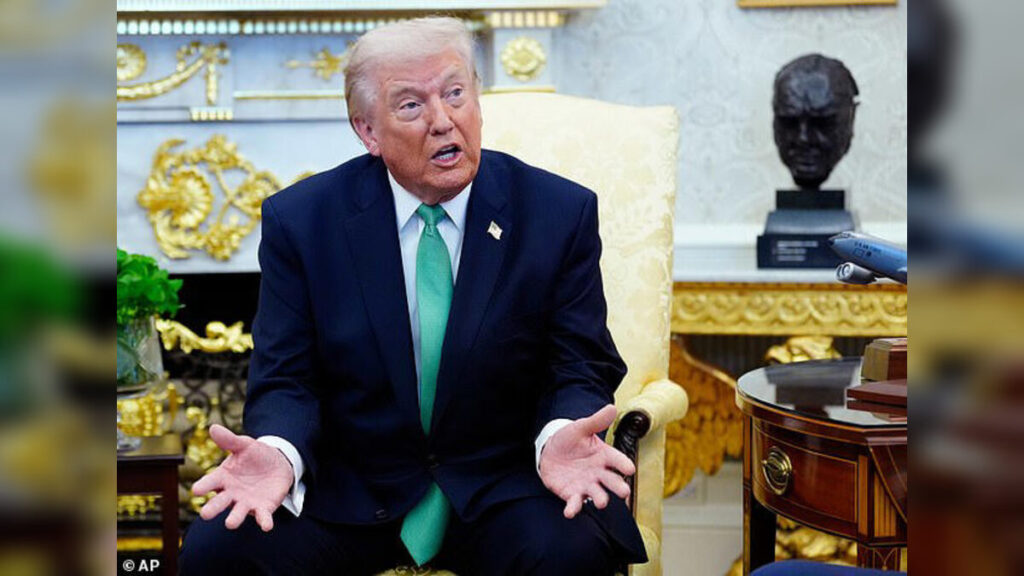
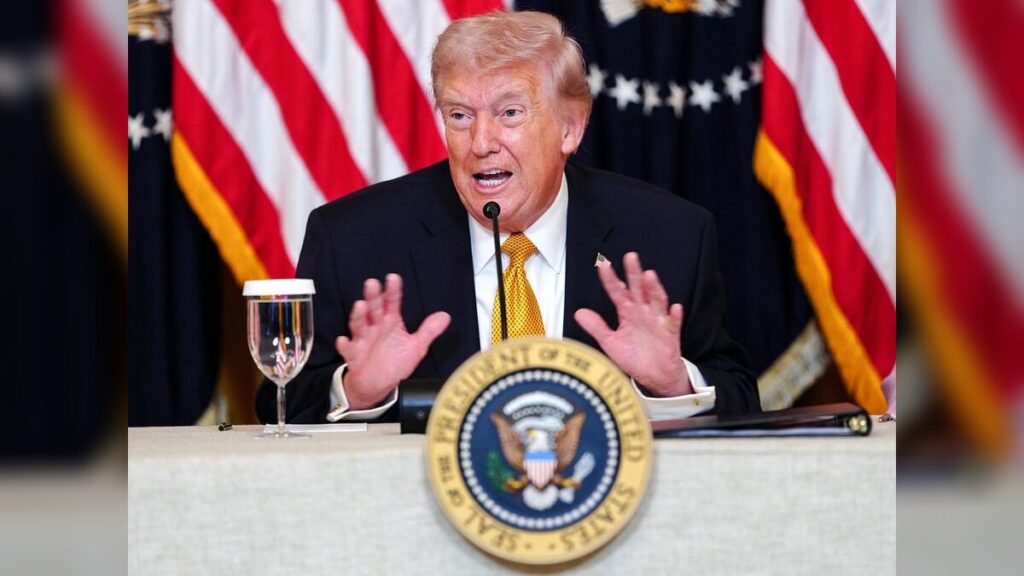
In a series of posts on Truth Social Friday evening, President Donald Trump suggested that the U.S. may soon scale back military operations against Iran and bring the broader Middle Eastern conflict closer to an end.
His comments outlined what he described as near‑completion of key military goals and hinted at a transition away from active strikes.
The president framed the campaign as having largely achieved its objectives and floated the possibility of drawing down U.S. involvement once Tehran’s military is sufficiently weakened.
Trump Lays Out Military Goals
Trump’s Truth Social message laid out four core aims he says are being met:
- Crippling Iran’s missile systems and related launch infrastructure
- Shattering the country’s defense industrial base
- Eliminating the Iranian navy and air force, along with anti‑aircraft systems
- Preventing Tehran from ever achieving nuclear weapons capability
He later added a fifth priority: reinforcing protection for the United States’ regional partners.
Emphasis on Gulf Allies and Future Security
Trump went on to name key U.S. allies in the Gulf — including Israel, Saudi Arabia, Qatar, the United Arab Emirates, Bahrain, and Kuwait — and stressed that defending these nations remains a high priority.
The president also outlined his vision for security in the Strait of Hormuz, a strategic chokepoint vital to global energy and trade flows.
Trump said that once Iran’s threat has been neutralized, countries that rely on the waterway should take the lead in policing it, with the U.S. offering support if requested.

“The Hormuz Strait will have to be guarded and policed, as necessary, by other Nations who use it — The United States does not,” Trump wrote.
A Message at Odds With Military Buildup
Despite the rhetoric about winding down, the Trump administration has been moving in the opposite direction on the ground — dispatching additional troops and warships to the region.
At the same time, it has asked Congress for another $200 billion to sustain and expand military operations.
This contrast has raised questions about how the proposed de‑escalation would be put into practice, especially as U.S. forces and funding continue to increase.
Impact and Consequences
If Trump’s musings translate into policy, it could signal a major shift in U.S. military strategy across the Middle East. Scaling back strikes might ease tensions with regional powers and reduce the risk of direct confrontation with Iran.
However, it could also leave allies uncertain about long‑term security guarantees, especially given the simultaneous surge in U.S. forces.
International markets, particularly oil and shipping industries tied to the Strait of Hormuz, may react to any signs of changing U.S. posture — either stabilizing if conflict winds down, or jittery if ambiguity persists.
What’s Next?
Officials in Washington and key Middle Eastern capitals will likely spend the coming days interpreting the president’s statements and assessing whether they indicate a genuine policy pivot or rhetorical positioning.
Lawmakers in Congress, already debating the supplemental war funding request, may seek clarification on how these seemingly contradictory moves square with one another.
Military leaders will also be watching closely for any formal changes in operational directives.
Summary
President Trump suggested on Truth Social that the U.S. is close to achieving its objectives in its campaign against Iran and may begin to scale back military efforts in the Middle East.
He outlined a set of goals he believes have been largely met, named key Gulf allies the U.S. intends to protect, and presented a future security role for nations that rely on the Strait of Hormuz.
His comments come amid continued troop deployments and a substantial new funding request, highlighting a tension between rhetoric and action.
Bulleted Takeaways
- Trump says U.S. is “very close” to meeting military goals against Iran
- He lists degrading Iranian forces and preventing nuclear capability among those goals
- Emphasizes protection for Israel and Gulf allies as a priority
- Suggests regional nations should police the Strait of Hormuz in future
- His comments clash with ongoing troop increases and a new $200 billion war funding request
