
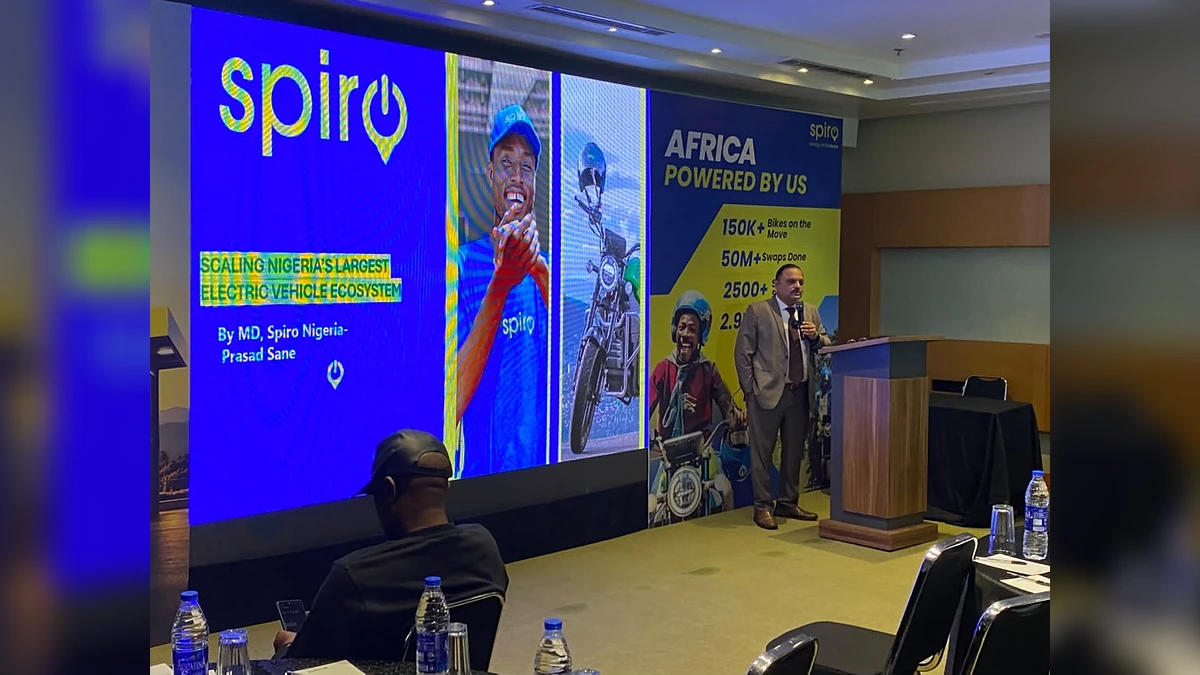
Electric mobility company Spiro has unveiled plans to significantly expand its motorcycle assembly operations in Nigeria, targeting an increase in production capacity from 30,000 to 200,000 units as demand for electric transportation continues to grow.
The expansion will involve relocating the company’s existing assembly operations in Sagamu, Ogun State, to a larger facility capable of supporting increased production and potentially accommodating the local manufacture of batteries and other motorcycle components.
The announcement was made during the Spiro Nigeria Media Connect event in Lagos on Friday, where company executives outlined plans to strengthen local production, expand battery-swapping infrastructure and introduce electric motorcycles into additional Nigerian markets.
The development forms part of Spiro’s broader strategy to establish a stronger presence in Nigeria’s transportation sector while reducing dependence on conventional petrol-powered motorcycles.
Spiro Plans New Assembly Facility to Support 200,000 Motorcycles
Spiro Nigeria Managing Director and Country Head Prasad Sane confirmed that the company intends to relocate its current assembly plant as part of its production expansion.
The existing facility in Sagamu has a capacity of approximately 30,000 motorcycles, but the company is preparing to increase that figure to 200,000.
Sane explained that the planned relocation would provide the additional space and infrastructure required to support the company’s manufacturing ambitions.
He said Spiro was committed to substantially increasing its production capacity and would move its operations to a new location to achieve that objective.
However, the company has not disclosed the proposed location of the new facility, the estimated investment required or the timetable for completing the relocation.
The expansion represents a major increase in potential manufacturing capacity and could strengthen Nigeria’s position in the company’s African electric motorcycle operations.
Local Battery Manufacturing Could Create New Jobs in Nigeria
Beyond assembling motorcycles, Spiro is considering opportunities to manufacture batteries and other components locally.
The company believes developing domestic production capabilities could support its long-term operations while reducing reliance on imported parts.
Local manufacturing could also create employment opportunities in technical services, assembly, maintenance, logistics and related industries.
The proposed investment would represent a further step towards building an electric vehicle supply chain within Nigeria rather than depending entirely on overseas production.
However, the company has not confirmed when local battery manufacturing might begin or whether a dedicated production facility has been approved.
Battery-Swapping Operations Expand Across Lagos, Ogun, Oyo and Benue
Spiro has also reported substantial growth in its battery-swapping network since beginning operations in Nigeria in July 2024.
According to the company’s Head of Operations, Edward Amanambu, Spiro initially launched with just three battery-swapping stations in Ogun State.
The network has since expanded into Lagos, Oyo and Benue states, bringing its services to four states.
Amanambu disclosed that approximately 84,000 battery swaps had been completed since the company’s Nigerian launch.
Battery swapping allows electric motorcycle riders to exchange depleted batteries for charged replacements instead of waiting for their motorcycles to recharge.
The system is particularly important for commercial motorcycle operators who depend on their vehicles for daily income and need to minimise downtime.
By expanding the availability of replacement batteries, Spiro hopes to make electric motorcycles more practical for riders operating across different parts of the country.
Eight New Battery Stations Planned Before December 2026
The company intends to establish eight additional battery-swapping stations before the end of December 2026.
Among the planned facilities are larger stations in Ijebu, Sagamu and Ibadan, where Spiro expects growing demand for electric motorcycle services.




These facilities are designed to accommodate higher numbers of riders and provide greater battery availability as the company’s motorcycle fleet expands.
According to the operational plans presented at the event, a large battery-swapping station equipped with 48 battery racks could serve approximately 1,200 riders.
The proposed infrastructure is expected to reduce waiting times and improve access to charged batteries for commercial and private motorcycle users.
Spiro’s expansion strategy places considerable emphasis on ensuring that its charging and swapping facilities grow alongside motorcycle sales.
Kano, Kaduna and Abuja Included in 2027 Expansion Plans
Spiro is preparing to extend its operations into northern and central Nigeria in 2027, with Kano, Kaduna and Abuja identified as priority markets.
The planned expansion would take the company’s services beyond its current presence in Lagos, Ogun, Oyo and Benue.
Under the broader network development programme, Spiro is targeting 18,600 motorcycles through new sales and conversions.
The company also intends to establish a total of 62 major battery-swapping stations across its planned operating network.
The move into additional states could provide access to new commercial transportation markets, particularly in areas where motorcycles play an important role in daily mobility.
However, the success of the rollout will depend on the availability of suitable infrastructure, reliable electricity, customer demand and the company’s ability to maintain an efficient battery distribution network.
Company Targets 50,000 Motorcycle Sales by 2027
Alongside its manufacturing expansion, Spiro has established ambitious targets for electric motorcycle adoption in Nigeria.
The company aims to sell 50,000 motorcycles by 2027 and eventually have 100,000 electric motorcycles operating on Nigerian roads within the next two to three years.
Achieving these targets would require significant growth in assembly operations, distribution channels, maintenance services and battery-swapping facilities.
The company is positioning electric motorcycles as an alternative to conventional petrol-powered models, particularly for riders seeking different operating and maintenance arrangements.
Its strategy combines vehicle sales with battery infrastructure development, allowing riders to access charged batteries through a dedicated swapping network.
The planned increase in production capacity to 200,000 motorcycles would provide room for further expansion beyond the company’s initial sales targets.
Spiro Showcases New Ekon Electric Motorcycle Models
The Lagos media event also provided an opportunity for Spiro to present developments in its electric motorcycle lineup.
Among the models showcased was the Spiro Ekon M1V 3, which has not yet been officially introduced into the Nigerian market.
The company also displayed the Ekon M12, highlighting features intended to improve comfort, convenience and everyday usability.
The Ekon M12 comes with alloy wheels, LED lighting, a storage compartment and an extended seating area.
These features are designed to appeal to riders who require motorcycles for regular commuting or commercial transportation.
The product demonstrations formed part of Spiro’s wider effort to improve its motorcycle offerings while expanding the infrastructure needed to support their operation.
Spiro Secures $320 Million in Debt and Equity Financing
The Nigerian expansion plans follow major financing developments announced by Spiro earlier in 2026.
In February, the company secured $50 million in debt financing to support its operations and growth plans.
This was followed by a $270 million equity financing round in June, which included a $55 million investment from Chinese investor NewTrails Capital.
Together, the two financing announcements represented $320 million in debt and equity funding.
The investments provide additional financial resources for Spiro’s wider African electric mobility ambitions.
However, the company has not disclosed how much of the funding will be allocated specifically to Nigeria’s proposed assembly plant, battery-swapping stations or local manufacturing initiatives.
Spiro was also recognised among TIME’s 100 Most Influential Companies in 2024, reflecting its growing profile in the electric mobility industry.
Nigeria’s Electric Motorcycle Market Faces Major Infrastructure Test
Spiro’s planned expansion comes as electric mobility companies seek opportunities in Nigeria’s large motorcycle transportation market.
The company’s approach relies on combining motorcycle production with an extensive network of battery-swapping facilities, allowing riders to replace depleted batteries without lengthy charging periods.
While the proposed manufacturing increase represents a significant development, the availability of supporting infrastructure will remain an important factor in determining how quickly the company can expand.
Reliable battery supplies, accessible swapping stations, vehicle affordability and maintenance support will all influence adoption among Nigerian riders.
The proposed local production of batteries and motorcycle components could also become an important part of the company’s longer-term investment strategy.
For now, Spiro’s immediate priorities include expanding its existing swapping network, preparing for new market entries in 2027 and securing a larger assembly facility.
If successfully implemented, the plans could significantly increase the number of electric motorcycles operating in Nigeria while creating new opportunities in manufacturing, transportation services and the country’s emerging electric mobility industry.
