
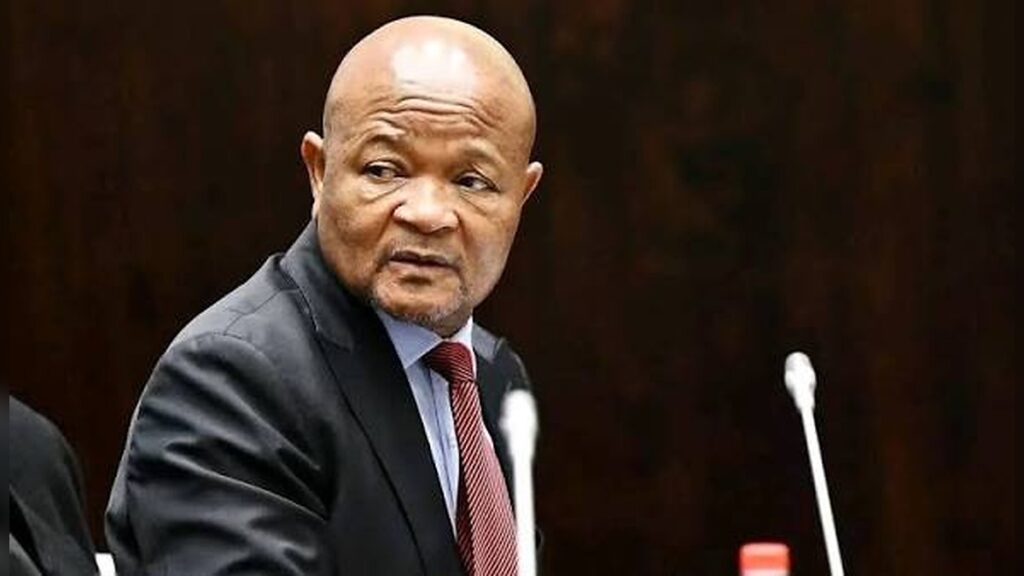
A parliamentary committee investigating claims of criminal infiltration within South Africa’s criminal justice system has found no evidence that Police Minister Senzo Mchunu engaged in criminal activity.
However, lawmakers say significant concerns remain about his leadership, decision-making and accountability while in office.
The findings form part of a draft report prepared by Parliament‘s ad hoc committee, which is expected to submit its final recommendations to National Assembly Speaker Thoko Didiza later this month after completing revisions.
No Proof of Criminal Agreement Over Task Team Closure
One of the committee’s main tasks was to examine allegations surrounding Mchunu’s decision to dissolve the Political Killings Task Team (PKTT) in December 2024.
After reviewing the evidence presented during its inquiry, the committee concluded that there was nothing to show Mchunu acted under the direction of a criminal syndicate or entered into any corrupt arrangement when the specialist police unit was disbanded.
Despite clearing him of criminal wrongdoing, the report argues that the process used to dismantle the task team raises unresolved questions about executive responsibility and governance standards.
President Still Awaiting Separate Commission’s Findings
Although the parliamentary report removes allegations of direct criminal conduct, it does not determine Mchunu’s political future.
The police minister has remained on special leave for the past year, with Firoz Cachalia serving in an acting capacity while President Cyril Ramaphosa awaits the findings of the independent commission of inquiry led by retired Constitutional Court Justice Mbuyiseli Madlanga.
The commission, assisted by advocates Sesi Baloyi and Sandile Khumalo, is investigating claims of political interference in policing and has yet to deliver its final conclusions.
Deputy Police Commissioner Faces Ongoing Scrutiny
The committee also examined the actions of suspended Deputy National Police Commissioner Lieutenant-General Shadrack Sibiya.




Its draft report points to unresolved concerns over his handling of 121 criminal case dockets and the implementation of the directive to dissolve the Political Killings Task Team.
However, lawmakers said they found no evidence linking Sibiya’s actions to businessman Vusimuzi “Cat” Matlala, Brown Mogotsi or any organized criminal network.
No Criminal Findings Against Anti-Corruption Chief
Investigating Directorate Against Corruption (IDAC) head Andrea Johnson was likewise cleared of criminal misconduct during the inquiry.
Instead of uncovering evidence of a coordinated criminal conspiracy operating across state institutions, the committee concluded that weaknesses within government systems and oversight mechanisms have made law enforcement agencies more vulnerable to outside influence and abuse.
Report Highlights Deep Institutional Weaknesses
Rather than focusing on individual criminal liability, the committee identified a range of structural problems affecting South Africa’s criminal justice system.
Among the issues highlighted were poor governance of specialized police units, weaknesses in the process used to dissolve the Political Killings Task Team, inadequate management of criminal case files, and persistent concerns surrounding Crime Intelligence.
The report also points to irregularities linked to the Medicare24 procurement process, shortcomings in disciplinary procedures, insufficient protection for whistleblowers and witnesses, and gaps in parliamentary oversight and civilian accountability.
Organized Crime Risks Recognized but No Evidence of State Capture
Lawmakers acknowledged that organized crime continues to pose a significant threat to institutions within the justice system.
However, the committee said the available evidence does not support claims that a single criminal network has captured multiple state institutions.
Although integrity concerns were identified within bodies such as the National Prosecuting Authority, the judiciary and the Investigating Directorate Against Corruption, the report stops short of concluding that those institutions have fallen under organized criminal control.
Political Disagreements Emerge Over Draft Report
The committee’s work is not yet complete, as members are expected to consider additional amendments before formally adopting the report.
Opposition party ActionSA has already indicated it will oppose the document in its current form.
Committee member Dereleen James argued that the draft does not accurately reflect the evidence presented during the inquiry, claiming several findings had been weakened or omitted.
According to James, the report understates key conclusions that were supported by testimony and, in several areas, reads more like a summary of proceedings than a firm assessment of the facts.
Final Report Headed to Parliament
Once finalized, the report will be submitted to Speaker Thoko Didiza before being tabled in the National Assembly for debate.
Members of Parliament will then consider its findings and decide whether additional investigations, disciplinary measures or other recommendations should follow as South Africa continues efforts to strengthen confidence in its criminal justice system.

