
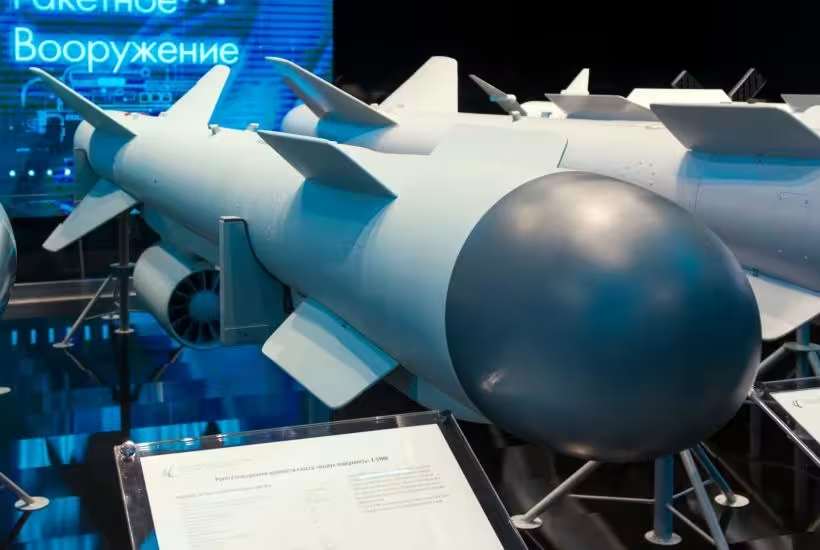
Russia is reportedly working on a hypersonic missile described as the “son of Oreshnik,” potentially surpassing the capabilities of the existing Oreshnik system.
Military commentator Viktor Baranets, writing for Komsomolskaya Pravda, claimed the weapon could carry multiple warheads and strike deeply buried targets, raising concerns in Europe and beyond.
Claims About the Missile’s Capabilities
According to reports, the missile could reportedly carry up to eight kinetic warheads and target installations up to thirty meters underground.
The weapon is said to have the potential to reach London in under eight minutes, highlighting its extremely high speed and strategic reach.
The report also noted that Russia is allegedly working on enhanced guidance and control systems to improve accuracy.
These upgrades could allow the missile to strike both military positions in Ukraine and infrastructure in Western nations with precision.
However, the existence of the missile has not been officially confirmed by any government or defense agency.
Context of Ongoing Weapons Development
This alleged missile comes amid a broader push by Russia to advance its missile and precision-guided weapons technology.
Earlier reports highlighted the development of the KUB-10ME tactical guided munition by Kalashnikov, boasting a range of over 100 kilometers and a strong resistance to electronic warfare and air defense systems.




The timing of these reports coincides with increased scrutiny by NATO and Western defense analysts, who have been monitoring Russia’s missile programs closely since the escalation of the war in Ukraine.
Hypersonic technology remains a key focus due to its speed, maneuverability, and difficulty to intercept with current air defense systems.
Strategic Implications
If verified, a missile capable of carrying multiple warheads and reaching European capitals within minutes would significantly alter the security calculus for NATO nations.
It would further intensify concerns over Russia’s expanding arsenal of precision-strike weapons and their potential deployment in conflicts beyond Ukraine.
Experts caution that while the reports are alarming, many details remain speculative.
There is no independent verification that such a missile has been completed or tested, and some aspects may reflect early-stage research rather than an operational system.
What’s Next?
Western defense agencies and intelligence services are likely to track this development closely.
Analysts will examine satellite imagery, missile test data, and open-source reporting to determine whether the “son of Oreshnik” exists and assess its operational readiness.
Meanwhile, NATO countries may accelerate missile defense initiatives and invest further in hypersonic tracking and interception technologies.
Diplomatic channels could also become more active as European nations seek assurances and clarity regarding Russia’s intentions.
Summary
Russia is reportedly developing a hypersonic missile, dubbed the “son of Oreshnik,” which could carry eight warheads and reach deeply buried targets, potentially striking London in eight minutes.
While the claims remain unverified, they highlight ongoing advancements in Russian missile technology, including precision-guided munitions like the KUB-10ME.
The reports raise strategic concerns for NATO and European security, with Western defense agencies expected to monitor the situation closely.

