
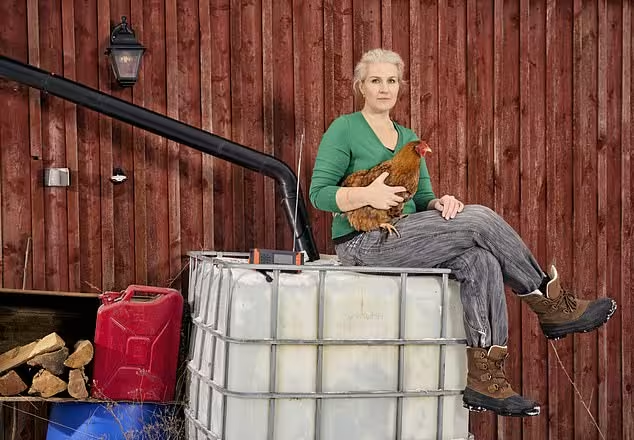
On the Swedish island of Gotland, Eva Rinblad, 48, a GP, and her husband Freke Ekstrand, 60, have transformed their home into a fortress of preparedness.
Their basement shelves are packed with homemade jam, dried mushrooms, beans, pasta, canned fish, and pickled vegetables.
Seedlings line the kitchen windowsills, solar panels glint on the roof, and water tanks hold 6,000 litres — enough to keep them supplied for months if municipal services fail.
Eva explains simply, “Of course you can be prepared without a chicken, but eggs are nice.”
Her preparation extends even to candy floss for her 11-year-old son — a touch of normalcy amid meticulous planning.
Why Gotland Residents Are Preparing
The threat is specific and unnerving. Gotland lies only 170 miles from Kaliningrad, the home base of Russia’s Baltic Fleet.
Its strategic position along major sea lanes for Russian imports and exports makes it vulnerable, and the island has a history of disarmament dating back to the 1990s.
Alf Söderman, director of civil defence on Gotland, recalls the reasoning: “The feeling was that it was a peaceful world and we didn’t need to put all this money into defence.”
That calm ended with Russia’s invasions of Georgia in 2008 and Crimea in 2014, and the unprovoked attack on Ukraine in 2022 was the final wake-up call.
Sweden, after 200 years of neutrality, joined NATO in March 2024.
Gotland is now being fortified with a target of 5,000 troops and a NATO-integrated missile defence system.
Everyday Swedes Step Up
Sweden has long emphasized individual preparedness.
Its yearly booklet, Vital Information for Residents of Sweden, usually covers storms, fires, and floods.
The latest edition warns of cyber attacks, terrorism, sabotage, and includes a striking image of a woman in combat fatigues holding a Kalashnikov.
Eva Rinblad embodies this practical, grounded approach.
She doesn’t live in a bunker or in hiding.



Instead, she grows vegetables, raises chickens, and maintains a large stockpile of food and supplies, explaining, “I just believe in a healthy level of preparation.”
Helena Davidsson, another Gotland resident, has equipped her home in Hogrän with essentials for a power outage or crisis: wood-burning stove, well, medical kit, batteries, camping stove, canned food, cash, and a wind-up solar-powered radio.
“Without a radio or a mobile phone you don’t know what’s happening around you,” she says.
Building Community Resilience
Beyond individual efforts, Gotland has launched Stark Socken — “strong village” — a community-led preparedness initiative.
Half of the island now participates, around 30,000 people.
Residents map who has stoves, generators, wells, or hand pumps, fostering neighbourly support in emergencies.
Maja Allard, a preparedness strategist, emphasizes the social side: “The power is in the conversations when you sit down with your neighbour and talk about how you can truly help each other.”
This approach extends preparedness beyond individual households to a layered system connecting community, municipal, national, and NATO defence strategies.
Söderman explains, “If we don’t have strong households, the whole system would crack because that is the ground we are standing on.”
The Shadow Threats
While a full-scale invasion is unlikely, Gotland faces persistent hybrid threats: cyber attacks, sabotage of undersea cables, and sightings of drones near NATO movements.
One incident last January involved a Russian-crewed cargo ship reportedly damaging a fibre-optic cable between Gotland and Latvia.
“They are here,” Söderman confirms, underlining that war may not be immediate, but disruption is constant.
Practical Advice from the Islanders
Residents have learned that even small measures can make a difference.
Eva advises stockpiling staples like pasta, beans, olive oil, and wine.
Helena recommends a wind-up radio, phone cables, and a small stock of sweets or treats for morale.
Ingela Barnard, 74, keeps a year’s worth of wood and a bottle of Scotch in her home, ready for any eventuality.
The message is clear: being prepared doesn’t require fear or extreme measures.
It’s about resilience, community, and maintaining everyday life under unusual circumstances.
What’s Next
Gotland’s civil defence teams will continue strengthening infrastructure, promoting Stark Socken, and coordinating with national and NATO forces.
Households are encouraged to maintain at least two weeks of supplies and engage with their neighbours to build robust support networks.
Training and community drills are expected to expand as the geopolitical situation evolves.
Summary
On Gotland, Sweden, residents like Eva Rinblad and Helena Davidsson are preparing for crises ranging from power outages to potential military threats from Russia.
Individual stockpiles of food, water, and supplies are complemented by the community initiative Stark Socken, which fosters collaboration and resilience across the island.
While a full-scale invasion is considered unlikely, hybrid threats such as cyber attacks and sabotage remain real.
Gotland’s model demonstrates how households, communities, and national defence can integrate to survive and thrive in uncertain times.

