
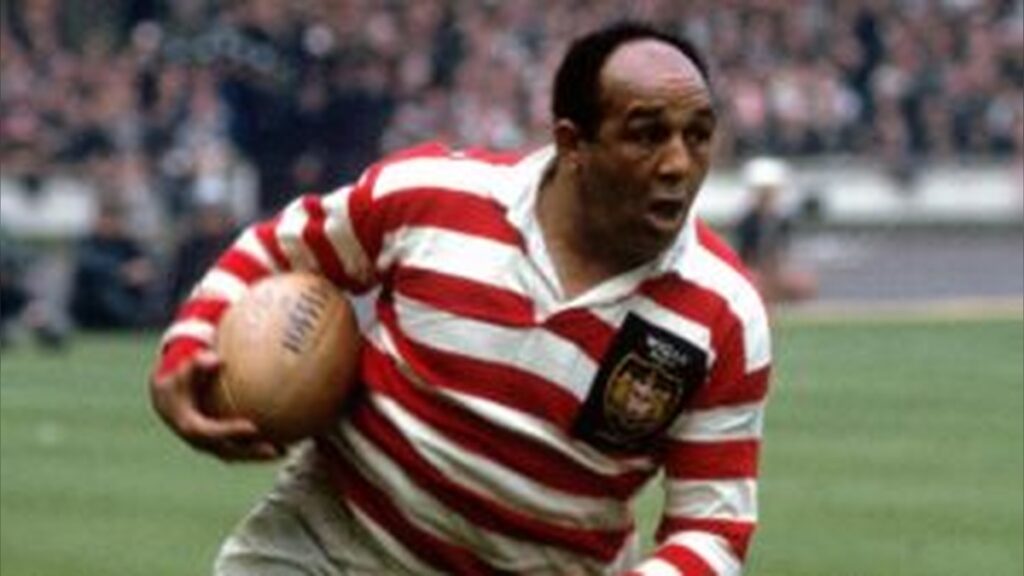
Rugby League is mourning the death of Sir Billy Boston, the legendary Wigan player and pioneering Great Britain international who died on Tuesday at the age of 92.
Boston was celebrated not only for his extraordinary record on the field but also for the warmth, humility and generosity that defined his life away from the game.
His influence stretched well beyond the Rugby League community, making him a symbol of sporting excellence and social progress.
For generations of supporters, Boston represented much more than a prolific try scorer.
He became a trailblazer who helped challenge racial barriers in British sport while remaining remarkably grounded despite his extraordinary achievements.
A Pioneer Who Changed British Sport
Boston made history in 1954 when he became the first non-white player to represent Great Britain on a Lions tour.
His achievements on that tour were remarkable.
He scored 36 tries in 18 matches across Australia and New Zealand and went on to make 31 international Test appearances.
His career statistics with Wigan were equally extraordinary.
Boston scored 478 tries in 488 matches for the club and appeared in six Challenge Cup finals.
Yet those numbers only tell part of his story.
Boston’s importance was comparable to other sporting pioneers who broke through racial barriers, including baseball great Jackie Robinson and tennis legend Arthur Ashe.
Like them, he helped reshape perceptions of who could reach the highest levels of his sport.
Wigan Was His Sporting Home
Boston joined Wigan in 1953 at the age of 19 after growing up playing Rugby Union.
He would spend the next decades establishing himself as one of the most feared and admired players in Rugby League, becoming deeply connected with the town and its supporters.
Although he was born in Cardiff, Boston lived in Wigan for 72 years and became one of the defining figures in the community.
His connection with the town was so profound that his legacy has been immortalised with statues in Cardiff, at Wembley and in Wigan.
A Knighthood That Broke Another Barrier
Boston’s recognition reached another historic milestone when he became the first Rugby League figure to receive a knighthood.
For more than a century, no Rugby League player had been awarded the honour, despite numerous recognitions being given to figures in other sports.
The contrast was striking. Rugby Union had produced 20 knights, while yachting had received 12, motor racing eight and horse racing eight during the same period.
Boston’s knighthood therefore carried significance far beyond his personal achievement.
It represented long-awaited recognition for a sport that had often felt overlooked by the establishment.
A Quiet Giant Who Never Sought the Spotlight
Despite becoming a sporting icon, Boston was known for his modest personality.
He rarely behaved like someone who considered himself a celebrity, even when meeting supporters or discussing the extraordinary career that had made him famous.




That humility was evident when he travelled to London for his knighthood ceremony at Buckingham Palace in June 2025.
At 90, and by then physically frailer, Boston was accompanied by Wigan Warriors owner Mike Danson and chief executive Kris Radlinski.
The occasion was deeply emotional for those around him, who understood how much the recognition meant to Wigan and to Rugby League as a whole.
Wigan Believed Boston Was a Crossover Hero
Radlinski reflected on the significance of Boston’s status, noting that Rugby League’s greatest strength was often its accessibility to supporters.
Players lived among the communities they represented, allowing fans to interact with them in ways that are unusual in many professional sports.
But that closeness could also make it harder for Rugby League stars to achieve the wider celebrity status associated with athletes from other sports.
Boston broke through that limitation.
His achievements, character and national recognition transformed him into a figure whose appeal extended well beyond the traditional Rugby League audience.
Northern and Working-Class Barriers Were Also Broken
Boston’s journey carried another important dimension.
Danson highlighted the relatively small proportion of knighthoods awarded to people from northern England and argued that the number becomes even smaller when working-class backgrounds are considered.
Boston’s achievement therefore represented another barrier overcome by a player who had become inseparable from the northern Rugby League tradition.
His success demonstrated that sporting greatness could emerge from outside the traditional centres of influence and eventually receive recognition at the highest level.
Tributes Pour In From Across Rugby League
Tributes began pouring in following news of Boston’s death.
Greater Manchester Mayor Andy Burnham described him as one of the greatest Rugby League players ever and praised his kindness and humility.
Burnham also highlighted Boston’s deep contribution to Wigan, describing him as a giant figure in every sense.
Wigan Warriors similarly paid tribute to their legendary player, calling him Rugby League’s first knight, a Wigan legend and “Everybody’s Hero.”
Wigan Warriors Prepare Special Tribute
Wigan Warriors have indicated that the club will honour Boston before their Betfred Super League fixture against Hull KR on Thursday.
The tribute will give supporters an opportunity to remember a player whose contribution to the club cannot be measured simply through trophies, records or statistics.
Boston’s influence became part of the identity of Wigan Warriors, with generations of players inheriting a responsibility to uphold the standards established by figures such as him.
Coach Calls Boston the Greatest
Wigan head coach Matt Peet described Boston as being permanently woven into the fabric of the club.
Peet said those who were lucky enough to watch Boston play regarded him as “simply the greatest” and emphasised that his legacy extended far beyond his sporting achievements.
He said Boston’s character, standards and accomplishments would continue to inspire future Wigan players.
Peet also stressed that the club would seek to honour Boston by embodying the pride, humility and excellence that characterised his life.
A Loss Made Even More Poignant
Boston’s death came only four days after the funeral of his wife, Lady Joan, whom he had married 70 years earlier.
The timing adds another deeply personal dimension to the loss for Boston’s family and those close to him.
After more than seven decades together, Boston’s final days came shortly after saying goodbye to the woman who had shared much of his life away from the rugby spotlight.
His Legacy Will Outlive His Records
Boston leaves behind statistics that place him among Rugby League’s all-time greats, but his most enduring contribution may be the barriers he helped dismantle.
He proved that a player from a minority background could rise to the summit of British Rugby League at a time when racial prejudice remained deeply entrenched.
He became a role model for generations, a symbol of Wigan’s sporting identity and eventually the first Rugby League player to receive a knighthood.
His three statues and national honours reflect the scale of his achievements, but the tributes from supporters, players and community leaders underline something statistics cannot capture: the affection in which he was held.
What’s Next?
Wigan Warriors are expected to honour Sir Billy Boston before Thursday’s Super League match against Hull KR, giving the club and its supporters an opportunity to celebrate his life and contribution.
His passing is also likely to prompt renewed reflection on the history of racial integration in British sport and the role Boston played in opening doors for future generations.
Summary
Sir Billy Boston leaves Rugby League as one of its most influential figures, remembered for extraordinary performances, historic breakthroughs and a humility that never appeared diminished by fame.
From becoming the first non-white player on a Great Britain Lions tour to establishing himself as a Wigan legend and later becoming Rugby League’s first knight, Boston repeatedly broke new ground.
At 92, his death marks the end of an extraordinary life, but his influence will remain embedded in Wigan, Rugby League and British sporting history for generations to come.

