
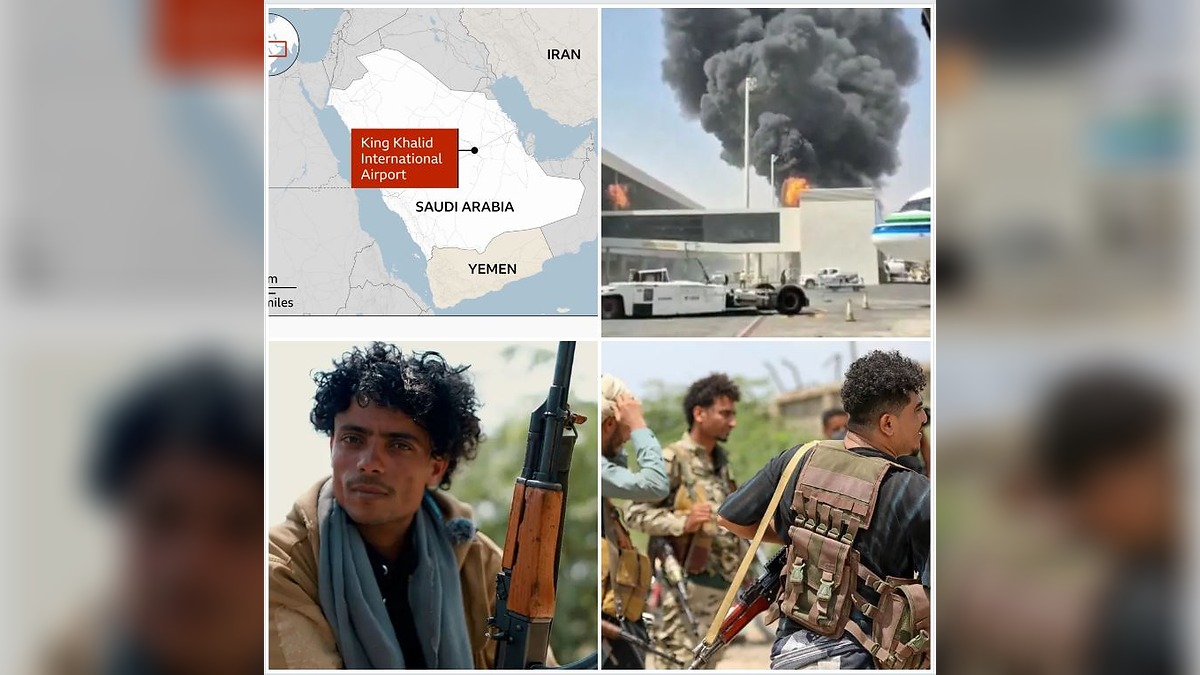
Saudi Arabia is facing renewed security concerns after King Khalid International Airport in Riyadh was struck for a second consecutive day, with officials reporting a fire in a passenger hall and injuries.
The latest incident follows a deadly attack on Saturday that killed at least 13 people and injured 308 others, according to Saudi authorities. The Indian embassy in Riyadh subsequently announced that an Indian man had died from injuries sustained in that earlier strike.
Yemen’s Houthi rebels have claimed responsibility for the attacks, warning airlines and passengers against using Saudi airports and airspace as the violence intensifies.
The repeated strikes have raised concerns about the safety of civilian aviation and increased pressure on regional and international governments to respond.
Saudi Air Defences Intercept Missile Near Airport
Maj Gen Turki al-Maliki, spokesman for the Saudi-led military coalition, said air defences had intercepted a missile near King Khalid International Airport.
Authorities were also responding to a fire in one of the airport’s passenger halls following the reported projectile strike. Saudi Arabia’s civil aviation authority confirmed that people had been injured.
The airport has come under attack several times in recent days. Thursday’s strike killed three Saudi nationals, while other deadly incidents were reported at airports in Abha and Riyadh in the days surrounding the latest escalation.
The succession of attacks has heightened concerns over the vulnerability of critical transport infrastructure as the conflict involving the Houthis and Saudi Arabia intensifies.
Houthis Threaten Further Attacks on Saudi Airports
The Houthi movement said it had targeted the airport using a combination of ballistic missiles, cruise missiles and drones during the preceding 24 hours.
The group’s military spokesman, Brig Gen Yahya Saree, vowed to continue what he described as escalating operations inside Saudi Arabia.
He warned that Saudi airports could be targets for further operations, while excluding airports in the holy cities of Mecca and Medina from that threat.
The Houthis have linked their campaign to Saudi support for government forces in Yemen’s civil war. They have also cited an alleged Saudi air strike on Sanaa International Airport, although Saudi Arabia has not confirmed that claim and independent verification was unavailable.
Houthi-run Al Masirah TV reported that the Saudi military had attacked the airport in Yemen’s capital. The allegation remains unverified.
Saturday’s Attack Killed Citizens From Several Countries
The earlier Riyadh airport attack caused substantial casualties, with victims reported from multiple countries.
Saudi Arabia’s civil aviation authority said the dead included four Saudi nationals, two Bangladeshi nationals and one citizen each from the United States, Jordan, Palestine, Syria, Sudan and Egypt.
The Indian embassy in Saudi Arabia later confirmed that an Indian man had succumbed to injuries sustained during the incident.




US Secretary of State Marco Rubio condemned the attacks and confirmed that an American citizen had been killed.
The international toll has added to concerns about the impact of the escalating violence on foreign nationals, travellers and airport personnel.
Trump Considers Possible US Military Action
US President Donald Trump said Washington was considering whether to launch strikes against the Houthis following the attacks.
Asked about the possibility of military action, Trump said the administration had only recently learned of the latest incident and would assess its options before making a decision.
He added that the United States would move quickly once a decision had been reached.
The comments leave open the possibility of further US involvement, although no decision to conduct additional strikes was confirmed in the report.
The developments come amid wider regional tensions linked to the war involving Israel, the United States and Iran, which began in February.
Saturday’s attack was described as the deadliest single assault on a Gulf Arab country since that wider conflict began.
UK Signals Possible Additional Support for Saudi Arabia
The United Kingdom has also indicated that it could consider providing further assistance to Saudi Arabia.
Defence Secretary Wes Streeting said Britain could potentially offer additional support, while Foreign Secretary Ed Miliband condemned the attack and said he was appalled by the violence.
The Saudi-led coalition had previously vowed to respond to Saturday’s strike, describing it as a war crime and blaming the Houthis.
Meanwhile, the UK Foreign Office is advising against travel to parts of Saudi Arabia, including areas within 10 kilometres of the border with Yemen. Other Western diplomatic missions have also issued warnings about travel in the region.
The latest developments have increased pressure on governments to assess the security risks facing their citizens and interests in the Middle East.
Yemen’s Government Calls for Decisive International Action
Abdullah Al-Alimi Bawazir, vice-president of Yemen’s internationally recognised government, called on regional and international partners to take decisive action following the attacks.
His appeal reflects the broader concern among Saudi-backed Yemeni authorities over the Houthis’ continuing military capabilities and their ability to strike targets beyond Yemen.
The Houthis control roughly a quarter of Yemen’s territory and areas containing as much as 80 per cent of its population, according to the report.
The Iran-backed movement has sought to expand its control over the country, while Saudi Arabia fears that a Houthi takeover could establish an Iranian-aligned power on its southern border.
Collapse of Ceasefire Fuels Renewed Violence
The latest attacks follow the breakdown in July of a temporary ceasefire between the Houthis and Saudi-led forces that had been brokered in 2022.
The conflict subsequently intensified following a Houthi offensive that secured strategically important stretches of Yemen’s Red Sea coast. Saudi forces launched strikes in response, while pro-government Yemeni forces later said they had retaken the areas.
The renewed fighting has placed additional strain on efforts to contain the conflict and protect key infrastructure across the region.
Repeated attacks on airports in Riyadh and Abha underline the growing risks to civilian transport, while warnings from the Houthis suggest that Saudi aviation facilities could remain under threat.
Regional Security Concerns Continue to Grow
The latest strike on King Khalid International Airport has intensified uncertainty over the direction of the conflict and the possibility of further international involvement.
Saudi Arabia has promised a response to the earlier attack, Britain has left open the possibility of additional assistance, and Washington is considering its next steps.
With the Houthis threatening further operations and the ceasefire no longer holding, the immediate concern is whether the violence will spread further and place additional civilian lives at risk.
The situation remains fluid, with the potential for further military action and disruption to travel across parts of the Middle East.

