
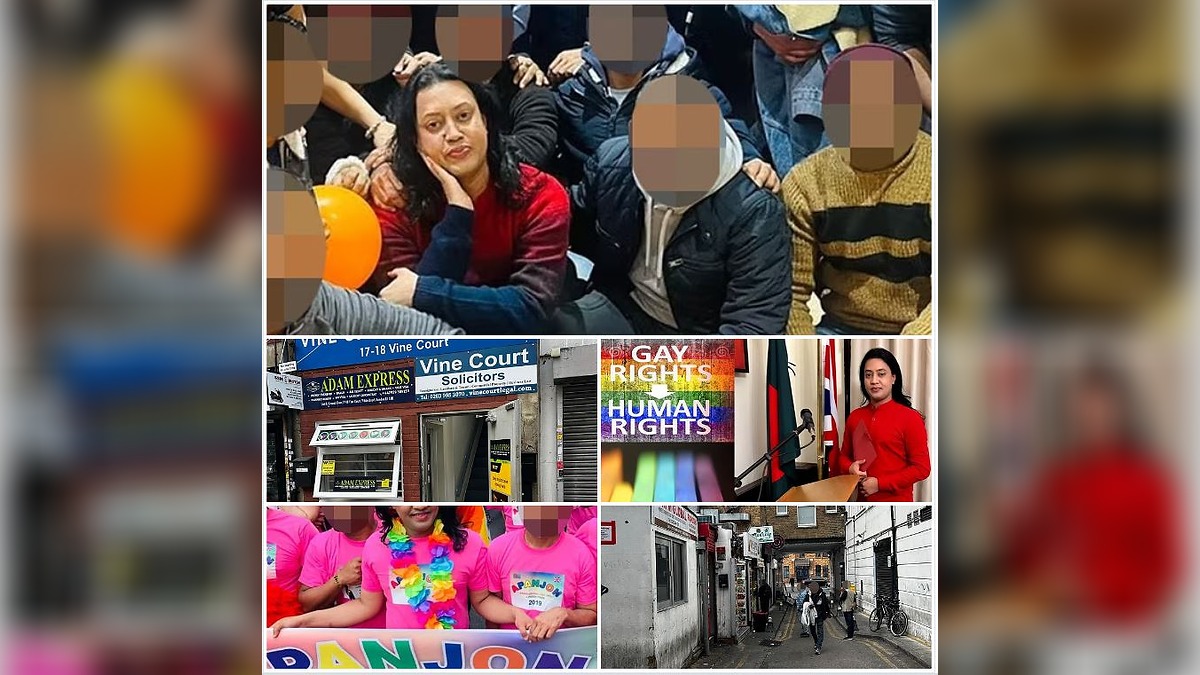
A London-based LGBTQ community organisation is under investigation after its founder and two other people were arrested in connection with suspected fraud and immigration offences, amid allegations that asylum applicants were provided with fabricated evidence of their sexual orientation.
Sajjad Miah, 42, founded Apanjon in east London after receiving asylum in the UK in 2013 on the grounds that she feared persecution in Bangladesh because of her sexuality. She has denied wrongdoing and maintains that the organisation supports genuine LGBTQ asylum seekers.
According to claims cited by the Daily Mail, the Home Office is reviewing more than 100 current and historical asylum applications potentially connected to the organisation. Officials are reportedly investigating allegations that some applicants paid thousands of pounds for documents, photographs and letters intended to support claims that they were gay and would face persecution if returned to their home countries.
The allegations have not been established in court, and Miah has not been convicted of any offence.
Founder Denies Providing False Evidence
Miah said she was arrested during an early-morning operation at her home and taken to a police station for questioning. Immigration Enforcement officers reportedly seized mobile phones, jewellery and thousands of pounds in cash during the raid.
Two people, including Miah, were reportedly arrested on suspicion of fraud and immigration offences, while a third person was arrested on suspicion of being in the UK illegally.
Speaking after her release on bail, Miah rejected the allegations and described the investigation as unfair treatment of an organisation established to assist vulnerable people.
She said she had experienced danger in Bangladesh before receiving protection in Britain and subsequently founded Apanjon to help others facing similar circumstances.
Miah maintained that the group issues letters of support only after observing prospective members for six months to assess whether their claims about their sexuality are genuine.
She also disputed suggestions that the organisation had supplied false documentation or accepted payments in exchange for fabricated evidence. Asked about the cash and jewellery seized by officers, she said the money was intended to cover her rent and the jewellery belonged to her sister.
Miah said she had been released without charge but understood that she might be required to return for further questioning.
Home Office Examines More Than 100 Applications
The investigation reportedly centres on claims that Apanjon provided asylum applicants with evidence packages costing as much as £4,500.
According to allegations attributed to Home Office sources, the packages may have included letters of support, photographs and other material designed to suggest that applicants had participated in LGBTQ social activities.
Some photographs were allegedly taken at the same gay bars and clubs, raising questions about whether they were being used to construct a misleading record of sexual orientation.
Officials are also reportedly examining cases in which applicants initially sought asylum on political grounds but later introduced claims based on sexuality after their original applications had been rejected.
One case cited in the report involved an applicant who reportedly raised his sexuality nine years after submitting his first asylum application.
The investigation is intended to establish whether evidence supplied in these cases was genuine and whether immigration procedures were improperly used. The allegations remain subject to investigation.
Immigration Judges Previously Questioned Some Evidence
Questions about the credibility of material associated with Apanjon reportedly arose in earlier immigration proceedings.
The Daily Mail reported that some judges had criticised evidence supplied by the organisation as unreliable or lacking credibility. In one case, an applicant who claimed to have attended Apanjon events reportedly submitted photographs that a judge considered staged.
Such findings may form part of the wider scrutiny now facing applications connected to the group, although individual immigration decisions do not establish that every person supported by the organisation made a fraudulent claim.
Apanjon’s website describes its work as campaigning for equality and justice for LGBTQ people in Bangladesh. Its advertised activities include monthly meetings, social gatherings, cultural events and assistance for people navigating the process of coming out.
The organisation also says it provides legal guidance through communication with solicitors and barristers, with the stated aim of helping LGBTQ people facing discrimination, violence and persecution.
Charity Operated From East London Business Centre
Apanjon’s reported headquarters were located at Vine Court Businesses, a small business centre in Whitechapel, east London.




The premises house several independent businesses, including a courier company, a money exchange operation, a recruitment firm and a solicitors’ office. The building is situated close to East London Mosque and within an area with a substantial Bangladeshi community.
Residents described seeing numerous officers enter the building during the operation. One resident told the newspaper that the raid began while children were preparing to leave for school.
A person near the premises also suggested that many people visited the organisation seeking immigration assistance. However, those observations do not independently establish the allegations against Apanjon.
The operation has brought renewed attention to the organisation’s activities and to the wider question of how evidence is assessed in asylum cases involving sexual orientation.
Founder Says She Has Received Death Threats
Miah said the publicity surrounding the raid had exposed her to threats from members of the Bangladeshi community.
She alleged that people had threatened to kill her because they believed she was promoting behaviour contrary to their religious and cultural values.
Miah said she was frightened to return to her home and was no longer staying there. She also rejected the Home Office’s reported allegations, insisting that Apanjon had been unfairly targeted.
Her account adds another dimension to the case, involving both the criminal investigation and the personal risks she says she is facing following the publicity.
LGBTQ Advocates Warn Against Fraudulent Claims
Ejel Khan, founder of the Muslim LGBT Network, told the Daily Mail that fraudulent applications based on sexual orientation were a serious concern.
Khan said people had previously offered him money to provide recommendation letters despite admitting that they were not gay. He said he refused to assist them because he advocates for asylum seekers who genuinely face persecution.
He argued that fabricated claims undermine the credibility of people who need international protection because of their sexual orientation.
The allegations against Apanjon have therefore raised concerns among LGBTQ advocates about the potential consequences of fraud for legitimate applicants, particularly those from countries where same-sex relationships can expose people to discrimination, violence or imprisonment.
At the same time, allegations against an organisation or individual must be distinguished from the circumstances of applicants whose claims are genuine.
UK Asylum Figures Show Increase in Sexuality-Based Claims
Figures cited in the report indicate that 2,133 asylum seekers whose claims included sexual orientation as a basis for protection were granted permission to remain in Britain in 2023, the most recent year identified in the report for which comparable data were available.
That figure compared with 762 in 2022 and 677 in 2021.
Pakistan accounted for the largest number of cases in 2023, with 578, followed by Bangladesh with 175, Nigeria with 103 and India with 39.
Sexual-orientation data were not recorded in a reportable format before 2015, according to the report. The figures concern asylum decisions involving sexuality and do not, by themselves, indicate how many claims were fraudulent.
Bangladesh criminalises same-sex sexual activity, with the law carrying a potential maximum penalty of life imprisonment. Conditions facing LGBTQ people in applicants’ home countries can therefore be relevant to decisions about whether they would face persecution if returned.
UK Courts Have Recognised the Risks Facing LGBTQ Asylum Seekers
The legal framework governing such applications has developed significantly over the past two decades.
In 2010, the UK Supreme Court ruled against the approach that gay asylum seekers could be refused protection on the assumption that they could avoid persecution by concealing their sexuality.
The judgment established that applicants should not be expected to hide an essential aspect of their identity to escape danger in their country of origin.
The principle remains central to assessing claims involving sexual orientation. Applicants must provide evidence sufficient to support their individual circumstances, while decision-makers must consider the risks they would face if returned.
The current investigation highlights the challenge of distinguishing genuine claims from alleged attempts to manipulate that system without undermining the protection available to people at risk.
Other Cases Have Raised Questions About Sexuality-Based Appeals
The Apanjon investigation follows other cases in which applicants’ claims about sexual orientation have been challenged during immigration proceedings.
The Daily Mail previously reported on a Cameroonian man, Marius Kamna, who received asylum after claiming to be gay despite having a wife and child in Cameroon. Kamna disputed the suggestion that his marriage undermined his claim, arguing that his personal circumstances involved secrets and persecution.
Another case involved Karam Majdi, an Egyptian national whose attempt to resist deportation on the grounds of bisexuality was rejected by a judge. The report said he had been jailed for raping a 14-year-old schoolgirl and that the judge concluded his removal remained in the public interest.
Separately, the newspaper reported that a Jamaican man convicted of raping his wife and sister had been permitted to remain in Britain following an appeal involving his claim to be bisexual, despite a judge describing his presence in the UK negatively.
These cases involve different individuals and legal circumstances. They illustrate the difficult questions that can arise when asylum protections intersect with criminal convictions, deportation decisions and disputed claims about sexual orientation.
Home Secretary Warns Against Exploiting the Asylum System
Home Secretary Shabana Mahmood has pledged action against people who fabricate persecution claims or profit from allegedly fraudulent applications.
She said people who falsely claim to have experienced persecution undermine the position of genuine victims and warned that those responsible for organising fraud could face prosecution and the confiscation of criminal proceeds.
Mahmood also said applicants found to have cheated the system could have their claims rejected and face removal from Britain.
Fraud-related offences can carry substantial penalties, with the report noting that a conviction for asylum fraud may result in a prison sentence of up to ten years, depending on the offence and applicable law.
The investigation into Apanjon will determine whether there is evidence to support the allegations against those arrested and whether any further action is warranted.
For now, Miah denies wrongdoing, the allegations remain unproven, and the broader challenge for British authorities is to investigate suspected fraud while preserving protection for people who genuinely face persecution because of their sexual orientation.

