
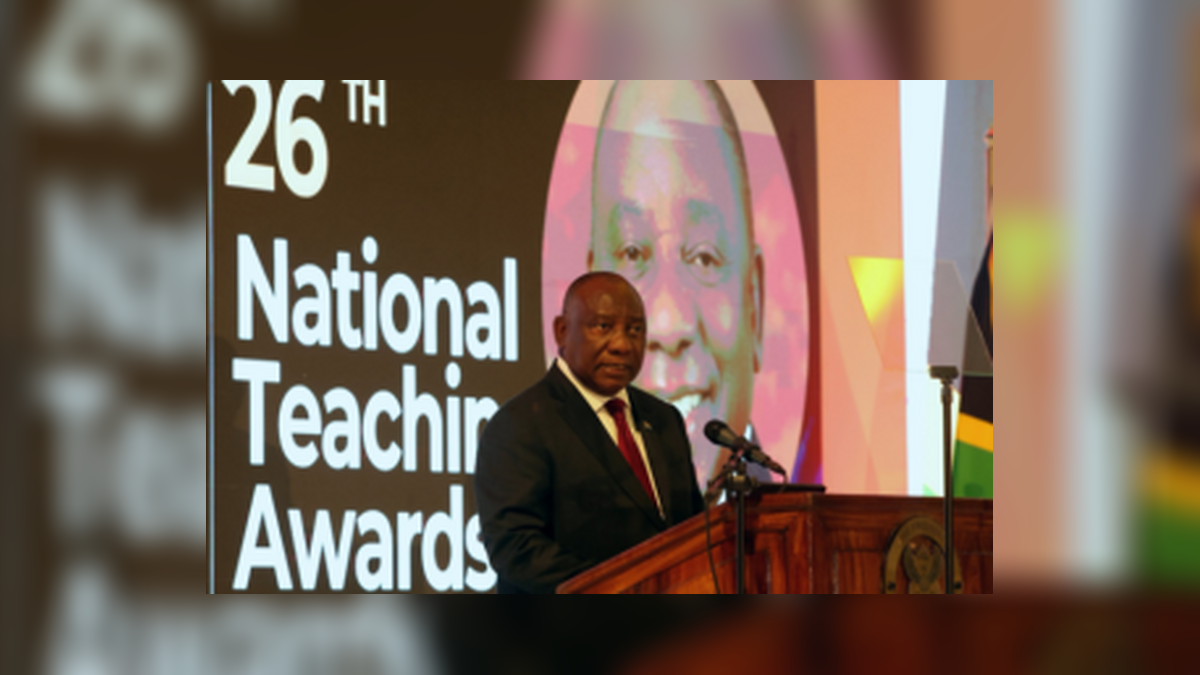
President Cyril Ramaphosa has urged government and society to place greater emphasis on supporting teachers, arguing that improving South Africa’s education system depends heavily on giving educators the conditions they need to succeed.
Speaking at the 26th National Teaching Awards at the Birchwood Hotel and Conference Centre in Ekurhuleni on Thursday, Ramaphosa said teachers remain at the centre of the country’s efforts to improve education and prepare young people for the future.
He said better educational results would require greater investment in teaching, attracting talented young people to the profession and supporting educators throughout their careers.
President Wants Teaching Restored as a Respected Profession
Ramaphosa said teaching should once again be regarded as one of the most respected professions in South Africa.
He called for safe and suitable school infrastructure, stronger professional development programmes and measures to reduce unnecessary administrative responsibilities that take teachers away from classroom instruction.
The President also highlighted overcrowding, the protection of teaching time and stronger action against violence, intimidation and disruption in schools as issues requiring continued attention.
Ramaphosa Recalls Teacher Who Changed His Life
The President used his own school experience to demonstrate the potentially transformative influence of a teacher.
He recalled that his former school principal, Mr Ntsandeni, played a particularly important role in his development. Ramaphosa said he had been an inquisitive learner who frequently challenged his teachers because he wanted to understand what he was being taught.
While some educators believed he should be expelled, Ntsandeni took a different approach and intervened on his behalf.
Ramaphosa said his former principal recognised potential in him that others had overlooked and understood that curiosity should be encouraged rather than punished.
‘Great Teachers’ Help Young People Reach Their Potential
Ramaphosa said Ntsandeni’s intervention gave him the opportunity to remain in school, continue learning and ultimately become the person he is today.
He said he would have liked to honour his former principal with a National Teaching Award had he still been alive.
For the President, the story illustrated the deeper purpose of teaching: recognising potential in young people and creating opportunities for that potential to develop.
Literacy and Numeracy Must Remain Priorities
Ramaphosa said educational excellence should ultimately be measured by whether children are gaining the knowledge and skills needed to improve their future prospects.
He identified foundational literacy and numeracy as two of South Africa’s most important educational priorities, warning that learners who struggle to read with understanding during their early years can face difficulties throughout their schooling.
He called on teachers, principals, education districts and provincial departments to maintain a strong focus on measurable learning outcomes.



The President also encouraged schools and provinces to share effective approaches so that successful educational practices can benefit learners across the country.
Technology Can Support Teachers but Not Replace Them
The growing influence of artificial intelligence and other digital technologies was another focus of the President’s address.
Ramaphosa said technology could provide educators with additional teaching resources, assist with lesson preparation and help support learners with different educational needs.
However, he stressed that technology also creates a responsibility to teach young people how to identify misinformation, think independently and use digital tools safely and ethically.
He argued that artificial intelligence may provide answers, but teachers help learners understand the questions they are asking. According to Ramaphosa, qualities such as encouragement, discipline, empathy and human connection cannot simply be replaced by technology.
Schools Have a Role in Fighting Gender-Based Violence
The President also called on schools to play a stronger role in addressing gender-based violence and femicide (GBVF).
He said sexual harassment, abuse and exploitation should not be tolerated in schools, regardless of whether the perpetrators are educators, staff members or learners.
Ramaphosa said young people should be taught about respect, dignity, equality and consent while also learning how to resolve disagreements without resorting to violence.
He particularly called for boys and young men to understand that strength should be associated with responsibility, self-control and respect rather than domination or abuse.
The President also supported stronger, age-appropriate life-skills education from early childhood through high school, involving educators, parents, community leaders and other influential figures.
National Teaching Awards Celebrate Excellence
The National Teaching Awards were established in 2000 by the late Education Minister Professor Kader Asmal to recognise outstanding educators.
Ramaphosa said the awards remain an important way of celebrating teachers who have dedicated their careers to developing learners and communities.
This year’s programme included the Kader Asmal Lifetime Achievement Award, recognising educators who have devoted decades to education.
More than 133 teachers participated in the national adjudication process in Gauteng earlier this month, with finalists recognised in categories ranging from Excellence in Grade R Teaching to Excellence in Teaching Mathematics at FET level.
Learners Also Get a Voice Through #MyTeacher
Ramaphosa highlighted the Minister’s Special Award, #MyTeacher, which gives learners an opportunity to nominate educators who have had a meaningful impact on their lives.
He congratulated all the finalists and nominees, saying that reaching the national adjudication stage was itself evidence of the contribution they had made to education.
Remembering Teachers of the 1976 Generation
With South Africa marking the 50th anniversary of the 1976 Soweto Uprising, Ramaphosa also reflected on the contribution of teachers during apartheid.
While the courage of the students who opposed the Bantu Education system remains central to the history of the uprising, he said the teachers who provided guidance, education and leadership during repression should also be remembered.
Ramaphosa noted that some teachers were imprisoned, tortured, banned, forced into exile or killed because of their involvement in the struggle.
He said their experiences demonstrated that teaching extends beyond classroom lessons and can involve shaping the values and society that future generations inherit.
‘South Africa’s Future Is Being Shaped in Our Classrooms’
Ramaphosa said educators continue to have an important responsibility in democratic South Africa, where they are expected to provide guidance, leadership and moral courage.
He said the country’s future is being shaped every day in classrooms, from children learning to read to learners discovering their abilities and teachers refusing to give up on those who need additional support.
The President congratulated this year’s award recipients and thanked educators for their contribution to the country.
The 2026 National Teaching Awards were held under the theme “Uniting for Excellence: Elevating Achievement, Empowering Educators to Shape South Africa’s Future.”
- Federal Judge Challenges Oklahoma’s Ban on Religious Charter Schools in Major Jewish School Ruling
- South Africa’s Most Expensive School? Hilton College Fees Hit R554,600 for First Year
- NSG Unveils New Public-Service Qualifications Amid Push to Professionalise Government
- UKVI Issues Stark Warning to International Students as Tiny Student Visa Errors Could Trigger Delays and Force Costly Fresh Applications
- Hazel O’Connor’s heartbreaking struggle revealed as 80s music icon faces mounting care costs after devastating brain bleed
- California High School Football Game Erupts in Gunfire as 17-Year-Old Athlete Is Killed and 15-Year-Old Suspect Arrested

