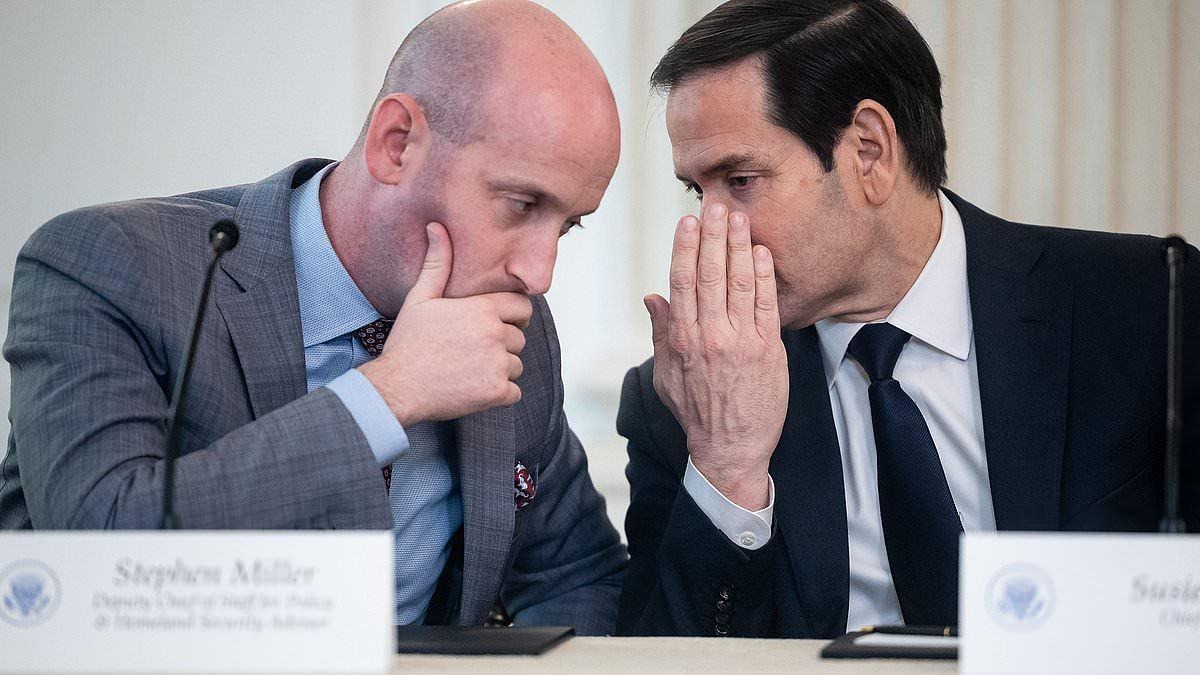
US Secretary of State Marco Rubio and White House adviser Stephen Miller have reportedly developed one of the closest working relationships in President Donald Trump’s administration, despite their history of bitter disagreements over immigration policy.
The pair, once political adversaries, are now among the most influential figures in Trump’s inner circle, with their growing partnership playing a significant role in shaping the administration’s domestic and foreign policy priorities.
Their relationship took on fresh significance last Friday when Rubio was in Miller’s office as news emerged that Trump had appointed Miller as his new White House chief of staff.
According to The Wall Street Journal, Miller received the news after an aide entered his office with details of the President’s announcement on Truth Social.
Turning to Rubio, Miller joked that he was now his boss before the two men shook hands.
The exchange highlighted the transformation of a relationship that was previously characterised by political hostility and disagreements over immigration.
Wives Reveal How Close the Two Men Have Become
Miller, 41, has acknowledged the closeness of their relationship, saying their wives have become accustomed to the considerable time they spend together.
He told The Wall Street Journal that their wives sometimes joke about the need to prevent the two men from spending too much time together because of the ideas they might develop.
‘We motivate each other,’ Miller said.
Miller’s wife, Katie, has also described Rubio and her husband as ‘besties’.
She revealed that she regularly speaks with Rubio’s wife, Jeanette, when the two men spend long periods talking on the telephone in the evenings.
Their friendship has even extended to an unusual shared fashion moment following the US operation that resulted in the capture of Venezuelan leader Nicolás Maduro.
Katie reportedly arrived at a dinner involving the two men at Trump’s Mar-a-Lago resort with matching grey Nike tracksuits resembling the clothing Maduro wore after his capture.
Rubio subsequently wore his tracksuit aboard Air Force One.
Their Partnership Has Influenced Major Trump Administration Decisions
The relationship between Rubio and Miller has become increasingly important as the administration pursues some of its most ambitious and controversial policies.
Miller is regarded as one of the leading architects of Trump’s hardline immigration agenda and America First approach.
Rubio, meanwhile, has emerged as a key diplomatic figure responsible for advancing those priorities through the State Department and international negotiations.
Their collaboration has featured prominently in discussions surrounding Trump’s ambitions to acquire Greenland, military strikes against suspected drug-smuggling vessels in the Caribbean and the operation that led to Maduro’s capture.
The two men have also worked together on immigration enforcement, border security and efforts to increase pressure on governments regarded as adversaries of the United States.
Their combined influence has placed them at the centre of some of the administration’s most significant policy decisions.
A Bitter Immigration Dispute Once Put Them on Opposite Sides
The strength of their current relationship represents a dramatic reversal from their earlier political confrontation.
Rubio entered the US Senate in January 2011 as a rising Republican figure from Florida, having gained prominence through the conservative Tea Party movement.
Two years later, he became a member of the bipartisan Gang of Eight, a group of senators that negotiated a major immigration reform proposal.
The proposed 844-page legislation included provisions for a pathway to citizenship for millions of undocumented migrants.
However, the proposal attracted fierce opposition from immigration hardliners within the Republican Party, including Miller, who was then a 27-year-old aide to Republican Senator Jeff Sessions of Alabama.
Miller viewed Rubio’s involvement in the legislation as a political concession that needed to be challenged.
He subsequently worked behind the scenes to encourage negative media coverage of the Florida senator.
Emails between Miller and Breitbart News staff, which became public in 2019, revealed the extent of his efforts.




In a July 2015 message, Miller wrote: ‘Really important that you got the Rubio hit in there.’
He also described Rubio as dishonest and accused him of supporting unlimited immigration.
When Rubio suspended his presidential campaign in March 2016, Miller reportedly took credit for helping to bring about his political defeat.
Trump’s Political Rise Changed Their Relationship
The emergence of Trump as a dominant figure in Republican politics eventually helped bring the former opponents closer together.
Rubio had previously warned that Trump could damage the Republican Party.
However, he gradually established himself as an important ally of the President, particularly on issues involving Latin America.
He also increasingly embraced the nationalist and populist positions that were becoming central to the Republican Party’s identity.
Their shared interest in immigration policy and legislative details helped establish a working relationship that surprised colleagues.
During Trump’s first administration, the President reportedly noticed the two men having an extended conversation aboard Air Force One.
‘Wow, look at these guys getting along,’ Trump remarked.
Their relationship continued after Trump left office in 2021.
Rubio remained in contact with Miller and occasionally sought his advice on speeches while increasingly aligning himself with the America First movement.
In 2023, Miller hosted an event promoting Rubio’s book criticising globalism, referring to the Florida senator as his ‘good friend’.
Their relationship became even closer following Trump’s victory in the 2024 presidential election.
Rubio Won Over Immigration Hardliners
Rubio’s appointment as secretary of state initially generated uncertainty among some conservative Republicans who remained concerned about his previous support for immigration reform.
His reputation as a foreign-policy hawk also raised questions about how closely he would align himself with Trump’s more nationalist approach.
However, his actions in office demonstrated increasing cooperation with Miller’s agenda.
The State Department supported the administration’s immigration crackdown through visa revocations, deportation negotiations and restrictions targeting foreign students involved in pro-Palestinian protests.
Just weeks after Trump’s inauguration, Rubio travelled to El Salvador to negotiate an agreement championed by Miller.
The arrangement involved transferring hundreds of deportees to a notorious maximum-security prison in the Central American country.
Their cooperation subsequently expanded into efforts against suspected drug-trafficking networks, combining Miller’s hardline approach to criminal organisations with Rubio’s longstanding campaign to increase pressure on Venezuela.
Military Operations Against Venezuela Expose Their Influence
The partnership between the two men became particularly significant in the administration’s approach to Venezuela.
They helped present Maduro as an alleged drug kingpin whose activities posed a direct threat to American national security.
Their arguments reportedly helped persuade Trump, who had previously been reluctant, to authorise the operation that resulted in the Venezuelan leader’s capture.
The operation also demonstrated how their different political roles could complement one another, with Miller helping shape the administration’s strategic direction and Rubio handling diplomatic and foreign-policy considerations.
However, the administration’s military campaign against suspected drug-smuggling vessels has generated concerns among some officials.
Certain State Department personnel have questioned the legality of the strikes and expressed unease about the limited opportunities for internal disagreement.
Rubio has also faced criticism from some of his longstanding supporters in Florida.
Business leaders in the state have warned that immigration restrictions introduced by the administration are making it more difficult for companies to recruit workers.
Despite these concerns, Rubio and Miller have remained closely aligned in their support for Trump’s policies.
Miller’s New Role Could Shape the Republican Party’s Future
Miller’s appointment as White House chief of staff has further strengthened his position within the administration.
The role places him at the centre of White House operations, giving him significant responsibility for managing the President’s schedule, controlling the flow of information and coordinating government priorities.
His growing influence could also have implications for the Republican Party beyond Trump’s second term.
Rubio, 55, is already facing increasing speculation about a possible presidential campaign in 2028.
Supporters have encouraged him to consider seeking the Republican nomination, although he previously committed to supporting Vice President JD Vance if he decides to run.
Miller was among those who opposed Rubio’s earlier immigration reform proposal, viewing it as an unacceptable concession.
Their current alliance could therefore become significant if the Republican Party faces a leadership contest as Trump approaches the end of his presidency.
With Rubio’s foreign-policy experience and Miller’s influence over the administration’s political and ideological direction, their partnership could play an important role in determining the party’s future leadership.
Their Former Feud Has Become a Family Joke
The two men recently demonstrated how completely their relationship has changed from the hostility that once defined it.
At a gathering involving the Rubio family, Katie Miller reportedly reminded Jeanette Rubio of the period when her husband was actively campaigning against the Florida senator.
Stephen Miller responded by asking his wife not to revisit the disagreement.
‘Katie, do not bring up unpleasant times,’ he said.
The exchange reflected the unlikely friendship between two men whose political careers were once shaped by opposing positions on one of the Republican Party’s most divisive issues.
