
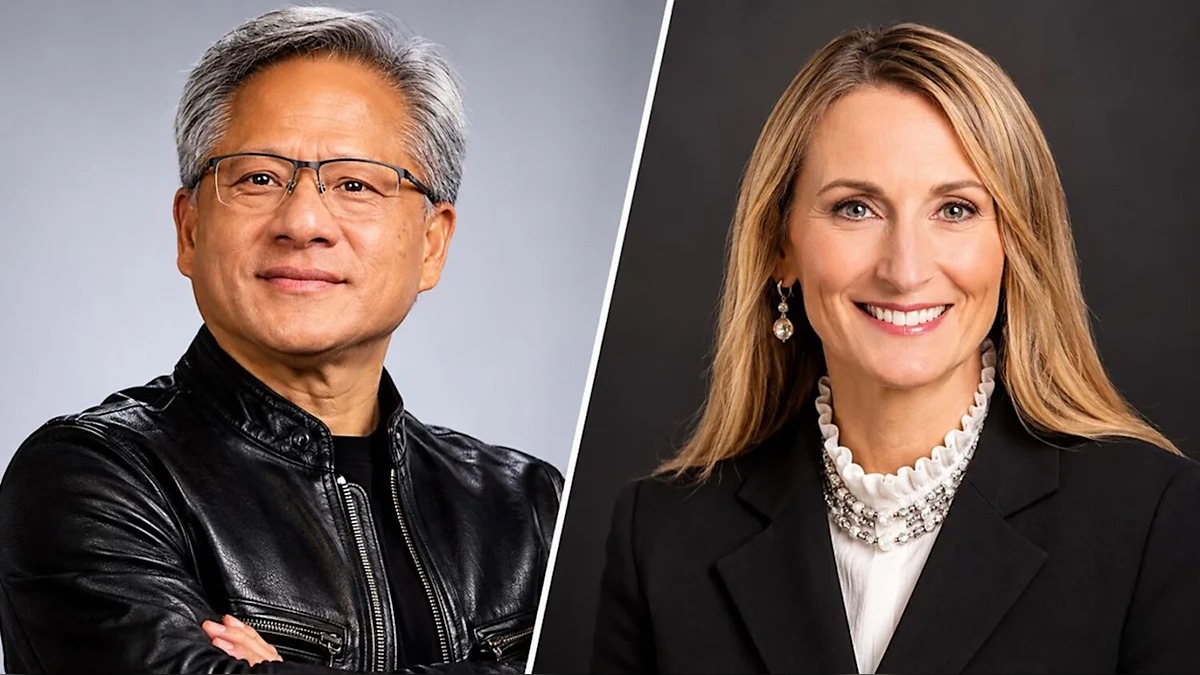
Nvidia’s new interim chief executive, Colette Kress, is expected to significantly reduce the company’s financial backing for other artificial intelligence businesses, potentially bringing an end to the aggressive investment strategy pursued by her predecessor, Jensen Huang.
Kress, who has long questioned Huang’s approach to financing other AI companies, is reportedly looking to impose stricter financial controls on the $3.9 trillion technology giant.
According to the Wall Street Journal, her appointment could mark a major shift in Nvidia’s involvement in funding emerging AI businesses, particularly startups that depend heavily on external investment to sustain their operations.
Under Huang, Nvidia had increasingly used its financial strength and dominant position in the semiconductor industry to support the expansion of the wider AI sector.
Nvidia’s investment programme expanded rapidly under Huang
Huang had established relationships with some of Wall Street’s biggest asset managers, seeking private capital and institutional investors to finance major computing infrastructure projects.
The proposed arrangements included funding for data centres, chip manufacturing facilities and other infrastructure required to support the growing demand for artificial intelligence.
According to CNBC, some of the financing arrangements involved specialised investment vehicles that would use Nvidia’s AI chips as collateral.
The company’s investment activities expanded considerably over the past two years.
Nvidia participated in a record 129 venture capital deals over the past year, compared with just 49 in 2023.
Those transactions represented approximately 27 per cent of the global venture capital deal value, according to the Wall Street Journal.
Nvidia’s latest quarterly financial filing also disclosed $36 billion in off-balance-sheet AI cloud agreements and financial backstops.
However, the future of several arrangements is now uncertain as Kress prepares to take a different approach to the company’s financial commitments.
Smaller AI companies face uncertainty over future funding
Nvidia’s potential withdrawal from some investment arrangements could create difficulties for emerging AI businesses that rely on the company’s financial support.
Some founders and venture capital investors have warned that companies with little or no revenue could struggle to secure the funding needed to continue operating if Nvidia reduces its investments.
UBS analyst Tim Arcuri estimated that a withdrawal of Nvidia’s financial support could remove $50 billion or more from the market.
Such a reduction could leave several emerging businesses struggling to finance their operations, particularly as borrowing costs increase.
Many of these companies depend on substantial investments to purchase computing resources and develop artificial intelligence models before establishing sustainable revenue streams.
Huang began questioning the returns on some deals
Huang, 63, began expanding Nvidia’s financing arrangements earlier this year as competitors, including Google’s parent company Alphabet and Advanced Micro Devices, introduced similar incentives to attract customers.
The former CEO was reportedly concerned about losing market share to competing chip manufacturers.
Nvidia formally announced its financing programme in July.
However, within a month, Huang and Kress were already questioning the potential returns from some of the arrangements, according to the Wall Street Journal.
One significant example involved OpenAI’s proposed data centre lease in Piketon, Ohio, involving SoftBank’s SB Energy.
Nvidia had used the strength of its balance sheet to help support the arrangement but subsequently reduced the scale of its financial commitment during August negotiations after Kress raised concerns about the deal.
Huang also reportedly told members of his finance team that Nvidia was facing increasing pressure as major cloud computing providers explored alternative chips to reduce their dependence on the company.
This raised concerns that Nvidia could be left with excess chip wafers and memory after committing to purchase supplies that customers might no longer need.
Huang subsequently instructed his staff to develop a system for assessing whether the financial guarantees being offered to smaller businesses were commercially worthwhile.
By the end of August, Nvidia had suspended some investment arrangements that were still being negotiated.
Huang declared an end to Nvidia’s open-checkbook policy
The former CEO made his position on the company’s financial commitments particularly clear during Nvidia’s major European AI conference in Berlin last month.
Speaking to executives from emerging cloud computing companies that purchase Nvidia chips and rent computing capacity to customers, Huang reportedly announced that the company’s days of operating an open checkbook were over.
He told the partners that companies seeking access to Nvidia’s highly sought-after graphics processing units would need to pay upfront rather than simply rent computing capacity and settle payments later.
According to executives who attended the discussion, Huang also criticised some companies for charging too little for their services.
He reportedly compared their pricing arrangements with those of Elon Musk, suggesting that the billionaire was paying more favourable rates for Nvidia’s computing resources.



“You’re not charging what you should be charging,” Huang said, according to the Wall Street Journal.
He also reportedly told the executives: “I don’t even need you guys. I could just give all this capacity to Elon! Elon wants it.”
It remains unclear whether Kress will maintain the policy or introduce further restrictions on Nvidia’s financial involvement with smaller AI businesses.
Major AI investment negotiations remain unresolved
Several significant funding discussions involving Nvidia and emerging artificial intelligence companies are continuing despite the uncertainty surrounding its investment strategy.
UK-based neocloud company Nscale is still negotiating with Nvidia and other potential investors over financial backing for a proposed $45 billion data centre project in West Virginia.
The facility is intended to support Anthropic’s computing requirements.
Nvidia has also reportedly made an offer to Reflection AI, an open-source AI model developer valued at $25 billion.
The proposal involves licensing the company’s technology and recruiting some of its employees, according to people familiar with the discussions.
However, the negotiations had not been finalised before Huang left his position.
Another major transaction involves Thinking Machines Lab, an AI company developing open-source models.
Nvidia has been working towards completing a substantial investment that would value the business at approximately $40 billion.
A person familiar with the negotiations said Thinking Machines remained confident that the agreement would eventually be completed.
Both Reflection AI and Thinking Machines are reportedly spending substantial amounts each month on computing resources required to develop their AI models, despite not yet establishing reliable revenue streams.
Bob Lang, founder and chief strategist at Explosive Options, told CNBC that major technology companies such as Nvidia and Meta control much of the financial power in the AI industry.
He warned that smaller businesses could face serious difficulties if those companies decide to withdraw their support.
Nvidia’s market value falls following Huang’s departure
The uncertainty surrounding Nvidia’s leadership has coincided with a significant decline in the company’s market valuation.
Nvidia’s market capitalisation has fallen 12.75 per cent since the disclosure of Huang’s alleged affair and his subsequent resignation.
The decline has been even greater when measured against the company’s peak valuation of approximately $5.8 trillion in early October.
Its market value has dropped by around 32 per cent from that level, wiping out approximately $1.9 trillion.
During the week the affair allegations emerged, Nvidia lost approximately $550 billion in market value.
The company’s market capitalisation stood at $3.9 trillion at Friday’s market close.
The decline has also occurred amid a broader pullback across the artificial intelligence sector.
Silicon Valley executives push for Huang’s return
Despite his departure, Huang’s supporters are reportedly working to persuade him to return as Nvidia’s chief executive.
According to the Financial Times, influential Silicon Valley figures have been discussing ways to reinstate the former CEO.
An ally of Huang told the publication that several technology executives were organising a so-called war room to coordinate efforts to secure his return.
The group reportedly hopes to obtain support from the White House, with Huang said to be assisting the campaign behind the scenes.
A public letter supporting his reinstatement has attracted backing from Elon Musk, Epic Games chief executive Tim Sweeney, nearly 9,000 current and former Nvidia employees and more than 83,000 investors.
Supporters have pointed to Huang’s 33-year leadership of Nvidia and his role in transforming the company into one of the central players in the global AI industry.
However, the campaign could face resistance from senior figures in Washington.
Treasury Secretary Scott Bessent called for a “dramatic shakeup” in Nvidia’s leadership on Sunday.
Trump describes Huang as a tremendous talent
President Donald Trump has maintained a largely positive public position towards Huang since the allegations emerged.
Speaking to CNN’s Stephen A. Smith on Thursday, Trump praised the former Nvidia chief executive for his achievements in the semiconductor industry.
He described Huang as a tremendous talent and highlighted the company’s development of highly sophisticated computer chips.
However, Trump indicated that Huang’s departure could be justified if allegations concerning the involvement of his alleged romantic partner in espionage were confirmed.
When Smith directly asked whether Huang had been right to resign, Trump paused before responding.
“The big thing was, was the woman a spy? If the woman was a spy, yes, if the woman was not a spy perhaps it would be different,” Trump said.
The woman at the centre of the allegations is Alice Huang, a businesswoman who has no familial relationship with the former Nvidia CEO.
She is an executive at Singapore-based data centre company Megaspeed, which US authorities suspect of smuggling restricted Nvidia chips into China.
Authorities also reportedly suspect that she was tasked with obtaining sensitive information from Huang and influencing Nvidia’s commercial decisions in ways that could improve China’s access to its chips.
Additional affair allegations could complicate reinstatement efforts
Huang has admitted to having an affair with Alice Huang, but he has also faced separate allegations involving two other women connected to Nvidia.
He has been accused of having a relationship with Kimberly Powell, the company’s vice president of healthcare, as well as another unidentified Nvidia employee.
The allegations involving Powell have not been admitted by Huang.
Both Huang and Powell are married, while Nvidia maintains strict policies governing relationships between employees, particularly those involving senior executives and subordinates.
Those rules could present a significant obstacle to efforts to restore Huang to his former position.
A source involved in the reinstatement campaign told the Financial Times that an affair with a subordinate could constitute grounds for dismissal.
Huang’s supporters therefore face questions about whether the company’s board would be willing or able to reinstate him despite the allegations.
Unlike some other prominent Silicon Valley founders, Huang does not hold a controlling stake in Nvidia that would allow him to override decisions made by the company’s board.
His return would consequently depend on securing sufficient support from the company’s leadership.
