
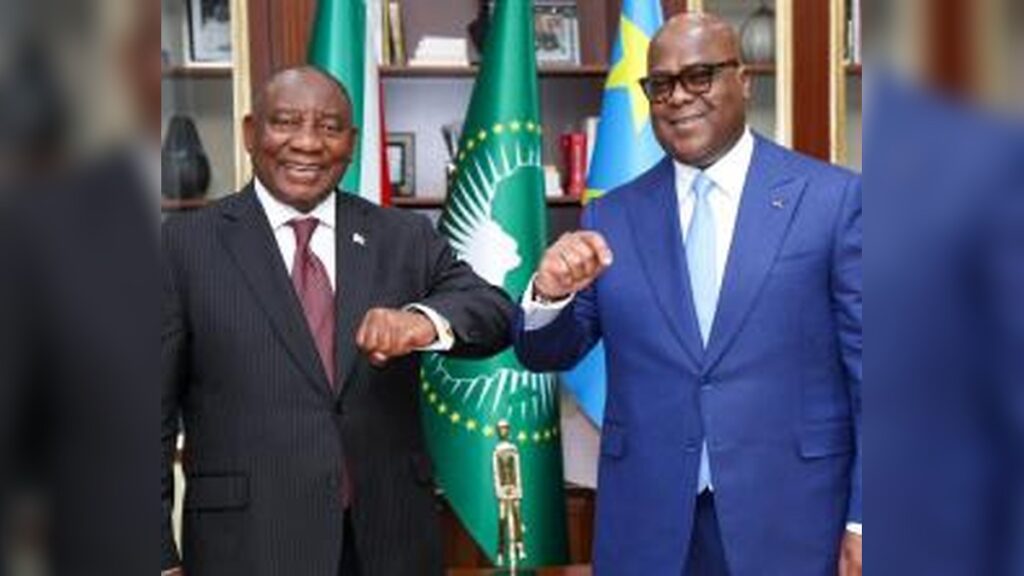
South African President Cyril Ramaphosa has reaffirmed his government’s commitment to managing migration in a way that safeguards human rights while addressing the concerns of citizens, following high-level talks with Democratic Republic of the Congo President Félix Tshisekedi in Kinshasa.
The two leaders met on Thursday to discuss a range of regional issues, including migration, cooperation between African nations and the ongoing Ebola outbreak.
Ramaphosa Says Migration Requires a Balanced Response
Speaking after the bilateral meeting, Ramaphosa described migration as a challenge affecting countries across Africa and beyond, stressing that no nation is immune to its impact.
He said discussions with Tshisekedi focused extensively on the issue, noting that governments must respond in a manner that balances public concerns with the rights and dignity of migrants.
According to the South African president, his administration remains guided by the country’s Constitution, which places strong emphasis on protecting human rights and respecting the dignity of every individual.
Government Acknowledges Public Frustration
Ramaphosa recognised that migration has become a growing concern for many South Africans, with recent demonstrations reflecting frustration over unemployment, poverty and the presence of foreign nationals.
He said the government understands these concerns but remains committed to ensuring that every person living in South Africa is protected from violence and treated in accordance with the rule of law.



The president emphasised that the state has a responsibility to uphold both public safety and the constitutional rights of citizens and non-citizens alike.
Security Forces Tasked With Protecting All Residents
Referring to nationwide protests held earlier in the week, Ramaphosa said law enforcement agencies worked to maintain public order while safeguarding vulnerable communities.
He stated that security personnel were instructed to protect the dignity and safety of everyone in the country, regardless of whether they were South African citizens or foreign nationals, including those without proper documentation.
Regional Cooperation Seen as Key to Migration Solutions
Ramaphosa announced that South Africa intends to strengthen diplomatic engagement with other African nations by dispatching envoys across the continent to discuss migration policies and identify shared solutions.
He argued that migration cannot be resolved through unilateral action and called for closer collaboration among African governments to address the causes and consequences of population movements.
The president also reiterated the importance of proper documentation, saying effective immigration systems help improve security while protecting the rights of migrants.
Tshisekedi Urges Compassionate Immigration Policies
President Félix Tshisekedi said the two leaders had also examined the situation facing African migrants living in South Africa and acknowledged that every sovereign state has the authority to manage its borders and immigration policies.
However, he urged governments to approach migration with compassion, insisting that respect for human dignity should remain central to immigration enforcement.
African Solidarity Remains Central Theme
Tshisekedi expressed confidence in South Africa’s leadership, saying he believed the country’s authorities would pursue balanced policies consistent with the principles of African solidarity and respect for fundamental rights.
He added that Ramaphosa’s visit underscored the close partnership between the Democratic Republic of the Congo and South Africa, stressing that regional challenges—including migration, health crises and peacebuilding—can only be addressed effectively through cooperation among African nations.
