
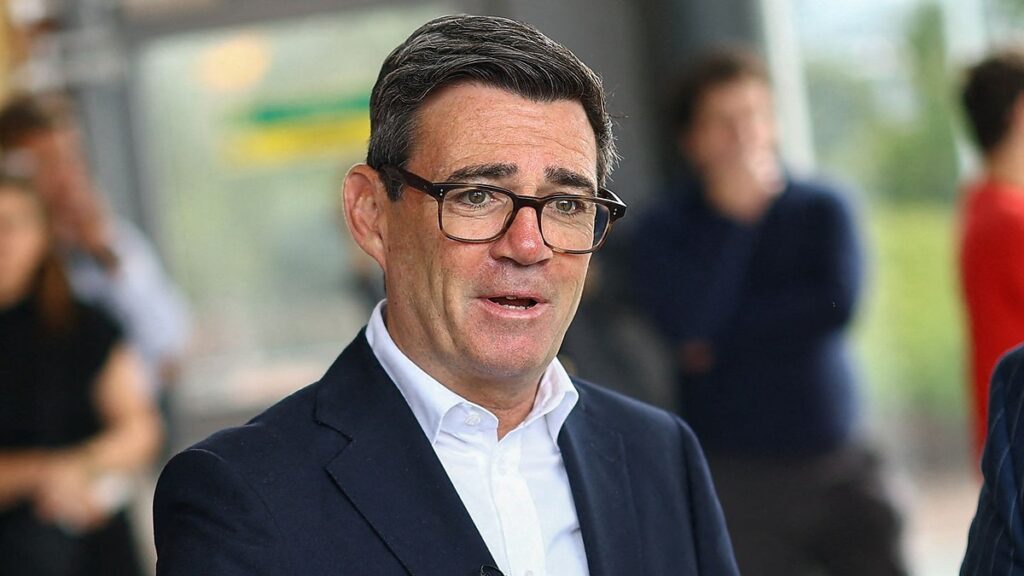
Andy Burnham has rejected suggestions that he should be embarrassed after being deceived by an individual claiming to be Susie Wiles, Donald Trump’s chief of staff.
The Prime Minister said the exchange involved only a limited amount of information and that he acted appropriately once concerns about the contact became apparent.
Speaking to broadcasters at Wolverhampton bus station, Burnham said he was not embarrassed by what happened, insisting that the messages contained nothing of consequence.
“I’m not,” he said when asked whether he felt embarrassed. Burnham added that he quickly recognised the contact needed to be reported and said he had done so.
Messages Continued After He Took Office
The communications began before Burnham became Prime Minister and continued after he entered office on July 20.
The person behind the messages allegedly presented themselves as Wiles, one of the most senior figures in the Trump administration.
The deception subsequently prompted British officials to alert their American counterparts.
Burnham maintained that the exchange did not involve sensitive information and said the appropriate authorities had been notified.
“There was a minimal exchange of information of zero consequence, and it was quickly reported,” he said.
When questioned about efforts to establish who had impersonated Wiles, Burnham said the “correct action” had been taken both in Britain and the United States.
British Embassy Alerted Washington
The British embassy in Washington reportedly contacted the White House after it became clear that Burnham had been communicating with someone falsely claiming to be the US president’s chief of staff.
The episode has nevertheless raised questions about the safeguards surrounding communications between senior British and American officials.
A source close to the White House said there would normally be a trusted chain of communication between officials in both countries to ensure that sensitive conversations were conducted through secure and formal channels.
The source acknowledged that Burnham had described the exchange as inconsequential but suggested the fact that officials were alerted demonstrated that the incident was serious enough to warrant attention.
Burnham Joins Long List of High-Profile Targets
The incident is not the first time a senior political or public figure has been deceived by someone impersonating a prominent individual.
David Cameron was previously targeted while serving as foreign secretary when a hoaxer posed as former Ukrainian president Petro Poroshenko.




Cameron had known the real Poroshenko for years but was nevertheless drawn into communication with the impersonator.
During his time as prime minister, Cameron was also connected to a prank caller who claimed to be Robert Hannigan, then head of GCHQ.
Prince Harry was similarly targeted by Russian pranksters who posed as climate activist Greta Thunberg and her father, Svante.
The conversations touched on his relationship with the Royal Family and his views on Donald Trump.
Tony Blair was also once targeted by comedian Jon Culshaw, who impersonated then Conservative leader William Hague.
Blair recognised the imitation and responded humorously to the attempt.
Former US vice-presidential candidate Sarah Palin was another high-profile victim, remaining on the phone for several minutes with Canadian pranksters pretending to be French president Nicolas Sarkozy.
Security Experts Raise Concerns
Despite Burnham’s insistence that no sensitive information was exchanged, security experts have questioned the circumstances surrounding the deception.
Professor Anthony Glees, a security and intelligence specialist at the University of Buckingham, described the incident as a serious security concern.
He argued that the situation was particularly troubling because the messages continued over several days during a period when Burnham was assuming the responsibilities of Prime Minister.
Glees said the exchange should not simply be dismissed as a harmless prank, given the seniority of the people allegedly involved and the potential importance of communications between the British government and the White House.
He also questioned whether those responsible for protecting Burnham’s communications should have been aware of previous attempts to compromise Wiles’s communications.
Wiles Has Previously Been Targeted
The impersonation comes against the backdrop of previous attacks involving Wiles.
Last May, an individual reportedly gained access to her personal contacts and used her identity to approach senior American officials.
The impersonator was also said to have used artificial intelligence to mimic her voice during calls with prominent Republicans.
Wiles was additionally targeted in 2024 by a cyber-espionage operation linked to Iran’s Revolutionary Guards, while her emails were infiltrated shortly before the US presidential election.
A hacker subsequently threatened to release further material, adding to concerns surrounding the security of communications involving one of Trump’s most influential aides.
White House Rejects Device-Hacking Link
The White House has sought to distinguish Burnham’s experience from the earlier incidents involving Wiles.
A statement said the episode involving Burnham was not connected to Wiles’s devices being hacked.
Trump was nevertheless questioned about the incident during an Oval Office press conference. The US president played down the episode, describing it as a “miscommunication”.
It is understood that Wiles changed her phone number and email address following the earlier breach, while additional security measures were introduced during an FBI investigation that has not yet identified the person responsible.
Political Hoaxes Remain a Persistent Threat
Burnham’s case illustrates the continuing challenge faced by senior officials as impersonation techniques become increasingly sophisticated.
Although political figures have been successfully targeted by pranksters for decades, the use of hacked contact lists, artificial intelligence and digitally impersonated identities has created new risks for government communications.
Burnham has maintained that he responded properly once the deception was identified, while authorities in Britain and the United States are understood to be examining the circumstances surrounding the incident.
