
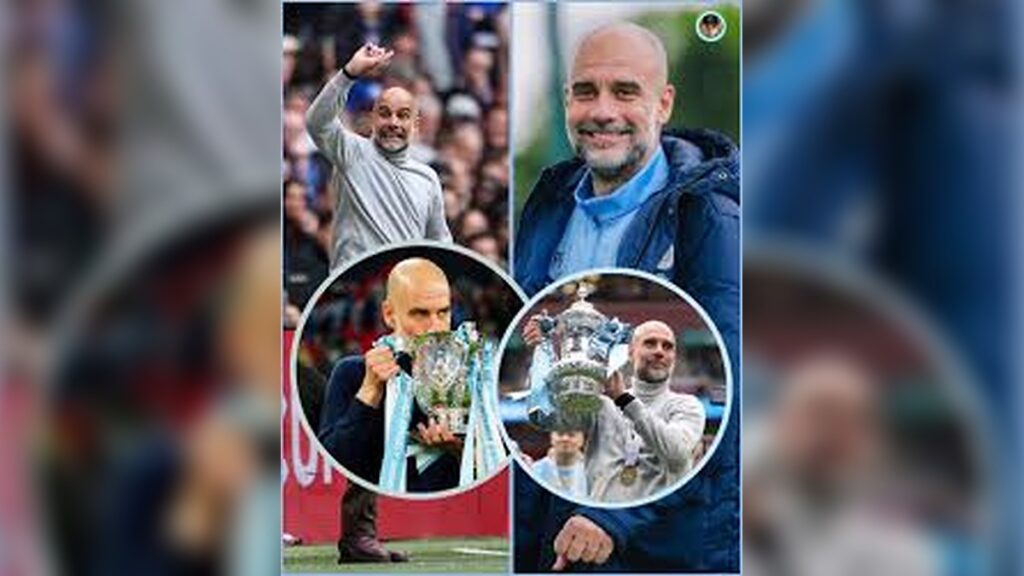
When Pep Guardiola finally steps away from English football, it won’t just feel like the end of a managerial spell.
It will feel like a shift in how the game itself thinks, plays, and even speaks.
Yes, the silverware is staggering — six Premier League titles and more than 20 trophies at Manchester City — but the deeper story is how his ideas seeped into every corner of the English game.
From elite stadiums to muddy Sunday league pitches, his influence is everywhere.
He arrived in 2016 with a reputation for obsession: possession football, positional structure, constant pressing.
Ten years later, those ideas no longer feel foreign in England — they feel normal.
The “Pep effect” that spread far beyond Manchester
What people now casually call the “Pep trickle” isn’t exaggeration.
It’s visible in how teams build from the back, how defenders are coached like midfielders, and how even youth coaches demand pressing triggers and tactical discipline.
Watch a grassroots coach on a Sunday morning shouting “press higher” at nine-year-olds and you’re basically hearing Guardiola’s football philosophy translated into local dialect.
This shift didn’t stay in coaching manuals either. Players, pundits, even rival managers started adjusting.
Former England striker Wayne Rooney has openly admitted he admired Guardiola’s methods and later tried to incorporate parts of his tactical thinking into his own coaching ideas.
Rivalries that defined an era
If there is one chapter that will always define Guardiola’s English legacy, it is his rivalry with Jürgen Klopp and Liverpool between 2018 and 2022.
On one side, Klopp’s relentless chaos and emotion at Liverpool FC.
On the other, Guardiola’s controlled, geometric precision at City.
It felt like two different interpretations of football crashing into each other at full speed.
Those seasons weren’t just competitive — they were historically intense.
Winning the Premier League often meant reaching 90+ points and still hoping City slipped up. Most didn’t.
More than trophies: a system built to evolve
Guardiola didn’t just win once and fade. That’s what separates him from many elite managers.
He kept rebuilding while still winning.




Midfielders became defenders, defenders became playmakers, and tactical systems shifted without the team collapsing.
Players like Kevin De Bruyne, Bernardo Silva, Ilkay Gündogan, and John Stones were constantly reshaped into new versions of themselves.
That ability to reinvent without breaking the machine is why his City didn’t just dominate — they sustained it.
Standing in the shadow of Ferguson, and next to him
Any serious discussion about English football greatness eventually circles back to Sir Alex Ferguson.
His work at Manchester United was about building dominance from instability over decades.
Guardiola’s project was different. He arrived at a club already rising, already wealthy, already structured for success — and pushed it into overdrive.
Ferguson built the foundation of modern dominance.
Guardiola perfected one of its most advanced versions.
Both evolved constantly. Both controlled eras.
Both changed English football in ways that still shape it today.
The emotional side of his final exit
Unlike Ferguson, who stayed until exhaustion crept in, Guardiola is leaving with energy still in the tank. That matters.
He walks away mid-rebuild, not at the end of a cycle.
That leaves Manchester City facing something it hasn’t truly experienced in a decade: uncertainty.
The structures remain strong, but systems don’t win titles on their own — people do.
And replacing someone like Guardiola isn’t just about tactics, it’s about identity.
Impact and Consequences
Guardiola’s departure will ripple far beyond Manchester.
For English football, it marks the possible end of an era defined by extreme tactical sophistication at the top level.
Clubs across the Premier League have already borrowed heavily from his methods, but without him, the league may slowly shift again toward new interpretations of pressing, possession, and tempo.
For Manchester City, the challenge is structural as much as tactical The club must now prove that its success is sustainable without the constant reinvention Guardiola brought.
Even with strong recruitment and resources, maintaining dominance in his absence is a different kind of test.
For players, his exit closes a rare chapter where elite footballers were consistently pushed into unfamiliar roles and elevated beyond their traditional limits.
What’s next?
The immediate question is simple: who follows him?
City’s next manager will inherit a squad built in Guardiola’s image but not necessarily designed for anyone else.
That creates pressure to either preserve the system or gradually reshape it.
Across the Premier League, rivals will see an opening — not necessarily because City will collapse, but because the psychological weight of Guardiola’s presence will no longer hang over every title race.
And for English football as a whole, the next tactical revolution may already be forming in response to what he built.
Summary
Pep Guardiola’s time in England will be remembered as more than a trophy collection at Manchester City.
It will be seen as a period where one manager fundamentally changed how English football is played, coached, and understood.
His departure leaves behind success, influence, and a league permanently shaped by his ideas.
Bulleted Takeaways
- Pep Guardiola is leaving English football after a decade at Manchester City
- He won over 20 trophies, including six Premier League titles
- His tactical ideas influenced coaching from elite clubs to grassroots football
- The “Pep effect” reshaped pressing, possession, and player roles across England
- His rivalry with Liverpool and Jurgen Klopp defined a golden Premier League era
- Players like De Bruyne, Silva, and Stones were transformed under his system
- He is often compared with Sir Alex Ferguson as one of the greatest managers in English football
- Unlike Ferguson, Guardiola leaves mid-rebuild rather than at the end of decline
- Manchester City now face a major test in maintaining dominance without him
- His legacy is considered cultural and tactical, not just statistical

