
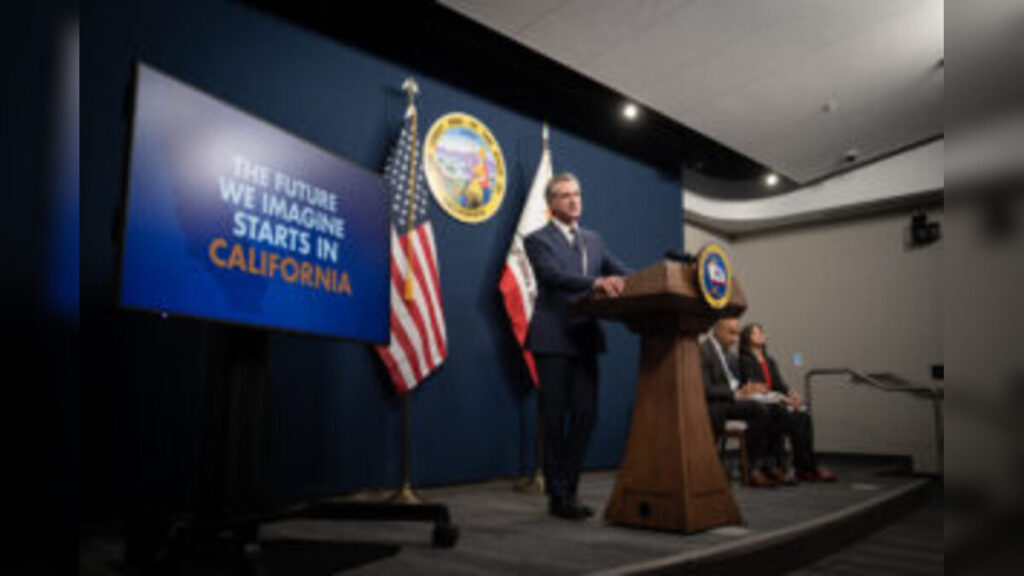
California Governor Gavin Newsom has introduced a revised 2026-27 state budget plan that his office says wipes out the state’s projected deficit through July 2028 while continuing funding for major public programs.
The proposal, released in Sacramento on May 14, 2026, presents a sharp fiscal message: no deficit in the current budget year, no deficit in the next budget year, and no structural deficit through July 2028.
Spending Cut Paired With Reserve Strategy
The revised plan includes a $1.8 billion reduction in General Fund spending. Newsom’s administration says the move is part of a broader effort to stabilize California’s finances over multiple years.
The budget also places $9.7 billion into the state’s Surplus Holding Account, a step meant to help future fiscal years and prevent the state from committing uncertain revenue too quickly.
Nearly $30 Billion in Reserves Maintained
Despite the spending reduction, the proposal keeps California’s combined reserves near $30 billion. According to the Governor’s office, reserves have grown by 30% since Newsom became governor.
The administration says the revised plan avoids major new ongoing General Fund commitments and instead focuses on fiscal restraint, budget stability, and preparation for future economic risks.
Core Services Remain Protected
Newsom argued that California can reduce spending while still protecting healthcare, education, and essential services.
The revised budget includes a $300 million healthcare affordability investment, which the Governor’s office linked to the failure to renew Affordable Care Act subsidies under President Trump.




Education and Schools Receive Major Funding
The proposal also includes a record $5 billion block grant for priorities such as teacher training and support.
Special education would receive a $2.4 billion ongoing increase, described by the Governor’s office as the largest special education investment in California history.
Another $500 million would go toward literacy and math support in high-need schools.
Small Businesses, Housing, and Disaster Recovery Included
The budget proposes a 50% tax cut for hundreds of thousands of new small businesses through reduced LLC fees.
It also includes a new $100 million disaster rebuilding fund aimed at helping wildfire survivors rebuild their homes.
Housing remains part of the plan, with proposed reforms intended to lower construction costs and increase affordable housing production.
Impact and Consequences
The revised budget gives Newsom a stronger fiscal argument at a time when California faces economic uncertainty and political pressure over spending.
If approved, the plan would reduce California’s short-term deficit concerns while preserving major investments in healthcare, schools, housing, disaster recovery, clean energy, public safety, and natural resources.
However, the proposal also signals a more cautious spending approach, with fewer new long-term commitments and a stronger emphasis on reserves.
What’s next?
The revised budget will now move through negotiations with state lawmakers before a final spending plan is adopted.
Key areas to watch include how legislators respond to the proposed spending reductions, reserve strategy, education funding, healthcare affordability measures, and housing reforms.
Summary
Governor Gavin Newsom’s revised 2026-27 California budget proposal eliminates the projected deficit through July 2028, reduces General Fund spending by $1.8 billion, maintains nearly $30 billion in reserves, and continues investments in major public services.
The plan combines fiscal restraint with targeted funding for healthcare, education, small businesses, housing, disaster recovery, and affordability programs.
Bulleted Takeaways
- Newsom’s revised budget projects a $0 deficit this year and next year.
- The plan eliminates California’s structural deficit through July 2028.
- General Fund spending would be reduced by $1.8 billion.
- California would place $9.7 billion into the Surplus Holding Account.
- The state would maintain nearly $30 billion in combined reserves.
- The proposal includes $300 million for healthcare affordability.
- Schools would receive major investments, including $5 billion for education priorities.
- Special education would receive a $2.4 billion ongoing increase.
- New small businesses would benefit from lower LLC fees.
- A $100 million disaster rebuilding fund would support wildfire survivors.
