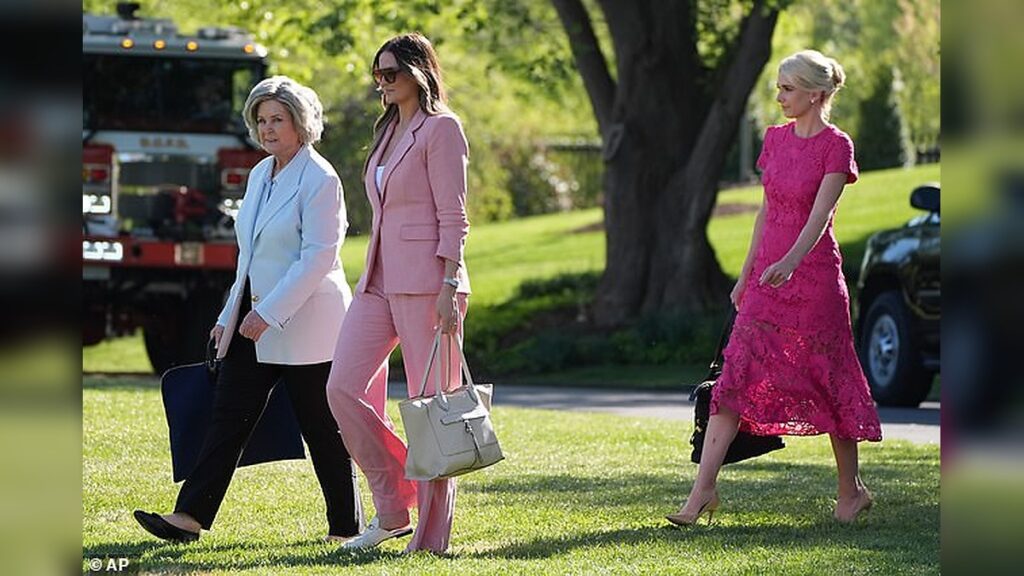
As Kamala Harris delivered a nationally televised speech during the Democratic National Convention in August 2024, a different political operation was unfolding away from the main cameras.
Natalie Harp, now one of Donald Trump’s closest executive aides, was reportedly working from a laptop and rapidly posting sharp social media messages in real time.
A Small Team Controls a Powerful Political Megaphone
Inside Trump’s second-term White House, his social media operation is described as one of the most important parts of his political strategy.
According to people familiar with the operation, only a small group has access to the accounts used to push the president’s message directly to supporters and critics.
That group is said to include Harp, longtime Trump aide Dan Scavino, and, at times, communications director Steven Cheung.
Harp’s Role as Trump’s Digital Messenger
Harp, who has worked with Trump since March 2022, is described as a constant presence around the president.
Sources say she often turns Trump’s dictated remarks into posts for Truth Social and X.
She has also earned the nickname “human printer” because of her habit of producing hard copies of articles, social media items, and favorable coverage for Trump to review quickly.
During the 2024 campaign, she reportedly carried printed materials in a bag and delivered them to Trump at high speed.
Scavino and Cheung Add Their Own Roles
Scavino, one of Trump’s longest-serving loyalists, is described as a major force behind the distribution of online material, including AI-generated videos and posts created by Trump supporters.
Cheung, meanwhile, is known for aggressive messaging and online attacks aimed at Trump’s political opponents.
Sources familiar with the operation say his role includes shaping the tone of broader communications and responding forcefully to critics.
Reports of Tension Inside the West Wing
Harp’s influence has reportedly created friction among some White House staffers.
Some reports have claimed she bypasses traditional internal review processes before posts go online, including the chief of staff’s office, communications staff, and national security officials.
A White House source denied that characterization, saying Harp simply follows the president’s instructions.


Trump’s Posting Style Remains Highly Personal
People close to Trump say the posts reflect his own voice, even when aides type or publish them.
One source described the process as direct: Trump dictates, and the aide posts. Others said he is highly particular about punctuation, capitalization, and presentation, even when it does not follow standard newsroom or grammar conventions.
The result, they say, is a style designed to sound unmistakably like Trump.
AI Images and Viral Posts Fuel Controversy
The second-term operation has leaned heavily into digital-first content, including AI-generated images and videos.
Posts have included Trump portrayed as the Pope, Jesus, and a monarch, along with other provocative images targeting political opponents.
Some content has triggered backlash, including an AI-style video that depicted Barack and Michelle Obama as monkeys. Sources cited in the report said Harp posted the video after Trump approved it, though one insider described the final version as poorly edited.
A Shift Away From First-Term Guardrails
Trump’s current social media strategy appears different from his first administration, when aides were reportedly expected to warn senior officials about potentially problematic posts.
In the second term, insiders describe a less filtered approach, based on the belief that Trump performs best when allowed to communicate in his own style.
That change has made his social media accounts a central weapon in his political messaging.
Behind-the-Scenes Content Becomes Part of the Strategy
Other members of Trump’s communications orbit have also shaped the administration’s online presence.
Margo Martin, a communications adviser, reportedly focuses on raw behind-the-scenes footage showing Trump in motorcades, travel settings, and daily White House activity.
The strategy favors direct and informal content over polished campaign-style videos.
Susie Wiles Steps Into the Digital Space
Chief of Staff Susie Wiles, often described as private and low-profile, has also entered the social media arena.
According to sources close to Wiles and Trump, she launched her own X account to highlight the administration’s work, though she reportedly does not weigh in on Trump’s posts.
Impact and Consequences
Trump’s social media structure gives him a direct, fast-moving channel to dominate political conversation without relying on traditional media filters.
The approach can energize supporters, pressure opponents, and rapidly amplify campaign messages. However, it also increases the risk of backlash when provocative, misleading, or offensive content is posted with little review.
The central role of a small team also means a handful of aides can heavily influence how presidential messaging reaches millions of people.
What’s next?
As the midterm elections approach, Trump’s team is expected to continue using Truth Social, X, AI-generated content, rapid endorsements, and attacks on rivals as core political tools.
The administration’s digital strategy will likely remain aggressive, personality-driven, and designed to keep Trump at the center of public debate.
Summary
Trump’s second-term social media operation is reportedly run by a tight inner circle led by Natalie Harp, Dan Scavino, and occasionally Steven Cheung.
The team turns Trump’s dictated remarks, political instincts, AI visuals, and rapid-response messaging into posts that shape national conversation.
While the strategy has boosted Trump’s online presence and strengthened his direct connection with supporters, it has also created controversy and internal concerns over limited review.
Bulleted Takeaways
- Natalie Harp, Dan Scavino, and Steven Cheung are described as central to Trump’s social media operation.
- Harp reportedly turns Trump’s dictated comments into posts.
- She is known as the “human printer” for quickly providing Trump with printed articles and online material.
- Scavino helps distribute posts and AI-generated content.
- Cheung contributes aggressive messaging against Trump’s critics.
- Some reports claim Harp bypasses traditional White House review channels.
- White House sources deny she acts independently and say she follows Trump’s direction.
- Trump’s posts are described as highly personal and shaped by his preferred punctuation and style.
- AI-generated images and videos have become a major part of his digital strategy.
- The approach is expected to intensify ahead of the midterm elections.
