
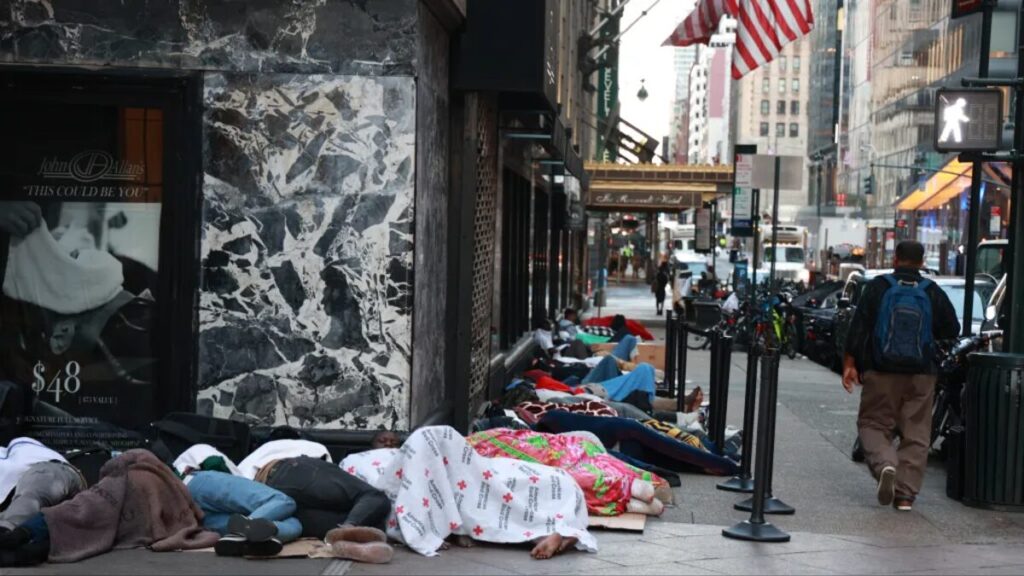
Last year, New York City reportedly spent a staggering $81,000 per homeless person on street services.
Meanwhile, the city’s homeless population grew by 26% during the same period.
The numbers have many scratching their heads: could all that money be better spent simply giving cash directly to those in need?
Critics suggest that funneling funds into street services may not address the root causes of homelessness, and some argue that direct financial support could be more effective in helping people secure stable housing.
LA Streets Tell a Different Story
Over on the West Coast, someone recently biked through Los Angeles and recorded a striking visual of the city’s ongoing crisis.
Overflowing trash bins, sprawling encampments, graffiti-covered walls, and abandoned cars painted a dystopian picture.
The video went viral, prompting widespread discussion about the contrast between official statistics and what residents actually see on the streets.
Progress on Paper, Chaos in Reality
According to the Los Angeles Homeless Services Authority, the city’s homeless population actually dropped 5% last year, with unsheltered cases down 13.5%. On paper, that’s good news.
But the streets still tell a different story.
The video captures the harsh reality: even small improvements in numbers don’t instantly translate to clean streets or safer neighborhoods.
The progress is measurable but slow, and the visuals make it clear how far the city still has to go.
Why the Numbers and the Reality Don’t Always Match
The difference between reported improvements and the day-to-day experience of citizens highlights a common challenge in tackling homelessness.




Funding may reduce some risks or move people into shelters temporarily, but systemic issues like affordable housing shortages, mental health support gaps, and drug addiction can make the streets look unchanged.
In LA and New York alike, the scale of resources invested doesn’t always equal visible results.
Impact and Consequences
High spending per individual without corresponding visible improvements can erode public trust and strain city budgets.
Citizens may feel that the streets are “out of control” despite official numbers suggesting progress.
For those experiencing homelessness, inconsistent services and limited access to long-term support perpetuate the cycle of instability.
What’s Next?
Cities like New York and Los Angeles are under pressure to rethink their approach.
Some experts advocate for more direct cash assistance or guaranteed housing programs rather than primarily funding outreach and temporary street services.
Others call for integrated strategies that combine shelter, healthcare, and employment support.
How cities balance spending, policy, and visible impact will shape the next phase of homelessness response in the U.S.
Summary
Despite massive spending and reported reductions in unsheltered populations, homelessness in major U.S. cities continues to present visible challenges.
New York City spent $81,000 per homeless person last year while seeing a 26% increase in population, and Los Angeles shows streets still overwhelmed by encampments and waste, even as numbers improve.
The gap between statistics and lived reality raises questions about the effectiveness of current strategies.
Bulleted Takeaways
-
New York City spent $81,000 per homeless person in street services last year while homelessness grew 26%.
-
Los Angeles saw a 5% drop in homeless population and a 13.5% decline in unsheltered cases, but streets still appear chaotic.
-
Viral videos from LA highlight a stark contrast between official stats and visual reality.
-
Experts suggest direct cash assistance or guaranteed housing might be more effective than high spending on street services alone.
-
Progress in homelessness is measurable but often slow and not immediately visible to the public.
-
The debate continues on how best to spend limited resources for long-term solutions.

