
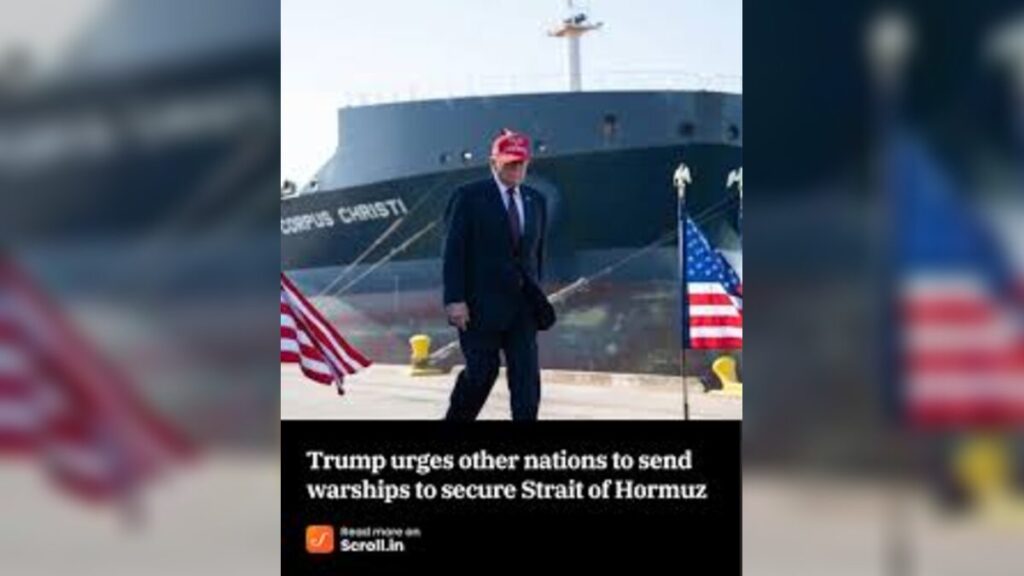
Fresh remarks from Donald Trump have intensified the already volatile situation in the Middle East.
In a statement shared on the social platform Truth Social, Trump said the United States and its allied partners would deploy naval forces to ensure that the vital shipping route known as the Strait of Hormuz remains open.
The narrow waterway has long been considered one of the most sensitive choke points in global trade.
A large portion of the world’s oil shipments move through it daily, making any threat to its security a major concern for international markets and governments alike.
Trump’s comments suggested an aggressive posture toward Iran’s naval presence, claiming U.S. forces would not hesitate to attack Iranian boats operating near the coastline if they posed a threat to maritime traffic.
Missile Strike Reported in Southern Israel
Meanwhile, the regional conflict escalated further as reports surfaced that an Iranian missile struck the southern Israeli city of Eilat during a new wave of attacks.
According to initial reports, the strike left two people injured.
While the injuries were described as non-fatal, the incident highlights how the conflict between Iran and Israel continues to spill into different fronts.
Eilat, a popular tourist destination and strategic port on the Red Sea, has occasionally been targeted during periods of heightened regional tensions because of its proximity to regional shipping routes and military infrastructure.
Why the Strait of Hormuz Matters So Much
The Strait of Hormuz is only about 21 miles wide at its narrowest point, yet it serves as the primary gateway for oil exports from Gulf countries such as Saudi Arabia, United Arab Emirates, Kuwait, and Iraq.
Analysts estimate that roughly a fifth of the world’s oil supply passes through this corridor every day.
Because of this, even small disruptions—such as attacks on tankers or naval confrontations—can quickly send global energy prices soaring.
Iran has previously warned that it could block the strait during times of conflict or sanctions pressure, a move that would have enormous economic consequences worldwide.
A Long History of Naval Confrontations
Naval tensions in the Persian Gulf are not new. Over the years, U.S. forces and Iranian Revolutionary Guard naval units have repeatedly clashed in the region.




The risk of confrontation grew especially high after the 2020 killing of Qasem Soleimani, a senior Iranian general whose death significantly escalated tensions between Washington and Tehran.
Iran has often used fast attack boats and drones in the region, while the U.S. typically relies on aircraft carriers, destroyers, and allied naval patrols to maintain freedom of navigation.
Impact and Consequences
If the United States and its allies move forward with deploying additional warships to the Gulf, several consequences could follow:
-
Higher global oil prices due to fears of disruption in the Strait of Hormuz.
-
Increased risk of naval clashes between U.S. forces and Iranian vessels.
-
Expansion of the Israel-Iran conflict into broader regional warfare.
-
Heightened military readiness across the Middle East, including Gulf states.
Even limited skirmishes in the region can have outsized economic and geopolitical ripple effects.
What’s Next?
Military analysts believe several scenarios could unfold in the coming weeks.
First, the United States and its partners may organize naval patrols or convoys to escort oil tankers through the strait.
Second, Iran could respond by increasing its naval presence or conducting military exercises near the waterway.
At the same time, diplomatic pressure may rise from global powers—including European and Asian nations that rely heavily on Gulf oil—to prevent the situation from spiraling into a broader war.
Meanwhile, Israel’s military is likely to remain on high alert after the reported missile strike on Eilat, anticipating further attacks or retaliation.
Summary
The situation in the Middle East appears to be entering another tense phase.
Trump’s statements about protecting the Strait of Hormuz with military force come at the same time as renewed missile attacks connected to the Iran-Israel conflict.
With critical energy routes at stake and regional cities already experiencing strikes, the coming days could prove crucial in determining whether tensions cool down—or escalate into something far larger.
Key Takeaways
-
Donald Trump said the U.S. and allied navies will move to keep the Strait of Hormuz open.
-
He warned that U.S. forces would attack Iranian boats threatening maritime traffic.
-
A reported Iranian missile strike hit Eilat, injuring two people.
-
The Strait of Hormuz carries roughly 20% of the world’s oil supply, making it a critical global chokepoint.
-
Rising tensions between Iran and Israel could expand into wider regional conflict.

