
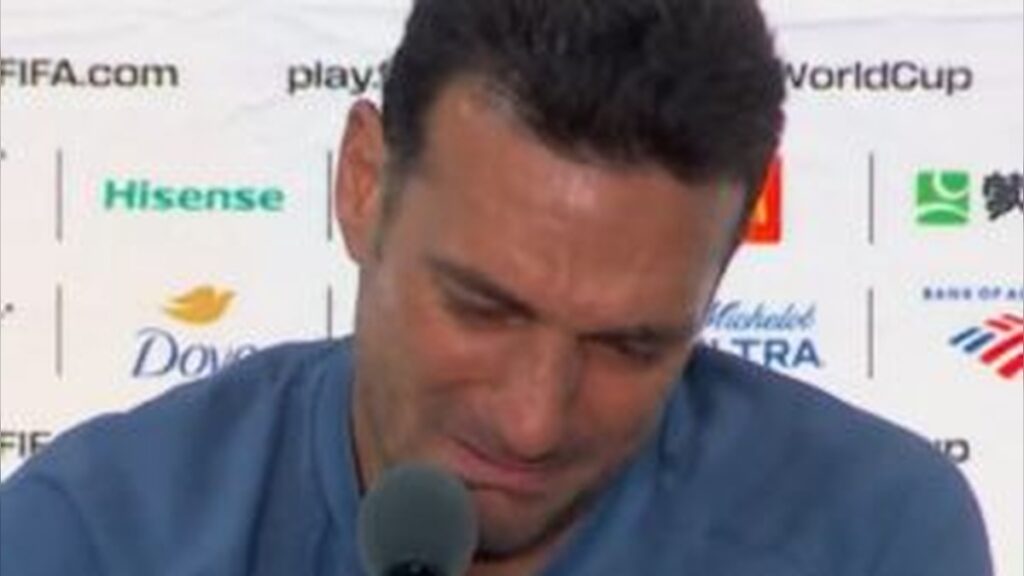
Argentina manager Lionel Scaloni struggled to contain his emotions after his side’s World Cup final defeat to Spain, cutting short his post-match press conference as the disappointment of the loss became overwhelming.
The 48-year-old appeared visibly emotional while reflecting on Argentina’s campaign before leaving the room in tears, adding further uncertainty over his future as national team coach.
Spain Ends Argentina’s Title Defence
Argentina entered the final hoping to successfully defend the World Cup they won in Qatar in 2022, a feat achieved only once before in the tournament’s history by a head coach.
Instead, Spain emerged victorious after Ferran Torres scored the decisive extra-time goal, securing a 2-1 win and delivering the country’s second World Cup title.
The triumph also completed an extraordinary run for Luis de la Fuente’s side, who added the World Cup to their recent European Championship success.
Scaloni Reflects on a Remarkable Journey
During his post-match media appearance, Scaloni described managing Argentina as the fulfilment of a lifelong dream.
He praised both his coaching staff and players for giving everything throughout the tournament, saying they had fought until the very end despite falling short in the final.
As he spoke, the emotional weight of the occasion became increasingly evident before he eventually admitted the defeat had deeply affected him and ended the press conference early.
Future as Argentina Coach Remains Unclear
Scaloni’s contract with the Argentine Football Association has only a few months remaining, and his comments suggested he is carefully considering what comes next.



He revealed that he intends to hold discussions with federation president Claudio Tapia before making any decision about his future.
Although he indicated he would honour the remainder of his current agreement, the coach acknowledged that recreating the special group of players who delivered major international success would be an enormous challenge.
Argentina Players Draw Criticism After Final Whistle
The emotional scenes involving Scaloni were followed by criticism of Argentina’s players after the medal ceremony.
Rather than remaining on the pitch to watch Spain lift the World Cup trophy, many members of the Argentine squad and coaching staff turned their attention toward their own supporters, spending time applauding fans behind one of the goals after collecting their runners-up medals.
Their decision not to witness Spain’s celebrations drew attention, as it has traditionally been common for losing finalists to remain on the field during the trophy presentation.
Tempers Flare After Dramatic Finish
Emotions boiled over once the final whistle sounded, with several confrontations breaking out between players from both teams.
Spain’s substitutes and staff rushed onto the pitch to celebrate the victory, leading to a series of heated exchanges involving members of the Argentine squad.
The tensions came after an already fiery contest that saw Argentina reduced to ten men when Enzo Fernández was sent off early in extra time following a dangerous challenge.
Red Cards Compound Argentina’s Frustration
The disciplinary problems did not end there.
Following the conclusion of the match, midfielder Leandro Paredes was shown a red card after becoming involved in an altercation with Spanish players, while Nahuel Molina and Thiago Almada were also caught up in the post-match clashes.
The incidents capped a frustrating evening for Argentina, whose hopes of retaining the World Cup ended in disappointment after a dramatic and ill-tempered final.
End of an Era Could Be Approaching
With his contract nearing its conclusion and emotions still running high, questions are already being asked about whether Scaloni has overseen his final match as Argentina manager.
Having guided the nation to World Cup glory in 2022 and established one of the country’s most successful international teams in recent history, his next decision could mark the beginning of a new chapter for Argentine football following a painful defeat on the sport’s biggest stage.

