
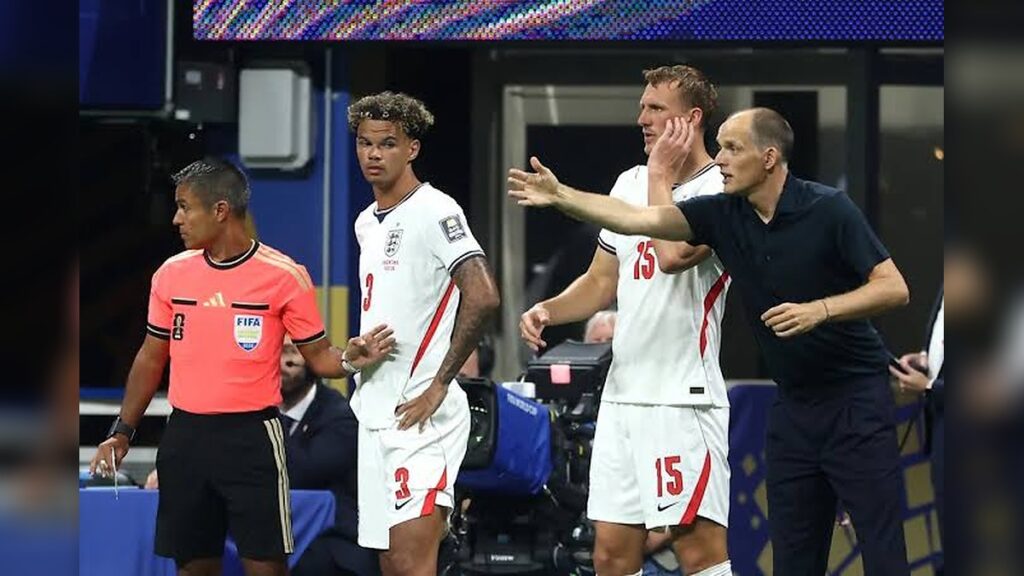
England manager Thomas Tuchel has come under renewed criticism following the Three Lions’ elimination from the 2026 FIFA World Cup, with former Premier League midfielder Jamie O’Hara accusing him of misleading supporters about the reasons behind the team’s semi-final defeat.
Although England bounced back to secure third place by defeating France, the fallout from their loss to Argentina continues to dominate the conversation.
Semi-Final Defeat Sparks Tactical Debate
England’s hopes of reaching a first World Cup final since 1966 ended when defending champions Argentina staged a late comeback to win Wednesday’s semi-final.
The Three Lions had taken the lead, but Tuchel’s tactical decisions became the focus of intense scrutiny after he introduced three defenders in an apparent attempt to protect the advantage.
Critics argued that the defensive approach allowed Argentina to dominate possession and create the openings that ultimately turned the match in their favour, sending Lionel Messi and his teammates into another World Cup final.
Tuchel’s Comments Trigger Strong Reactions
In the aftermath of the defeat, Tuchel suggested that England’s footballing identity and development culture played a role in the team’s inability to see out the victory.
His comments, particularly those relating to England’s football “DNA,” quickly generated debate, with many believing the manager underestimated the quality of English players emerging through modern academy systems.
The remarks have since become one of the most discussed aspects of England’s World Cup campaign.




Jamie O’Hara Rejects Manager’s Assessment
Former footballer and broadcaster Jamie O’Hara was among Tuchel’s most vocal critics, dismissing the England manager’s explanation during an appearance on talkSPORT.
O’Hara argued that English academies now produce some of the world’s most sought-after young footballers, pointing to players such as Jude Bellingham as evidence that England possesses both the technical ability and depth of talent required to compete with football’s elite nations.
He insisted that clubs across Europe are increasingly recruiting English players because of the strength of the country’s development system, making Tuchel’s assessment difficult to accept.
Third-Place Victory Raises More Questions
England responded to their semi-final disappointment by producing an entertaining 6-4 victory over France in the third-place play-off.
Bukayo Saka, who did not feature in the defeat to Argentina, delivered one of the standout performances as England attacked with greater freedom and confidence.
The display prompted further criticism from those who believed the team had been too cautious in the semi-final, suggesting England’s attacking quality had been unnecessarily restricted during the tournament’s biggest match.
O’Hara Accuses Tuchel of Misleading Supporters
Reflecting on England’s performances, O’Hara argued that the third-place victory only reinforced his frustrations with Tuchel’s tactical choices.
He claimed the players appeared liberated once the pressure had eased, leading him to question why the same attacking approach had not been adopted against Argentina.
The former midfielder went even further by accusing Tuchel of failing to be truthful with England supporters, saying the manager’s explanation for the semi-final defeat did not accurately reflect the quality available within the national team.
Attention Turns to England’s Future
Despite recording England’s best World Cup finish since the country’s historic triumph in 1966, the debate surrounding Tuchel’s leadership is unlikely to disappear anytime soon.
While a third-place finish represents a positive achievement on paper, questions over tactical decisions, player selection and post-match explanations continue to divide opinion as England begin looking ahead to the next chapter of their international journey.

