
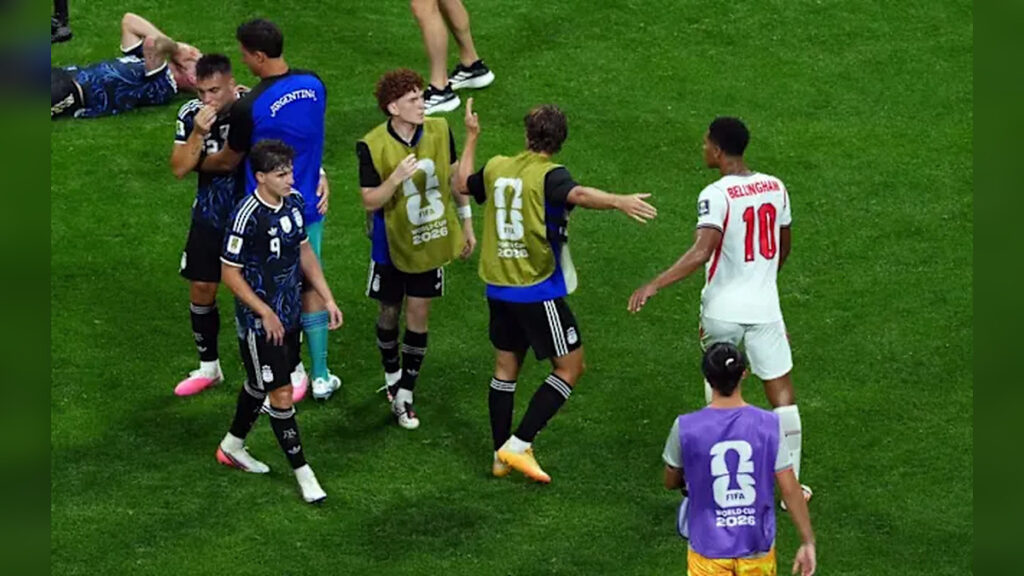
England’s heartbreaking World Cup semi-final loss to Argentina ended in heated confrontations as emotions spilled onto the pitch following the reigning champions’ dramatic comeback victory.
At the center of the post-match incident was Jude Bellingham, who became involved in an altercation with Argentina substitute Valentín Barco after the final whistle.
The clash followed Argentina’s 2-1 win in Atlanta, where England surrendered a late 1-0 advantage as Enzo Fernández equalized before Lautaro Martínez struck the decisive goal in stoppage time.
Barco’s Celebration Added to Rising Tensions
New footage has shed light on what may have sparked Bellingham’s angry reaction.
After Fernández scored Argentina’s equalizer, Barco—who did not feature in the match—ran from the bench onto the pitch and celebrated directly in front of England’s players.
The prolonged celebration frustrated England’s squad, with defender John Stones appearing to push Barco away as players waited for play to resume.
Reports also suggested the Chelsea-bound full-back had spent much of the match provoking England’s substitutes from the sidelines, creating further hostility throughout the contest.
Final Whistle Brings Flashpoint
The tension carried over into the closing moments after the referee blew for full time.
Tottenham defender Cristian Romero appeared to exchange words with Bellingham before Barco became involved once again.
Video footage shows Barco embracing teammates before turning and seemingly making another remark. Moments later, Bellingham reacted by striking the back of Barco’s head with what appeared to be a slap.
Barco immediately turned and shoved the England midfielder, prompting Nicolas Otamendi to intervene with a push of his own.
Several Argentine players attempted to separate those involved, but Bellingham and Otamendi continued exchanging words even after teammates stepped in to calm the situation.
Political Banner Overshadows Argentina’s Celebration
The controversy extended beyond the confrontation between players.
During their celebrations, several Argentina players displayed a banner reading, “The Malvinas (Falklands) are ours,” reviving one of the most politically sensitive territorial disputes between Argentina and the United Kingdom.




Romero, Lisandro Martínez and Giovani Lo Celso were seen posing with the banner, while captain Lionel Messi celebrated nearby.
The display has generated criticism because FIFA regulations prohibit political messages and symbols during official competitions.
Calls have since emerged for FIFA to investigate the incident and determine whether disciplinary action is warranted against the players involved.
Falklands Dispute Returns to the Spotlight
The banner references Argentina’s claim over the Falkland Islands, known in Argentina as the Malvinas, a dispute that remains a longstanding point of diplomatic tension.
The issue is particularly sensitive in Britain due to the 1982 Falklands War, during which 907 people lost their lives, including 255 British service personnel.
In a 2013 referendum, an overwhelming majority of Falkland Islanders voted to remain a British Overseas Territory.
Argentina’s national team previously displayed a similar banner more than a decade ago, resulting in a financial penalty, though many observers now argue stronger sanctions should be considered given the global audience for the World Cup semi-final.
England’s Collapse Under Intense Scrutiny
The post-match controversy compounded England’s disappointment after they failed to protect their lead in the closing stages.
Anthony Gordon had given Thomas Tuchel’s side the advantage before a series of defensive substitutions coincided with Argentina taking control of the match.
Fernández equalized with five minutes remaining before Lautaro Martínez completed the comeback in stoppage time.
The defeat has intensified criticism of Tuchel’s tactical approach, with some supporters and pundits questioning his late-game decisions after England missed the opportunity to reach their first World Cup final since 1966.
Tuchel Defends His Tactical Decisions
Despite the criticism, Tuchel insisted he had no regrets over his substitutions, arguing England became increasingly passive rather than suffering from tactical flaws.
The England manager said his team struggled to regain possession after taking the lead and allowed Argentina to build sustained attacking pressure through repeated crosses and shots.
According to Tuchel, the system remained unchanged, but England gradually lost control as the match progressed.
Players Reflect on Painful Exit
Captain Harry Kane admitted the squad was devastated by the result, saying England performed well for most of the match before retreating too deep after going ahead.
He acknowledged that Argentina’s relentless pressure eventually overwhelmed England’s defense and said the team must identify the final element needed to succeed in the closing stages of major tournaments.
Defender Dan Burn echoed those sentiments, describing the defeat as deeply painful.
He said England had executed their game plan effectively for much of the contest but ultimately invited too much pressure after taking the lead, allowing Argentina to capitalize on the opportunities created.
What’s Next?
Attention now shifts to FIFA, which faces mounting pressure to review both the post-match confrontation involving Bellingham and the display of the politically charged Falklands banner during Argentina’s celebrations.
Meanwhile, England’s focus will turn to evaluating another painful exit from a major tournament, with scrutiny expected to remain on Tuchel’s tactical choices as the Football Association assesses the team’s path forward after falling just one victory short of the World Cup final.
