
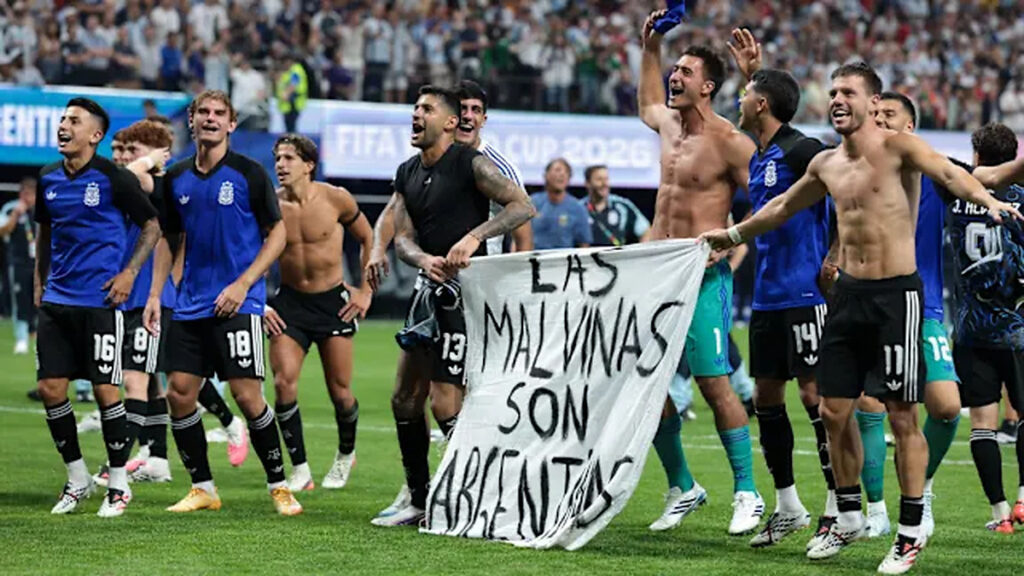
A growing political controversy has overshadowed Argentina’s dramatic World Cup semi-final victory over England after several players celebrated with a banner asserting Argentina’s claim to the Falkland Islands, prompting calls for FIFA to impose disciplinary action ahead of the tournament final.
The incident unfolded moments after Argentina secured a dramatic 2-1 comeback victory over England in Atlanta, with footage showing players silencing supporters before unveiling the politically charged message.
Celebration Sparks Immediate Backlash
New videos recorded from inside the stadium captured a group of Argentina players raising their fingers to their lips in a gesture directed toward England supporters before lifting a banner bearing the slogan “Las Malvinas son Argentinas” — the Argentine claim that the Falkland Islands belong to Argentina.
Several prominent members of the squad, including captain Lionel Messi, Tottenham defender Cristian Romero, Manchester United centre-back Lisandro Martinez and midfielder Giovani Lo Celso, were seen celebrating around the banner following the final whistle.
Lo Celso later placed the banner on the pitch while teammates continued their celebrations as jubilant Argentina supporters waved similar messages from the stands.
Pressure Mounts on FIFA to Take Action
The display has intensified scrutiny of FIFA’s regulations prohibiting political messages during official competitions.
Football’s governing body had reportedly prohibited Falklands-related banners inside the stadium because of their political nature, raising questions over whether the post-match celebrations breached tournament rules.
Although FIFA had not issued an immediate response, critics argued the governing body should consider sanctions, with some demanding suspensions that would rule involved players out of the World Cup final against Spain.
The controversy has also renewed attention on a similar incident in 2014, when Argentina’s football federation received a relatively modest financial penalty after players displayed an almost identical banner before an international friendly.
British Politicians Condemn the Display
Senior British political figures reacted strongly to the celebrations, describing the banner as inappropriate and calling for disciplinary measures.
Reform UK leader Nigel Farage criticized the players’ conduct while urging greater investment in Britain’s naval capabilities.
Shadow minister Andrew Griffith argued the banner violated FIFA regulations, comparing the situation with previous disciplinary cases involving other national teams.
He questioned why Argentina’s players should avoid punishment if football authorities had previously sanctioned players for political or symbolic displays.
Business and Trade Secretary Peter Kyle also condemned the celebration, saying England’s conduct contrasted sharply with Argentina’s actions after the match.
Scottish Conservative MSP Murdo Fraser likewise insisted the Falkland Islands remain British territory and rejected Argentina’s territorial claim.



Political Tensions Extended Beyond the Pitch
The dispute had been escalating even before kick-off.
Argentina’s vice-president, Victoria Villarruel, described England as “usurping pirates” in social media posts before the semi-final and declared that the Falklands belonged to Argentina after the victory, writing that supporters carried the islands “in their blood and their hearts.”
Foreign Minister Pablo Quirno had also questioned the legitimacy of the Falkland Islanders’ referendum supporting continued British sovereignty.
The political rhetoric reflected long-standing diplomatic disagreements that resurfaced throughout the World Cup.
Historical Dispute Remains Unresolved
The Falkland Islands have remained under British administration since the 19th century, although Argentina continues to maintain its sovereignty claim over the South Atlantic territory.
The dispute led to the 1982 Falklands War after Argentine forces invaded the islands.
British troops subsequently retook the territory during a conflict that claimed the lives of 907 people, including 255 British servicemen.
In a 2013 referendum, 99.8 percent of Falkland Islanders voted to remain a British Overseas Territory, a result Britain cites as reflecting the wishes of the islands’ population.
England’s Collapse Adds to Disappointment
The political controversy compounded an already painful evening for England, whose hopes of reaching a first World Cup final since 1966 were shattered in dramatic fashion.
Thomas Tuchel’s side led 1-0 through Anthony Gordon and appeared on course for victory before Argentina mounted a late comeback.
Enzo Fernandez equalized with only minutes remaining before Lautaro Martinez scored the decisive winner in stoppage time, completing a remarkable turnaround.
Attention quickly turned to Tuchel’s tactical changes after he replaced attacking players with defensive options while protecting England’s narrow advantage.
Tuchel Defends His Decisions
Following the defeat, Tuchel rejected suggestions that his substitutions were responsible for England’s elimination.
The England manager insisted he had “no regrets,” arguing that criticism is inevitable after a defeat and maintaining that his decisions were made to help the team secure victory.
He acknowledged that England retreated too deeply after conceding the equalizer but said the side also struggled to regain possession during Argentina’s late surge.
Fans Report Heated Atmosphere
The atmosphere following the final whistle remained tense both inside and outside the stadium.
Some England supporters described confrontations with celebrating Argentina fans, alleging provocative behavior that heightened emotions after the dramatic finish.
Witnesses expressed concern that tensions could continue beyond the stadium as supporters dispersed following one of the tournament’s most emotionally charged matches.
What’s Next?
FIFA is expected to review the celebrations to determine whether Argentina’s players violated regulations governing political messaging at World Cup matches.
Any disciplinary decision will attract global attention given the importance of Sunday’s final against Spain, while England begins another period of reflection after suffering a heartbreaking semi-final exit despite leading until the closing minutes.
Summary
Argentina’s 2-1 World Cup semi-final victory over England has become the subject of major controversy after players celebrated with a Falklands banner despite FIFA’s restrictions on political displays.
British politicians have condemned the gesture and demanded sanctions, while England’s late collapse has intensified criticism of manager Thomas Tuchel following another agonizing World Cup exit.
