
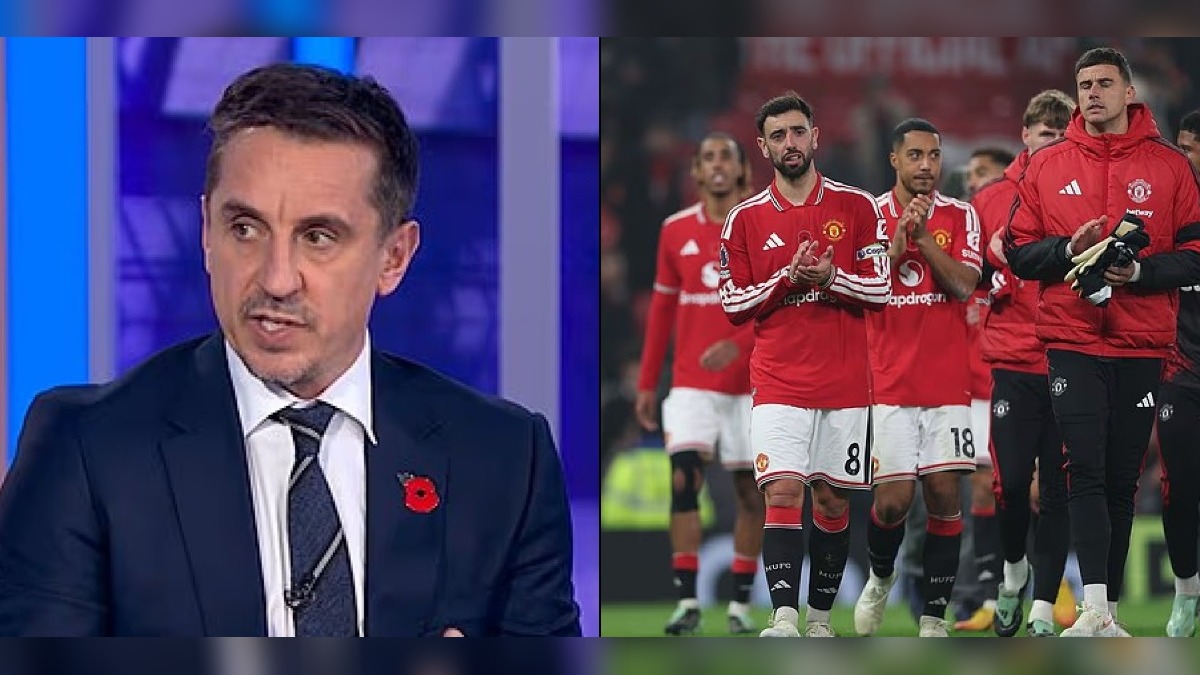
Former Manchester United captain Gary Neville has criticised the club’s players for continuing their post-match walks around Old Trafford following disappointing results, warning that the routine could be causing them further emotional distress.
United fought back from a two-goal deficit against Aston Villa to secure a dramatic 4-4 draw at Old Trafford.
However, the result did little to ease the pressure on the club, which will remain in the Premier League relegation zone for the next two weeks.
It is the longest period Manchester United have spent in the relegation places since 1986.
Following the final whistle, the players walked around the pitch to acknowledge supporters, who responded by chanting the name of manager Michael Carrick.
Neville, speaking on NBC Sports, acknowledged the team’s determination but questioned the decision to continue the post-match tradition after another disappointing result.
“You have got to admire their persistence, they kept going,” he said, while also describing United’s defensive mistakes as shocking.
However, he took particular issue with the players’ repeated walks around the stadium after failing to secure victories.
“I played for Manchester United 602 times and I always appreciated the fans at the end of the game, but this pattern of them walking around the pitch after defeats by Bournemouth and a 4-4 at home against Aston Villa, it’s almost painful to watch.
They’re almost causing themselves emotional damage,” Neville said.
He added that although Carrick would appreciate the supporters’ backing, the situation surrounding the club remained deeply troubling.
“Michael will be proud of them and the fans are singing his name because they love him but this is a really sorry situation,” he said.
Carrick Rules Out Walking Away From United
Carrick also faced questions about his future during a tense post-match interview with Sky Sports reporter Patrick Davison.
The exchange began when Davison suggested that the manager could consider stepping aside if he believed it was the best decision for the club.
Asked whether he expected to remain in charge over the coming weeks, Carrick firmly rejected the possibility of walking away.
“It’s not going to happen, no,” he responded.
When Davison suggested that discussions about his position would probably take place, Carrick questioned the assumption before insisting that his immediate priority was improving the team’s results.

“We understand the situation; we haven’t won enough games.
But I expect to move forward and keep working on things we’ve been working on, showing a lot of the good in the game today, tighten up on a few mistakes and win football matches,” he said.
United Manager Remains Confident About Turning Things Around
Speaking later at his post-match press conference, Carrick expressed confidence that Manchester United still had enough quality to improve their position this season.
Asked whether he believed the team could recover, he answered emphatically.
“One hundred per cent,” Carrick said.
He acknowledged that the team’s defensive shortcomings needed significant improvement, particularly because mistakes had continued to affect their performances.
“Goals change games and we’ve got to deal with it and it’s something we have to improve on drastically.
But there’s more than enough, we’re just making it too difficult for ourselves at the moment in certain times,” he added.
Carrick also maintained that he understood the direction the club needed to take, stressing that securing victories remained the immediate priority.
“I’m quite clear with what direction the club needs to go in. We’ve just got to win games,” he said.
Neville Questions United’s Leadership and Ownership
Neville also turned his criticism towards Manchester United’s hierarchy, suggesting that the club’s leadership had no clear plan for handling Carrick’s situation.
His comments came amid protests by supporters on Sunday against the club’s ownership, particularly INEOS and the Glazer family.
According to Neville, repeatedly changing managers would not resolve the underlying problems at Old Trafford.
“You can keep changing the manager and thinking that’s going to be the answer.
But this has been proven now over eight managers in 12 years – that’s not the answer,” he said.
He added that Carrick’s future remained uncertain, while questioning whether the club’s owners had a clear understanding of how to proceed.
“Michael could leave, Michael might stay, we don’t know.
The ownership don’t have a clue what to do,” Neville said.
Eight Managers Have Failed to Deliver Lasting Change
Neville highlighted Manchester United’s history of managerial changes since Sir Alex Ferguson’s departure, arguing that the repeated appointments had failed to address the club’s deeper organisational problems.
He listed Ruben Amorim, Erik ten Hag, Ole Gunnar Solskjaer, Michael Carrick, Jose Mourinho, Louis van Gaal, David Moyes and Ralf Rangnick among the eight managers involved in the club’s recent managerial history.
The former defender noted that several of those appointments involved highly regarded managers with proven records of success, while others were promising young coaches or former United players familiar with the club.
He argued that their inability to deliver sustained success pointed towards wider problems involving recruitment, performance management and leadership.
“None of it has worked because if you recruit badly, if you’ve got a poor performance department, a poor recruitment department, you’ve not got leadership that is strong right through the spine of the football club, you will fail,” he said.
Neville further stressed that successful organisations required a coordinated leadership structure, from ownership and the boardroom to the people directly involved in operations.
“Every organisation in the world will fail if you’ve not got an aligned leadership from top to bottom – your board and your ownership right the way through to the person who is stood on the pitch trying to play football,” he added.
He concluded by questioning the experience of some senior figures currently occupying important positions within the club, insisting that Manchester United continued to face significant internal challenges.
