
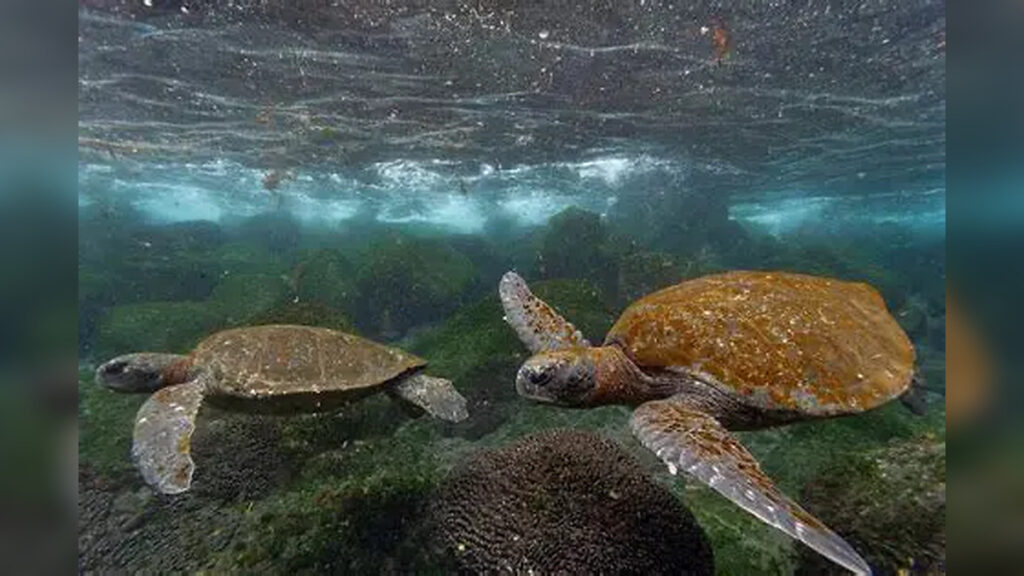
Green sea turtles living around the Galapagos Islands may be considerably less adventurous than scientists once believed.
New tracking research suggests that some members of the population remain in the same local waters for years, rarely travelling beyond their preferred island habitats.
The findings challenge the traditional picture of green sea turtles as highly migratory animals and highlight the importance of protecting not only individual feeding areas but also the marine routes connecting different islands.
Scientists Investigate a Distinctive Turtle Population
The research examined green sea turtles, scientifically known as Chelonia mydas, which include two genetically distinct forms in the eastern Pacific.
The so-called “black” form is associated with the eastern Pacific, while the “yellow” form is found farther west.
The Galapagos Islands are particularly significant because both forms occur in the same environment and depend on many of the same resources.
That unusual overlap makes the archipelago an important natural setting for studying how different turtle populations move and use their surroundings.
Satellite Tags Reveal Limited Movement
Researchers led by Professor John R. Royce of Alma College fitted nine adult yellow-form turtles with electronic tracking devices.
The group consisted of seven males and two females.
The tags transmitted location information through the Argos satellite system, allowing researchers to monitor the animals for periods of up to 418 days.
Instead of showing constant long-distance movement, the tracking data revealed a strong preference for relatively shallow coastal waters.
Five Turtles Barely Left Their Island Areas
Five of the nine tracked turtles remained close to a single island throughout the monitoring period.
Other individuals did move between islands, travelling around Isabela, San Cristobal and Española.
These movements were most common during the cooler months, from April through October.
Across the tracked population, the average home range was approximately 1,498 square kilometres.
The most striking observation was that none of the nine turtles crossed beyond the boundaries of the Galapagos Marine Reserve while they were being monitored.




Staying Close to Home Could Create New Conservation Risks
The turtles’ limited movements could make them particularly dependent on the health of specific marine environments.
Although remaining close to established feeding grounds may provide advantages, turtles that repeatedly rely on the same areas can also become vulnerable if those habitats deteriorate.
Biologist Andrey Voroshilov has pointed to another potential concern: protecting individual feeding grounds may not be enough.
Turtles travelling between islands also depend on the open-water corridors connecting those locations.
Damage or disruption along those routes could therefore affect animals even when their principal feeding areas remain protected.
One Year of Tracking Cannot Tell the Whole Story
Despite the significance of the findings, researchers caution that the monitoring period provides only a snapshot of the turtles’ lives.
The tags followed the animals for a maximum of just over a year, meaning longer journeys could have occurred outside the observation window.
This is particularly important because females belonging to the yellow form are not known to nest on Galapagos beaches.
Scientists therefore expect that they must eventually make much longer journeys back toward their birthplaces in the western Pacific.
No such trans-Pacific movement was detected during the tracking period, but its absence does not prove that these migrations never occur.
Researchers Still Need to Solve the Migration Puzzle
The study raises a broader question about when and why these turtles undertake long-distance journeys.
For much of the monitored period, the animals behaved more like permanent residents of the Galapagos Marine Reserve than ocean-going migrants.
Understanding whether this pattern continues throughout their lives will require tracking turtles for longer periods and across different stages of their reproductive cycle.
Future research could help establish how often the turtles leave the reserve, what triggers major migrations and whether migration patterns differ between males and females.
The Galapagos Remains Crucial to Their Survival
The findings reinforce the importance of maintaining broad marine protection around the Galapagos Islands.
If a substantial portion of the yellow-form population spends most of its time inside the reserve, the condition of its coastal habitats could have a direct impact on the animals’ survival.
At the same time, scientists must account for the possibility of occasional long-distance journeys when designing conservation strategies.
What’s Next?
Researchers are expected to focus on collecting longer-term movement data to determine whether the apparent “homebody” behaviour continues beyond a single year.
Longer tracking could reveal whether the turtles eventually undertake journeys to distant nesting grounds and identify the environmental or biological factors that prompt them to leave the Galapagos.
Such information could help conservation authorities protect not only the islands’ coastal feeding habitats but also the wider marine corridors used by the turtles.
Summary
New tracking research suggests that yellow-form green sea turtles in the Galapagos are far less migratory than previously assumed.
Five of nine tracked adults stayed near a single island, while the others moved between Isabela, San Cristobal and Española.
Their average home range was about 1,498 square kilometres, and none travelled outside the Galapagos Marine Reserve during the monitoring period.
However, the study covered only a limited period and cannot determine whether these turtles eventually make much longer journeys to distant nesting areas.
Further research will be needed to understand the full migration cycle and ensure that conservation efforts protect every part of their habitat.

