
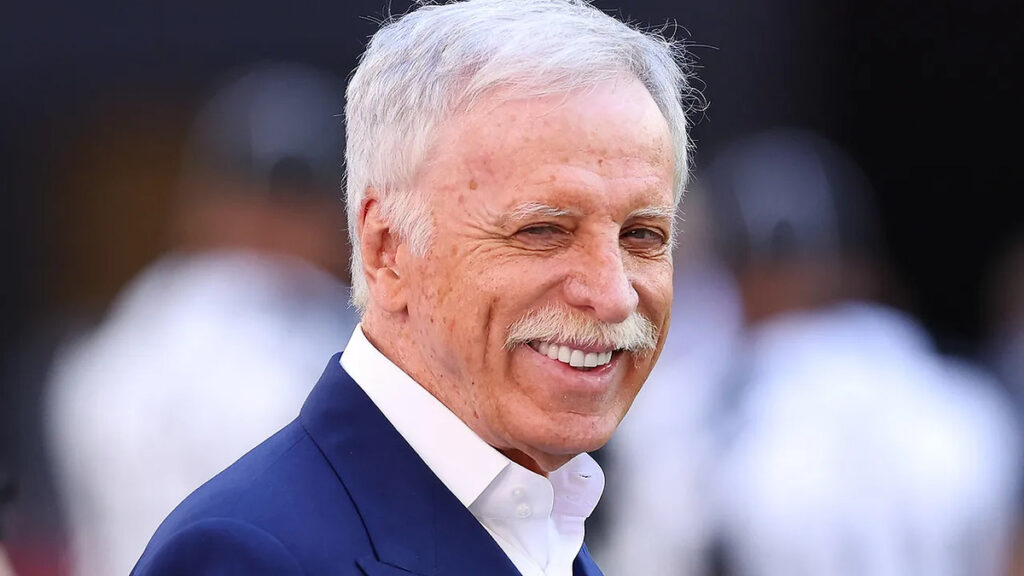
Billionaire Stan Kroenke is expanding an already enormous business empire after agreeing to purchase Major League Baseball’s Los Angeles Angels from Arte Moreno.
The deal, announced Tuesday, is expected to be completed during the first quarter of 2027.
Once finalized, it will give Kroenke controlling interests in the Angels, Los Angeles Rams, Denver Nuggets, Colorado Avalanche and Arsenal Football Club.
The latest acquisition further strengthens Kroenke’s position among the most powerful sports owners in the world while adding another major American franchise to his growing collection.
A New Chapter for the Angels
Kroenke described the Angels as a historic franchise operating in an important sports market and said his organisation was looking forward to building its future.
“The Angels are a storied franchise anchored in a great market,” Kroenke said in a statement issued by the Angels and Kroenke Sports & Entertainment.
“We look forward to an exciting future with the Angels organization.”
The transaction will add MLB to a portfolio that already spans several of the biggest professional sports leagues in North America and European football.
Kroenke’s Sports Empire Keeps Growing
Kroenke is already the owner of a vast collection of high-profile sporting properties.
His holdings include the NFL’s Los Angeles Rams, the NBA’s Denver Nuggets, the NHL’s Colorado Avalanche and English Premier League side Arsenal.
His addition of the Angels means he will have significant control across football, basketball, hockey, baseball and soccer.
The breadth of the portfolio has helped make Kroenke Sports & Entertainment one of the most valuable sports empires in the world.
The Angels acquisition therefore represents more than another individual investment.
It adds another major professional sports franchise to an organisation that has spent years building a diversified sports empire.
The Billionaire Who Also Owns Vast Tracts of America
Away from stadiums and sporting competitions, Kroenke has another remarkable distinction.
The Colorado real-estate billionaire was ranked America’s largest private landowner in the 2025 Land Report, with approximately 2.7 million acres under his ownership.
That amount of land is enormous by almost any comparison.
It is roughly equivalent to two million football fields and exceeds the total area of Yosemite National Park.
Kroenke’s rise to the top of the landownership rankings reflects years of aggressive investment in ranches and other large properties across the United States.
A Huge Ranch Purchase Changed the Rankings
Kroenke climbed to the No. 1 position on the landowner list after making a massive acquisition of ranchland.
In December, he purchased approximately 937,000 acres from the Singleton family, whose business interests include Teledyne Technologies.
The transaction was described as the largest U.S. land purchase in more than a decade and significantly expanded Kroenke’s already extensive property portfolio.



The acquisition allowed him to overtake fellow billionaires John Malone and Ted Turner, who ranked second and third respectively.
How Walmart Helped Build Kroenke’s Fortune
Kroenke’s real-estate story is closely connected to Walmart, although not simply because he has been married to Walmart heiress Ann Walton Kroenke since 1974.
Before becoming one of America’s most prominent sports owners, Kroenke built his fortune through commercial real estate development.
He developed shopping centres across the United States, frequently using Walmart stores as major anchors for those properties.
The strategy helped establish the financial foundation that would later support his expansion into sports and large-scale land ownership.
Why Billionaires Are Buying Farmland
Kroenke’s enormous land holdings also reflect a broader trend among wealthy investors.
Farmland, ranchland and timberland have increasingly become attractive alternative assets for investors seeking to diversify their wealth.
Unlike stocks and other financial assets, land is a finite physical resource and can generate income through agricultural leases.
The appeal has become particularly strong among investors concerned about inflation and market volatility.
U.S. farmland averaged approximately $4,350 per acre in 2025, representing a 4.3 percent year-over-year increase, according to U.S. Department of Agriculture data.
Nearly 40 percent of American farmland is owned by landlords who lease the properties to farmers and agricultural operators.
Farmland Has Become a Trillion-Dollar Investment Market
Steve Bruere, president of agricultural real-estate firm Peoples Company, has described farmland as a roughly $4.3 trillion asset class.
He argues that investors looking for diversification and protection against inflation can find attractive characteristics in agricultural property.
Farmland can potentially appreciate while also producing rental income, making it different from assets that depend entirely on price increases to generate returns.
The finite supply of arable land, combined with population growth and long-term food demand, has also strengthened the investment case for farmland.
The 2008 Crisis Accelerated the Trend
The growing interest in farmland can be traced partly to the aftermath of the 2008 financial crisis.
The collapse of traditional financial markets encouraged wealthy investors to search for alternative investments that could diversify their portfolios and potentially protect their capital from inflation and market instability.
Farmland emerged as one of those alternatives, alongside other assets such as precious metals, private credit and other forms of real estate.
For investors, agricultural land offers the potential combination of capital appreciation and recurring rental income.
Farmers Face a Different Reality
The growing interest from wealthy investors, however, has created concerns about accessibility for working farmers.
Many farmers lack sufficient capital to purchase the land they operate and therefore depend on rental agreements to continue farming.
Erin Foster West of the National Young Farmers Coalition said wealthy buyers with substantial financial resources can make it considerably more difficult for farmers to compete for available land.
The challenge can be especially severe for young and beginning farmers attempting to purchase their first property or established farmers trying to expand their operations.
Rising Land Prices Add to the Pressure
The gap between the cost of buying farmland and the cost of renting it has become another important factor.
Average U.S. cropland rent rose to about $161 per acre, representing only a 0.6 percent annual increase, according to USDA data cited in the report.
While renting remains significantly more accessible than purchasing land outright, rising property values can make ownership increasingly difficult for farmers without substantial capital.
That creates an unusual situation in which the people working the land can struggle to compete with investors whose primary objective is long-term asset ownership.
What’s Next for Kroenke?
The Angels deal will give Kroenke another major franchise to manage once the transaction closes in early 2027.
At the same time, his expanding land portfolio demonstrates that his ambitions extend far beyond sports. His businesses now span professional teams, commercial real estate and millions of acres of American land.
The combination has made Kroenke one of the country’s most influential private landowners and sports investors.
Summary
Stan Kroenke is preparing to add the Los Angeles Angels to an extraordinary portfolio that already includes the Rams, Nuggets, Avalanche and Arsenal.
At the same time, his approximately 2.7 million acres of land make him America’s largest private landowner according to the 2025 Land Report.
His rise illustrates two powerful investment trends among the ultrawealthy: the consolidation of major sports franchises and the growing attraction of farmland as an alternative asset.
While investors see agricultural land as a potential hedge against inflation and market volatility, farmers warn that deep-pocketed buyers can make it increasingly difficult for working and beginning farmers to become landowners.

