
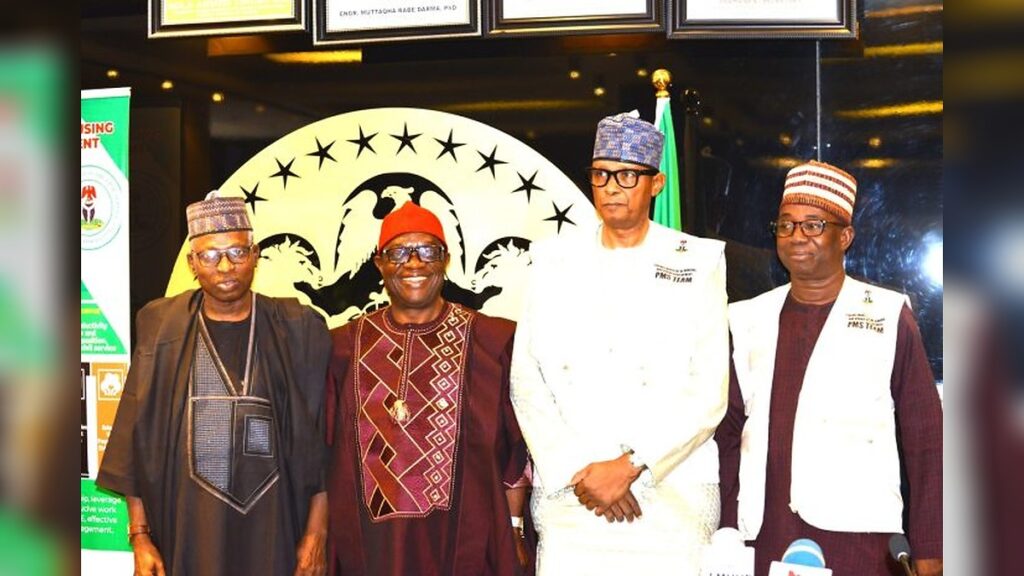
Nigeria’s Federal Government has restated its determination to convert informal settlements across the country into structured and habitable communities, positioning urban regeneration as a central pillar of its development agenda.
The Minister of Housing and Urban Development, Engr. Muttaqha Rabe Darma, PhD, emphasized that improving living conditions in slum communities remains a top priority of the current administration.
He made this known during a courtesy visit by the Nigeria Institute of Town Planners (NITP), led by its National President, Tpl. Dr. Ogbonna Chime, FNITP, who engaged the Ministry on key planning and development concerns.
Identifying Key Slum Upgrading Targets Across the Country
The Minister highlighted several densely populated informal settlements earmarked for transformation under upcoming urban development initiatives.
These include Makoko in Lagos State, Gishiri in the Federal Capital Territory, as well as selected communities in Kano and Port Harcourt.
According to him, the Ministry’s forthcoming urban development policy will focus heavily on upgrading such settlements, with the objective of improving infrastructure, housing quality, sanitation, and overall livability for residents currently living under substandard conditions.
Push to Reactivate and Implement the 1992 Planning Law
Engr. Darma also drew attention to the long-standing challenge surrounding the Regional and Urban Development Law enacted in 1992, which has yet to be fully implemented decades after its passage.
He disclosed that the Ministry is undertaking a comprehensive review of the legislation, while also exploring collaboration with relevant ministries to ensure effective execution.
He further called on professional bodies such as the NITP to contribute technical input that could help shape a workable implementation framework.
Strengthening Local Expertise in the Built Environment Sector
Reaffirming the administration’s preference for homegrown expertise, the Minister stressed that the government is deliberately prioritising the use of indigenous consultants in planning and development projects.
He explained that this approach is aimed at expanding employment opportunities, strengthening skills transfer, and building long-term capacity within Nigeria’s built environment sector.
Darma further revealed that approximately 2,000 young professionals have already been trained in various aspects of the built environment, with many now actively contributing to projects across the country.
AI, Innovation, and the Future of Planning Work
Addressing concerns raised about workforce gaps following retirements in the public sector, the Minister encouraged professionals to embrace technological advancement, particularly Artificial Intelligence (AI), as a tool shaping the future of planning and development work.
He noted that AI would not displace professionals who are technologically skilled, but rather enhance productivity and efficiency for those who adapt.




Continuous learning and upskilling, he said, will be essential for relevance in the evolving sector.
Funding Challenges and Calls for Innovative Solutions
On the issue of funding raised by stakeholders, Engr. Darma urged professional associations and regulatory bodies to adopt more innovative approaches to sustaining their operations.
He emphasized the need for creative financing strategies that ensure institutions remain functional and impactful without relying solely on government support.
He also invited the NITP to submit further technical recommendations to be considered in the Ministry’s upcoming strategic development framework.
NITP Reaffirms Partnership and Policy Support
Earlier in the engagement, NITP President Tpl. Dr. Ogbonna Chime welcomed the Minister to his role and expressed the Institute’s readiness to collaborate closely with the Ministry in achieving national urban development objectives.
He urged the government to fully implement the 1992 Urban and Regional Planning Law, describing it as essential for effective land use control, orderly development, and sustainable urban growth.
Dr. Chime also advocated for stronger engagement of indigenous town planning consultants, timely replacement of retired professionals in government service, and improved financial support for regulatory institutions within the sector.
He further extended an invitation to the Minister for the Institute’s 60th anniversary celebration and 57th International Conference scheduled for October in Lagos State.
Impact and Consequences
The renewed government focus on informal settlement upgrading could significantly reshape urban development planning across major Nigerian cities.
If implemented effectively, it may reduce overcrowding, improve sanitation, enhance housing quality, and strengthen infrastructure in long-neglected communities.
However, successful execution will depend heavily on funding availability, institutional coordination, and political will.
The emphasis on indigenous professionals could also boost employment within the built environment sector while reducing reliance on foreign consultants.
The push for AI adoption signals a broader shift toward digitization in urban planning, which may improve efficiency but also require substantial retraining of existing personnel.
What’s next?
The Ministry is expected to finalize and release its new urban development policy, which will define the roadmap for slum upgrading projects nationwide.
Stakeholders will also be submitting policy recommendations, particularly on the implementation of the 1992 planning law.
Further consultations with professional bodies like the NITP are likely, alongside planning for pilot interventions in identified informal settlements such as Makoko and Gishiri.
Attention will also turn to funding models and how both government and professional associations can sustain long-term urban development reforms.
Summary
The Federal Government has reaffirmed its commitment to transforming informal settlements into livable urban spaces through a new development policy.
Key priorities include upgrading slums, implementing long-delayed planning legislation, promoting indigenous expertise, and embracing technological innovation such as AI.
Stakeholders have also called for stronger funding mechanisms and improved institutional capacity.
Bulleted Takeaways
- Federal Government pledges transformation of informal settlements into livable communities
- Makoko (Lagos), Gishiri (Abuja), Kano, and Port Harcourt settlements targeted for upgrading
- Ministry reviewing long-stalled 1992 Urban and Regional Planning Law for implementation
- Policy shift prioritizes indigenous consultants to boost local capacity and employment
- About 2,000 youths already trained in built environment skills nationwide
- Officials urged to adopt AI and continuous learning for future workforce relevance
- NITP calls for stronger funding, professional inclusion, and law enforcement in urban planning
- New urban development policy expected to guide future slum upgrading projects across Nigeria
