
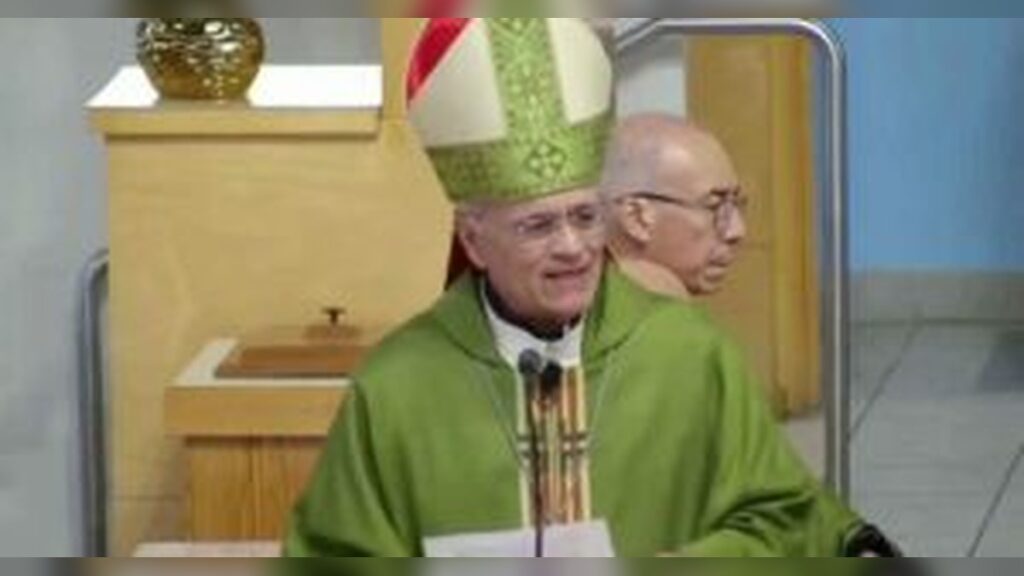
Exiled Nicaraguan Bishop Silvio Báez has delivered a pointed warning against authoritarian governments that invoke Christianity while using political power to control and silence their people.
Speaking during Mass at St. Agatha Parish in Miami on Aug. 30, Báez argued that governments that genuinely follow Jesus cannot ignore the meaning of the cross, humility and sacrifice.
His remarks appeared to echo his longstanding criticism of Nicaragua’s Ortega-Murillo government, although he did not explicitly name the administration during the homily.
‘Worn-out dictatorships’ misuse Jesus’ name
Báez said authoritarian regimes can misuse the name of Jesus when they present their political dominance as something sanctioned by God.
He argued that such governments place themselves ahead of Christ rather than following his example, turning religion into a tool for legitimizing their authority.
According to the bishop, dictatorships that claim Jesus while avoiding the message of the Crucifixion ultimately expose a contradiction between Christian teaching and the pursuit of permanent political control.
He stressed that anyone who wants to profess Jesus as the Messiah and Son of God must also be willing to follow the path of the cross.
His comments point toward Nicaragua
Although Báez did not identify a particular government, his history makes his remarks especially significant in the context of Nicaragua.
The government of President Daniel Ortega and Vice President Rosario Murillo has faced years of criticism over its treatment of political opponents and the Catholic Church.
Government-aligned media, including El 19 Digital, describes Nicaragua as a Christian, socialist and supportive society, while critics have accused the authorities of using religious language alongside increasingly authoritarian rule.
Báez remains a prominent critic of the regime
Báez has personal experience of the political conflict in Nicaragua.
He served as auxiliary bishop of Managua from 2009 and became an outspoken defender of protesters during the unrest that erupted in 2018.
More than 350 people were killed during the crackdown, according to the Inter-American Court of Human Rights.
The bishop left Nicaragua in April 2019 after Pope Francis requested that he depart because of serious concerns about his safety.
He subsequently established his life and ministry in Miami.
In August 2025, Pope Leo XIV confirmed Báez in his position as auxiliary bishop of Managua, allowing him to continue serving while remaining in exile.
Catholic Church has faced sustained pressure
Báez’s comments also come against the backdrop of a prolonged deterioration in relations between Nicaragua’s government and the Catholic Church.



Since the 2018 unrest, authorities have been accused of monitoring and restricting priests, expelling religious sisters, taking control of church assets and property, restricting ordinations and forcing bishops and other clergy into exile.
Among those affected was Bishop Carlos Enrique Herrera Gutiérrez of Jinotega, who had served as president of the Nicaraguan Bishops’ Conference before being expelled from the country in 2025.
Báez continues to celebrate Sunday Mass at St. Agatha Parish, where Nicaraguan priests Marcos Antonio Somarriba and Edwing Román, both also in exile, serve alongside him.
For Báez, the cross means more than suffering
Much of Báez’s homily focused on what Christians should understand by the phrase “taking up the cross.”
He rejected the idea that it simply means tolerating personal difficulties.
Instead, he described the cross as the cost of authentic love and a commitment to living according to Jesus’ example.
That commitment, he said, requires people to overcome their fear of loving others, accept vulnerability and stand beside people who are poor, marginalized or victimized.
Báez also said following the path of the cross can mean accepting painful consequences when confronting suffering and defending the dignity of people who are being mistreated.
He warns against silence in the face of power
The bishop connected his religious message to the realities of societies where powerful individuals can operate without accountability.
He argued that truth-tellers can be persecuted, people seeking justice can be marginalized and those who challenge powerful authorities can become targets of insults, slander and intimidation.
For Báez, remaining silent simply to avoid personal difficulties represents a failure to understand Jesus’ teaching.
‘Thinking like Peter’ can mean choosing comfort
The bishop used the example of the Apostle Peter to describe the temptation to reject sacrifice in favor of safety and convenience.
He said people can “think like Peter” when they refuse to accept that correcting injustice sometimes requires them to put themselves aside and make sacrifices for others.
That attitude can also appear when people decide it is better not to challenge abuses of power or become involved in struggles for a more just society.
Báez argued that problems cannot always be resolved through wealth, political influence or extraordinary intervention.
Instead, he said meaningful change requires humility, selflessness and a willingness to put God and other people before oneself.
A message shaped by exile
Báez’s latest comments carry particular weight because his own ministry has been shaped by confrontation with political power and forced exile.
His message in Miami was ultimately broader than a criticism of any single government.
He presented the cross as a test of whether individuals and societies genuinely embrace the Christian message they claim to represent.
For an exiled bishop who continues to speak about Nicaragua from outside the country, the distinction between using Jesus to defend power and following Jesus through sacrifice remains central to his public ministry.
What’s next?
Báez is expected to continue his pastoral work among Nicaraguan Catholics in exile while maintaining his role as auxiliary bishop of Managua.
Meanwhile, tensions between Nicaragua’s government and the Catholic Church remain a major concern for religious leaders and human rights advocates.
His latest homily suggests that Báez intends to continue addressing the relationship between faith, political authority, justice and persecution, particularly through the Christian concept of the cross.
Summary
Bishop Silvio Báez has condemned what he called “worn-out dictatorships” that invoke Jesus to legitimize political power while ignoring Christ’s example of humility, service and sacrifice.
While he did not explicitly name Nicaragua’s Ortega-Murillo government, his history as an exiled critic of the regime gives the comments clear relevance to his country’s political situation.
Báez used his Aug. 30 Mass in Miami to argue that authentic Christianity requires standing with victims, challenging injustice and accepting the personal cost of defending others.

