
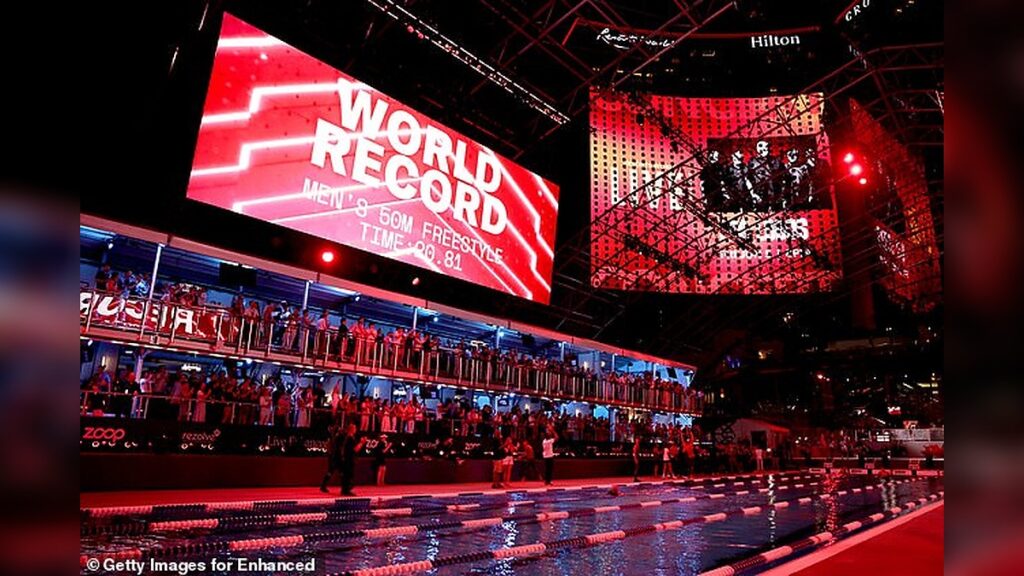
The long-awaited debut of the controversial Enhanced Games in Las Vegas was supposed to usher in a new era of sport — one where athletes openly used performance-enhancing drugs under medical supervision and shattered records that had stood for years.
Instead, the event ended with more questions than answers.
For months, organizers promoted the competition as a revolutionary alternative to traditional sports, arguing that modern science, hormone therapy, and controlled drug use could push the human body far beyond natural limits.
Huge promises were attached to the spectacle, including a staggering $1 million reward for anyone capable of breaking an official world record.
But when the dust settled inside Resorts World Las Vegas, only a single athlete managed to claim the cash.
Kristian Gkolomeev Becomes the Face of the Enhanced Games
Greek swimmer Kristian Gkolomeev delivered the defining moment of the tournament in the men’s 50-meter freestyle.
Using the event’s medically supervised enhancement program alongside a high-tech buoyant swimsuit that would normally be banned in standard competition, Gkolomeev powered through the water in 20.81 seconds.
That performance edged past the recognized world-record time of 20.88 seconds previously set by Cameron McEvoy.
The swim instantly earned him the Games’ headline-grabbing seven-figure prize and gave organizers the breakthrough moment they desperately wanted.
Still, the celebration was quickly overshadowed by what happened across the rest of the competition.
Most Enhanced Athletes Failed to Reach Historic Marks
Despite widespread use of testosterone, HGH, and other enhancement programs, nearly every other athlete fell short of rewriting the record books.
British swimmer Ben Proud came painfully close in the men’s 50m butterfly.
He touched the wall in 22.32 seconds, narrowly missing the official world record of 22.27 by just five hundredths of a second.
Another emotional moment came from American swimmer Cody Miller, who competed in front of his hometown crowd in Las Vegas. After reportedly undergoing an intense eight-week enhancement cycle involving testosterone and HGH, Miller posted a personal-best time of 26.55 seconds in the 50m breaststroke.
Even with the improved physique and training support, he still remained far from the official world-record mark of 25.95 seconds.
That pattern repeated itself throughout the event: improved performances, yes — but very few truly historic ones.
Drug-Free Athletes Quietly Stole the Spotlight
Perhaps the biggest embarrassment for the organizers came from athletes who refused to participate in the enhancement protocols entirely.
American swimmer Hunter Armstrong delivered one of the weekend’s most talked-about upsets in the men’s 50m backstroke.
Armstrong chose to remain completely drug-free in order to protect his eligibility for the 2028 Summer Olympics.
Despite competing against rivals openly using performance enhancers, he dominated the field with a winning time of 24.21 seconds.
The result stunned spectators because Armstrong defeated multiple enhanced swimmers without relying on any banned substances himself.
Track events produced a similar outcome.
Former world champion Fred Kerley entered the men’s 100 meters as a self-described non-enhanced athlete.




Kerley ran 9.93 seconds in the heats before winning the final in 9.97 seconds.
In both races, he managed to beat enhanced competitors, including Emmanuel Matadi, who had access to the Games’ specialized medical programs.
Those victories immediately fueled criticism that elite natural athletes may still outperform chemically enhanced rivals when talent, preparation, and experience are already world class.
Strength Events Also Failed to Deliver
The disappointment extended beyond swimming and sprinting.
In the strength competitions, former World’s Strongest Man winner Mitchell Hooper and Icelandic strongman Thor Bjornsson both attempted to challenge the deadlift world record.
Neither man succeeded.
Bjornsson — widely recognized for his role in the TV series Game of Thrones — had previously established the benchmark record himself back in 2025.
Yet even inside a competition designed around enhanced performance, the mark survived untouched.
The women’s events also ended without a single world record being broken.
The Bigger Debate Around the Enhanced Games
The Enhanced Games were controversial long before the opening ceremony.
Supporters argued that doping already exists in elite sport and should be regulated openly instead of hidden underground.
Organizers claimed that medically monitored enhancement programs could be safer than secret abuse within traditional competitions.
Critics, however, viewed the concept as dangerous and unethical.
Bodies like the World Anti-Doping Agency have repeatedly warned that normalizing steroid and hormone use could create severe long-term health risks for athletes.
Medical experts have also pointed to possible complications involving heart disease, organ damage, hormonal disorders, and mental-health effects connected to prolonged PED use.
The event’s underwhelming results are likely to strengthen arguments from those who believe discipline, genetics, and training still matter more than pharmaceutical shortcuts.
Impact and Consequences
The outcome of the inaugural Enhanced Games could have significant consequences for the future of alternative sports competitions.
First, the event may struggle to maintain credibility after promising a wave of shattered records that largely never arrived.
Public expectations were extremely high, especially after months of bold marketing campaigns suggesting athletes would routinely surpass Olympic-level performances.
Second, the victories by unenhanced athletes may become the defining narrative of the Games.
For many viewers, seeing natural competitors outperform enhanced rivals weakened the central argument that PEDs automatically create superior athletes.
There could also be renewed pressure on global sports organizations to tighten anti-doping enforcement.
Traditional Olympic supporters may use the event as evidence that clean sport remains the gold standard.
At the same time, some investors and biohacking advocates may still see potential in the Enhanced Games model, especially from an entertainment and commercial standpoint.
What’s Next?
Organizers are expected to push forward with future editions of the Enhanced Games despite the mixed debut.
They will likely continue recruiting high-profile athletes, expanding enhancement programs, and increasing prize incentives to attract attention.
There may also be attempts to refine training methods and pharmaceutical protocols in hopes of producing more dramatic record-breaking performances.
Meanwhile, international sports authorities are expected to keep monitoring the movement closely.
The biggest question now is whether athletes and fans will fully embrace a competition built around open enhancement — or whether the Las Vegas event ultimately becomes remembered as an experiment that failed to live up to its revolutionary promises.
Summary
The inaugural Enhanced Games arrived in Las Vegas with enormous hype, massive prize money, and promises of superhuman athletic performances fueled by openly accepted doping.
Yet only one world record fell.
Greek swimmer Kristian Gkolomeev became the event’s lone million-dollar winner after breaking the men’s 50m freestyle record.
Elsewhere, enhanced athletes repeatedly fell short, while several drug-free competitors surprisingly dominated their events.
Rather than proving that performance-enhancing drugs guarantee athletic supremacy, the competition may have unintentionally reinforced the enduring value of natural talent, elite preparation, and traditional training.
Bulleted Takeaways
- The inaugural Enhanced Games took place in Las Vegas with open use of performance-enhancing drugs.
- Athletes were offered $1 million for breaking official world records.
- Kristian Gkolomeev was the only athlete to break a world record.
- Ben Proud narrowly missed a record in the 50m butterfly.
- Drug-free athletes like Hunter Armstrong and Fred Kerley defeated enhanced rivals.
- Strongmen Thor Bjornsson and Mitchell Hooper failed to break the deadlift world record.
- Critics argue the event exposed the limits of artificial enhancement in elite sport.
- The Games are expected to continue despite the controversial and underwhelming debut.

