
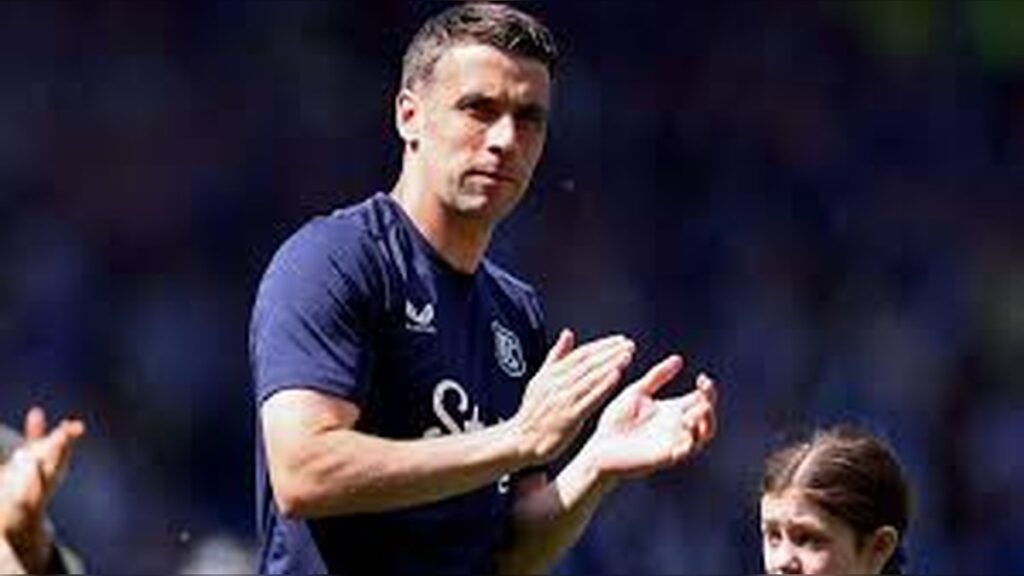
There’s a running joke Mick Doherty likes to repeat about Seamus Coleman: “He’s the only Irishman I know who doesn’t drink.”
It’s said with a grin, but it captures what so many at Everton have come to believe over the years—Coleman doesn’t quite fit the usual footballer stereotype. He never really has.
What makes it more striking is how unlikely his journey was.
From a small coastal town in Donegal to becoming one of Everton’s longest-serving captains, his story started with a £60,000 gamble that, in hindsight, looks almost ridiculous in its value.
A £60,000 gamble that changed Everton’s modern history
Back in 2009, Everton took a chance on a right-back from Sligo Rovers.
The fee—just £60,000—barely registers in today’s transfer market, but it turned out to be one of the smartest pieces of business the club has ever done.
David Moyes needed convincing at first. There was no guarantee the young Irish defender would make it at Premier League level.
But Mick Doherty, the scout who had spotted him, was firm enough to push it through with one simple argument: even if it didn’t work, Everton would get their money back.
They never did—because Coleman became worth far more than that.
The scout who saw something others missed
Doherty didn’t even set out to scout Coleman.
He was originally watching his own son play for Sligo Rovers when something else caught his attention: a tireless, unpolished right-back who just wouldn’t stop running.
That player was Coleman.
The more games Doherty attended, the more obvious it became.
Coleman wasn’t the finished article, but there was intelligence, aggression, and a relentless engine that couldn’t be coached into someone—it was already there.
By the time Doherty spoke to Moyes, the pitch was simple: take the kid, develop him, and see what happens.
From Sligo to the Premier League learning curve
The jump from League of Ireland football to Everton was massive.
Coleman arrived on modest wages and quickly discovered he was tactically behind many of his new teammates.
Physically and mentally, though, he surprised people. He didn’t shrink in the dressing room, even surrounded by established Premier League professionals.
He earned respect the hard way—by working.
Blackpool loan and the making of a Premier League defender
Moyes initially didn’t fully trust Coleman defensively, so he was used further up the pitch before being sent on loan to Blackpool under Ian Holloway.
That spell changed everything.



Blackpool were a tough, experienced group, but Coleman’s attitude stood out immediately. He wasn’t overawed.
He demanded intensity from teammates, regardless of reputation.
Holloway, never short of dramatic praise, once said he would trust Coleman with anything—because of his honesty, loyalty, and character.
It was also there that Coleman helped Blackpool earn promotion to the Premier League through the playoffs, a moment that signaled he was ready for the top level.
Building a partnership with Leighton Baines
When Coleman returned to Everton, he eventually formed one of the Premier League’s most balanced full-back partnerships with Leighton Baines.
One attacked, one balanced the structure. One provided crosses, the other covered space.
Together, they gave Everton stability during the Moyes era push for European football.
Baines later described Coleman as someone who quietly raised standards without needing attention.
Even when he didn’t speak much, people listened when he did.
Captaincy, managerial eras, and rare praise from Ancelotti
Over time, Coleman moved from promising full-back to club captain.
Different managers trusted him in different ways—Roberto Martínez, Ronald Koeman, Marco Silva, Carlo Ancelotti, and others all leaned on his influence.
Ancelotti went as far as comparing him to elite leadership figures in world football, highlighting him as the kind of player who represents a club beyond just performance.
Through ownership changes, managerial instability, and relegation battles, Coleman remained a constant.
The moments that defined his leadership
Coleman’s influence often showed up away from the highlight reels.
When James McCarthy suffered a horrific double leg injury, Coleman was the first person at his side.
He didn’t stop there—he found McCarthy’s family in the stands, helped guide them through the shock, and later visited him during recovery.
That wasn’t an isolated act. Teammates repeatedly describe him as the player who showed up in hospital rooms, funerals, training ground disputes, and moments when morale collapsed.
Even younger players felt it. When Alex Iwobi struggled under heavy criticism from fans, Coleman was the one who physically pulled him into focus after a strong tackle, shouting encouragement in front of everyone.
It wasn’t always gentle leadership—but it was consistent.
Impact and consequences
Coleman’s presence helped Everton hold onto an identity during one of the most unstable periods in their modern history.
While managers came and went and transfer strategies shifted wildly, he remained a cultural anchor.
His impact wasn’t just emotional. It shaped performance standards.
Players like Dominic Calvert-Lewin have openly credited him with keeping them grounded, while current leaders such as James Tarkowski still defer to his judgment in key moments.
The consequence of that kind of influence is simple: even when results dipped, Everton never fully lost its internal leadership core. Coleman became the bridge between eras.
What’s next?
As his playing career nears its final stages, Coleman has been offered pathways into coaching and club roles at Everton.
David Moyes has already suggested there will always be a place for him at Finch Farm.
But before anything off the pitch, he still wants one more run as a player—one last chapter before transitioning into life behind the scenes.
The club sees him as more than a squad member. They see him as structure.
Summary
Seamus Coleman’s Everton story isn’t just about a bargain transfer or longevity.
It’s about a player who grew into a symbol of the club’s identity during chaos, rebuilding, and constant change.
From Sligo Rovers to Goodison Park captaincy, his career has been defined less by headlines and more by influence.
Bulleted Takeaways
- Signed from Sligo Rovers in 2009 for just £60,000
- Discovered by scout Mick Doherty while watching his son play
- Developed significantly during a loan spell at Blackpool
- Formed key partnership with Leighton Baines at Everton
- Became club captain across multiple managerial eras
- Widely praised by managers including Carlo Ancelotti
- Known for strong leadership in crisis moments and off-pitch support
- Played key role in stabilising Everton’s dressing room culture
- Still viewed as a future coaching or club leadership figure
- Considered one of Everton’s most important modern-era players

