
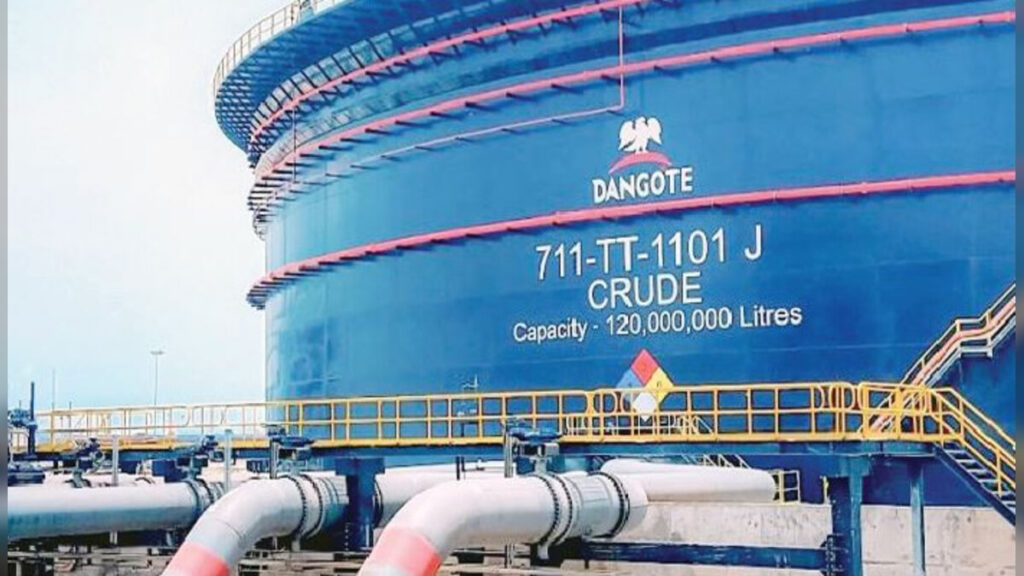
Nigeria’s downstream oil sector is witnessing a noticeable shift as the massive Lekki-based Dangote Refinery continues to ramp up production and push more refined products into global markets.
In April 2026 alone, the facility exported about 1.66 billion litres of petroleum products, a figure that underscores how quickly it is becoming a major player in international fuel supply chains.
What stands out is not just the volume, but the timing—global fuel markets have been unsettled, and alternative supply sources are in higher demand than usual.
Strong Output Driven by High Operational Efficiency
According to data from the Nigerian Midstream and Downstream Petroleum Regulatory Authority, the refinery maintained near-maximum output throughout April.
Utilisation reportedly stayed above 99%, reflecting steady crude supply and consistent plant performance.
The refinery processed and exported a mix of petrol, diesel, and aviation fuel.
While Nigeria’s domestic market absorbed a large portion of output, surplus volumes were redirected to international buyers seeking stable alternatives amid tightening global supply conditions.
Industry observers note that this level of sustained output is significant for a facility of such scale—often described as the world’s largest single-train refinery with a capacity of around 650,000 barrels per day.
Global Energy Tensions Boost Demand
One of the key backdrops to this surge is the ongoing uncertainty in global energy routes, particularly concerns around disruptions in the Strait of Hormuz, a critical passage for global oil shipments.
As tensions in parts of the Middle East escalate, buyers are increasingly turning to non-traditional suppliers.
This shift has created room for new exporters like Nigeria’s Dangote refinery to step into the global supply chain more aggressively.
Petrol exports rose sharply, while diesel shipments remained consistently strong.
Aviation fuel also recorded increased demand, driven by recovering global air travel and airline stockpiling strategies.




Domestic Supply Meets Export Ambitions
Even with rising exports, the refinery continued to meet significant domestic demand.
Petrol production in April exceeded local consumption needs, which made exports possible without creating shortages at home.
Crude supply to local refineries also improved during the month compared to earlier periods, helping sustain higher output levels across all product categories.
However, fuel prices inside Nigeria remained elevated.
Analysts attribute this to global crude price pressures, exchange rate dynamics, and the fact that domestic pricing is still influenced by international benchmarks.
Structural Shift in Nigeria’s Oil Economy
The performance of the Dangote refinery signals a deeper transformation in Nigeria’s petroleum landscape.
For decades, the country—despite being a top crude oil producer—relied heavily on imported refined products.
Now, with large-scale refining capacity coming online, Nigeria is gradually moving toward becoming a net exporter of refined fuels, particularly petrol and diesel.
Energy experts say this could reduce pressure on foreign exchange reserves, which were historically strained by fuel imports.
It may also improve energy security if production remains stable and logistics continue to scale efficiently.
Impact and Consequences
The refinery’s growing export footprint carries several important implications:
- Foreign exchange gains: Increased exports could boost dollar inflows into Nigeria’s economy.
- Reduced import dependence: Less reliance on imported refined fuel strengthens economic resilience.
- Regional energy influence: Nigeria could become a key fuel supplier in West and Central Africa.
- Price stability challenges: Domestic fuel prices may still fluctuate due to global crude volatility.
- Refining sector transformation: Local refining dominance is reshaping the downstream oil industry structure.
What’s Next?
Looking ahead, attention will likely focus on whether the refinery can maintain its near-full utilisation levels over a longer period.
Consistency in crude supply, logistics efficiency, and export infrastructure will be key.
There is also growing interest in how Nigeria manages the balance between domestic supply stability and export expansion.
If production continues to scale smoothly, more refined products could enter international markets, strengthening Nigeria’s position in global energy trade.
Expansion of pipeline connectivity, storage capacity, and distribution networks may also become a priority as output grows beyond domestic absorption levels.
Summary
The April 2026 performance of the Dangote refinery highlights a turning point for Nigeria’s downstream oil sector.
With record export volumes, high operational efficiency, and strong global demand, the facility is increasingly shaping both domestic fuel supply and international trade flows.
While challenges such as price volatility and supply chain stability remain, the broader trend suggests Nigeria is steadily transitioning from a fuel-import-dependent economy to one with growing export capability in refined petroleum products.
Bulleted Takeaways
- Dangote refinery exported about 1.66 billion litres of refined fuels in April 2026.
- Output was driven by over 99% operational utilisation.
- Products exported included petrol, diesel, and aviation fuel.
- Global demand rose due to Middle East supply concerns and Strait of Hormuz tensions.
- Nigeria is moving toward becoming a net exporter of refined petroleum products.
- Domestic fuel supply remained stable despite strong export activity.
- Fuel prices in Nigeria stayed high due to global crude and currency pressures.
- Export growth may boost foreign exchange earnings and energy security.

