
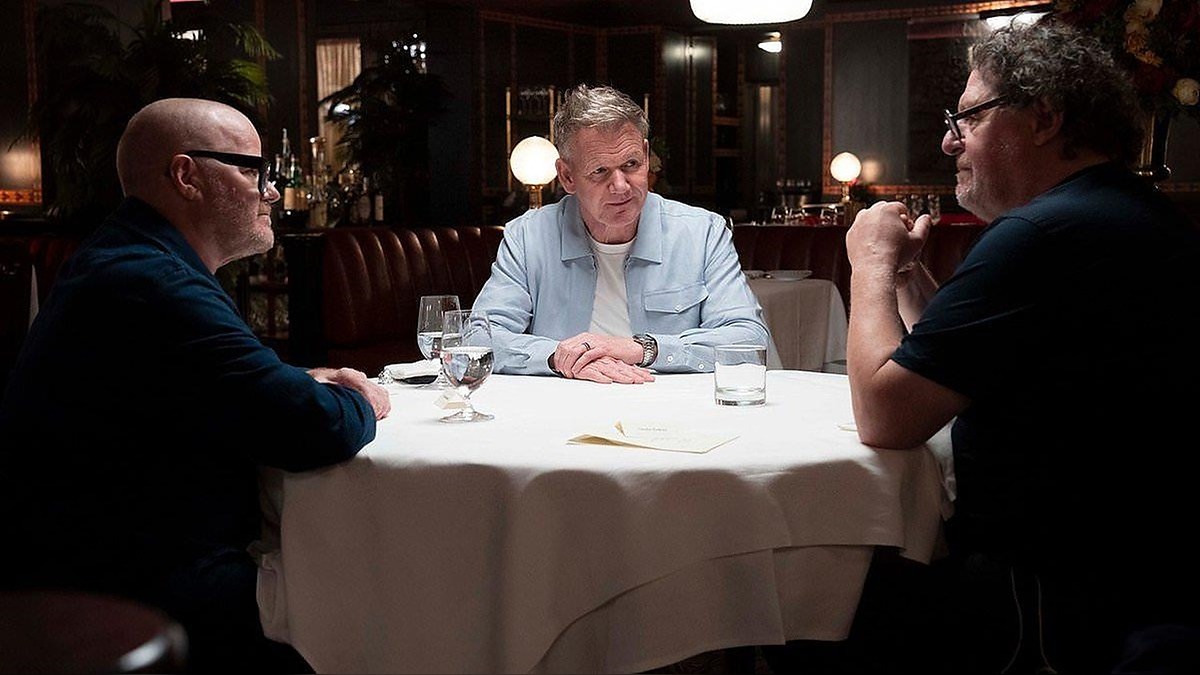
Gordon Ramsay, Marco Pierre White and Heston Blumenthal have come together for a rare reunion in a new BBC documentary exploring their careers, rivalries and influence on British cuisine.
The three celebrated chefs, whose combined achievements include 27 Michelin stars, sat down for a meal earlier this year after years of professional disagreements and personal animosity.
Their reunion forms the closing part of the three-episode series, The Rise Of The Rockstar Chef, which examines how they helped transform the British restaurant industry and turned chefs into household names.
The gathering was particularly notable because their previous meeting in a restaurant, at Heston’s Fat Duck in Bray, Berkshire, in 2003, ended in a heated confrontation between Ramsay and White.
Previous restaurant encounter ended in confrontation
During the 2003 incident, White and Ramsay had separately booked Sunday lunch at the Fat Duck, where Blumenthal was overseeing the kitchen.
Blumenthal attempted to keep the former colleagues apart, seating Ramsay and his wife Tana inside the restaurant while White and his guests were accommodated in the garden.
However, White became angry after discovering that Ramsay was also dining at the establishment.
He reportedly demanded that Blumenthal ask Ramsay to leave.
The situation escalated when Ramsay went into the garden and confronted White, beginning his remarks with an insult.
The two chefs subsequently avoided speaking to each other for years, with their disagreements occasionally resurfacing through interviews and public comments.
Documentary producers negotiated reunion for months
Amanda Westwood, executive producer of the BBC series, revealed that bringing the three chefs together required months of discussions, persuasion and negotiations.
The programme was produced by Ramsay’s production company, although the production team remained uncertain whether all three men would attend and how they would interact.
White was filmed travelling to the reunion and was asked whether he was looking forward to seeing his former colleagues.
He replied: “It’s always nice to see Heston,” without offering the same enthusiasm about Ramsay.
Westwood said the production team was nervous about the gathering because the chefs’ previous encounter had ended badly.
She explained that everyone involved understood the significance of the occasion and was uncertain whether the three men would arrive and remain together.
All three eventually attended, sharing lunch and preparing individual courses as part of the gathering.
Celebrity guests revisit the chefs’ turbulent history
The documentary also features interviews with several prominent figures from the culinary and entertainment industries.
Chefs Raymond Blanc, Angela Hartnett and Marcus Wareing contribute their recollections of the period when Ramsay, White and Blumenthal were reshaping Britain’s restaurant scene.
Actors Lenny Henry and Stanley Tucci also appear in the series, alongside other chefs, journalists and personalities who witnessed the development of the three culinary careers.
Westwood said several interviewees expressed interest in attending the reunion themselves after learning about the planned gathering.
Actor Nigel Havers also recounts an incident involving White’s former restaurant, Canteen, which he co-owned with actor Michael Caine.
Havers recalls being unexpectedly thrown out of the establishment, although he remains uncertain about what prompted his removal.
White was known for dismissing diners, sometimes over seemingly minor requests such as asking for salt.
On one occasion, he reportedly expelled 54 customers in a single night.




Havers said he was angry about his experience and recalled considering releasing mice in the restaurant in retaliation.
Marco Pierre White’s influence on Gordon Ramsay
The series traces the development of Britain’s celebrity-chef culture from the 1980s into the 1990s, when White emerged as one of the industry’s most influential figures.
Ramsay worked under White at Harvey’s, his Wandsworth restaurant, where White earned his first Michelin star.
Ramsay describes his former mentor as an intimidating figure, comparing him to a cult leader, the Pied Piper and a Mafia boss.
He also recalls the demanding environment in which White trained his kitchen staff, describing it as a place where young chefs had to survive the experience to establish themselves.
Ramsay said working under White was extremely difficult, adding that leaving the restaurant was sometimes the only way for chefs to escape the pressure.
He also recalled White’s unusual habit of entering the kitchen through a ceiling hatch rather than using the stairs when returning from the upstairs toilet.
Several young chefs reportedly left Harvey’s through a back alley when they could no longer cope with White’s management style.
Dispute over Gordon Ramsay’s departure from Harvey’s
Ramsay’s relationship with White deteriorated when he decided to leave Harvey’s and establish his own career.
The documentary examines their conflicting accounts of the confrontation that took place on Ramsay’s final day at the restaurant.
Both men recall a disagreement involving a red mullet dish, with White reportedly insisting that the fish had been overcooked by approximately 20 seconds.
Ramsay says he challenged White’s assessment, prompting his former boss to grab him by the collar and pin him against a coffee machine.
He recalls glass breaking during the altercation and the kitchen falling silent.
White denies that the incident happened as Ramsay described it.
However, Ramsay acknowledges that he cried during the confrontation, saying he was upset and shocked by the level of aggression.
He said he believed White knew he was capable of running the restaurant independently and wanted to undermine him before he moved on to another establishment.
Ramsay also admitted that he had never forgiven White for the incident.
Stolen booking diary intensified rivalry
The breakdown of their relationship was followed by several years of disputes, including a controversy involving a restaurant booking diary.
The diary allegedly disappeared from Ramsay’s restaurant, Aubergine, with suspicions surrounding whether White had taken it out of jealousy.
Another version of events suggested that Ramsay had staged the incident to damage his former mentor’s reputation.
The documentary does not establish what actually happened, but both chefs recall feeling betrayed by the other.
White said Ramsay had wronged him, while Ramsay expressed similar accusations against his former mentor.
By the middle of the 1990s, their professional relationship had turned into an open rivalry.
Heston Blumenthal developed his own culinary reputation
Blumenthal also trained under White before establishing himself as one of Britain’s most distinctive chefs through his experimental approach to cooking.
While Ramsay and White were engaged in their rivalry, Blumenthal developed the Fat Duck into an internationally recognised restaurant.
He recalls that the early days of the establishment were equally chaotic, although for different reasons.
Blumenthal revealed that he caused an oven explosion on the restaurant’s second day, setting his hair on fire.
He subsequently spent a service wearing a bag of frozen peas strapped to his head.
The Fat Duck eventually earned recognition as the world’s best restaurant, placing Blumenthal among the leading figures in international gastronomy.
Archive footage reveals softer side of Ramsay and White’s relationship
Despite their long-running disagreements, the documentary also includes moments that highlight the friendship that once existed between Ramsay and White.
One particularly emotional sequence shows White watching archive footage of himself and Ramsay fishing together.
White becomes quiet as he watches the recordings, describing the images of the two men together as beautiful.
He also says it is nice to hear Ramsay laughing and reflects on their 40-year association.
Ramsay offers his own interpretation of their fishing trips, suggesting that White had invited him because he wanted companionship and friendship.
Reunion brings three Michelin-starred careers together
Westwood said watching the three chefs interact during the reunion was moving, particularly because of their shared history and understanding of what each had achieved.
She described them as three individuals who could fully appreciate the challenges involved in reaching their respective levels of success.
Although they had been rivals, she said they also recognised and respected one another’s achievements.
The reunion provides the concluding moment of The Rise Of The Rockstar Chef, bringing together three chefs whose careers helped shape Britain’s modern restaurant industry.
