
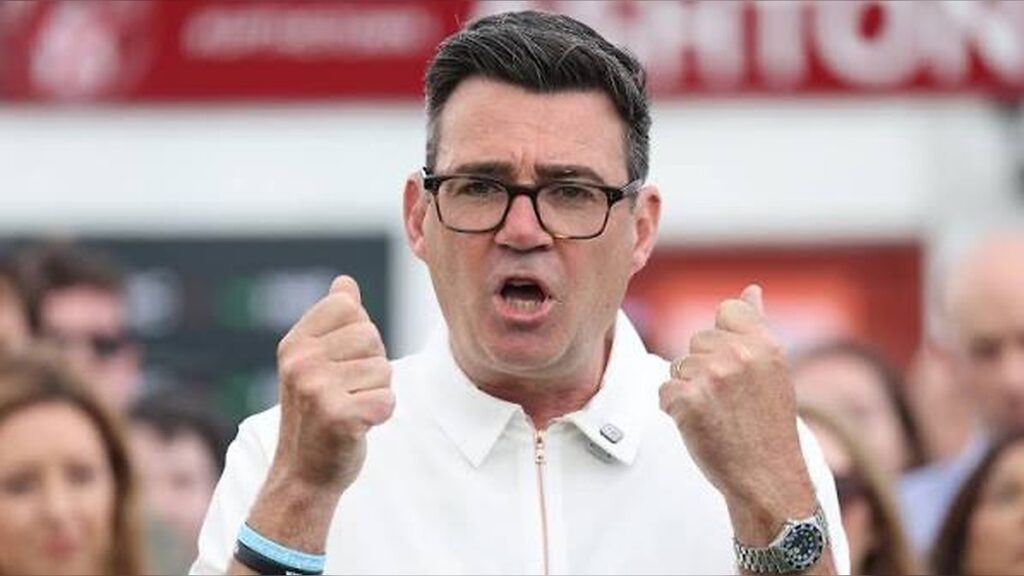
Andy Burnham is set to officially begin his leadership of the Labour Party today, using his first major address to argue that Britain must break away from the political and economic model that has shaped the country for the past four decades.
His speech marks the conclusion of a leadership process that saw overwhelming backing from Labour MPs and paves the way for him to replace Keir Starmer as prime minister on Monday.
Rather than focusing on continuity, Burnham is expected to present himself as the leader who will reshape the country’s future by challenging long-standing political assumptions.
Thatcher Era Set to Face Sharp Criticism
Central to Burnham’s message will be a direct attack on the legacy of Margaret Thatcher’s government.
He is expected to argue that Britain took a series of “wrong turns” during the 1980s, claiming that political authority became increasingly centralized while key parts of the economy were handed over to private ownership.
According to extracts from his planned remarks, Burnham believes reversing those trends will require a fundamentally different approach to governing.
He will argue that the country needs a new economic direction capable of delivering greater prosperity across every region of the UK.
Promise of a More Interventionist Labour Government
Burnham is expected to pledge that his administration will not shy away from ambitious reforms, promising a government prepared to tackle issues previous leaders have avoided.
He will describe Labour as being “unashamedly Labour” in both its priorities and decision-making.
Although he is not expected to unveil detailed policy announcements, his comments are likely to fuel speculation that his government could embrace greater public ownership and stronger state involvement in key sectors.
Limited Praise for Starmer as Leadership Changes Hands
While setting out a new vision, Burnham is also expected to acknowledge the achievements of outgoing leader Keir Starmer.
He will credit Starmer with returning Labour to power and highlight progress made on workers’ rights, improvements to the NHS and the passage of the Hillsborough Law.
Starmer will not attend today’s leadership event but has publicly insisted he believes Labour would have been capable of winning another general election under his leadership.


He has nevertheless said he is handing over the party in a strong position.
Leadership Victory Came With Overwhelming Support
Burnham’s rise to the top of Labour has been largely uncontested.
After returning to Parliament through a recent by-election, he secured nominations from 369 of Labour’s 403 MPs—far exceeding the threshold required to stand.
His campaign also attracted support from eight of Labour’s eleven affiliated trade unions, underlining the broad coalition behind his leadership despite the party’s recent struggles in national opinion polls.
Polling Challenges Await the New Leader
Burnham inherits a party facing mounting political pressure.
Labour has spent roughly a year and a half trailing Reform UK in many opinion surveys, raising concerns about its electoral standing.
Party figures hope that Burnham’s arrival will reinvigorate Labour’s appeal and improve its fortunes before the next general election, though questions remain about how significantly his leadership will differ from that of Starmer.
Cabinet Speculation Continues
One of the biggest unanswered questions surrounds Burnham’s senior ministerial appointments.
Earlier speculation that Ed Miliband could become Chancellor prompted concern among some businesses and trade union figures, although that possibility now appears less likely.
Attention has instead shifted toward Home Secretary Shabana Mahmood, who is increasingly viewed as a leading contender to take charge of the Treasury.
Devolution and Fiscal Discipline Expected to Remain Priorities
Burnham has consistently argued for shifting greater powers away from Westminster and into the hands of regional leaders.
His wider devolution plans include establishing a northern base for Downing Street in Manchester, an initiative he has previously described as creating a “No. 10 North.”
Economically, he has indicated that he intends to retain Rachel Reeves’ fiscal rules while honouring Labour’s commitments not to increase income tax, VAT or national insurance.
However, he has stopped short of ruling out the introduction of a wealth tax.
Early Pressure Building on Policy Decisions
Opposition parties are already pressing Burnham to move quickly once he enters Downing Street.
The Liberal Democrats have urged him to intervene in the water sector by placing Thames Water into special administration during his first weeks in office.
Meanwhile, Burnham has strengthened his political team by appointing Matthew McGregor, the chief executive of campaign group 38 Degrees and an experienced election strategist, as Director of Political Strategy in Number 10.
Public Image Campaign Continues Alongside Political Rollout
Despite preparing for one of the most significant moments of his political career, Burnham has continued to avoid direct questioning from journalists.
Instead, he has relied heavily on social media videos designed to introduce his personality to voters.
Recent clips have featured light-hearted conversations about how he drinks his tea, whether he wears socks with sandals, and his opinion that Yorkshire puddings should not be served with Christmas dinner, offering a more personal contrast to the serious political message expected in his leadership speech.

