
Nvidia chief executive Jensen Huang has pushed back against warnings that artificial intelligence could eventually threaten human civilisation, insisting that the technology remains under human control.
Speaking in an exclusive interview with Fortune journalists Jeremy Kahn and Bea Nolan, Huang dismissed concerns raised by prominent figures in the AI industry, including Anthropic CEO Dario Amodei, who has warned about the potential dangers associated with increasingly powerful AI systems.
Huang argued that those who genuinely believe AI development could lead to the end of civilisation should reconsider their involvement in advancing the technology.
“I don’t know why anybody would want to support the advancement of a technology that’s going to result, you know, in the end of human civilization as we know it. And so, if they believe that, they really ought to stop working on it,” he said.
His remarks highlight the growing disagreement among technology leaders over whether artificial intelligence poses an existential threat or can be developed safely under appropriate human oversight.
Huang Insists Artificial Intelligence Remains Under Human Control
Huang’s comments reflect his confidence that AI development does not inevitably lead to catastrophic consequences.
The Nvidia CEO has rejected the suggestion that the technology’s progress should be viewed primarily through the lens of existential risk. His position contrasts with warnings from some researchers and executives who argue that increasingly capable AI systems could eventually become difficult to control.
Amodei and other industry figures have raised concerns about the risks associated with advanced AI, including the possibility that systems could develop capabilities that outpace existing safeguards.
Huang’s response places the responsibility for addressing such dangers on those developing the technology. Rather than accepting predictions of an unavoidable catastrophe, he questioned why people who believe AI could destroy civilisation would continue contributing to its advancement.
The disagreement comes as Nvidia remains central to the expansion of AI infrastructure, supplying the chips used to train and operate many advanced AI systems.
AI Safety Debate Divides Technology Leaders
The dispute over AI’s long-term consequences has become an important issue across the technology sector.
Supporters of continued development argue that artificial intelligence could deliver major advances in scientific research, healthcare, productivity and other fields. They also maintain that risks can be reduced through engineering safeguards, testing and responsible oversight.
Critics of rapid development, however, warn that the capabilities of advanced systems may create challenges that existing safety measures cannot fully address. They argue that companies should take potential long-term consequences seriously rather than assuming human control will always be guaranteed.
Huang’s comments underline the divide between those who emphasise the technology’s potential benefits and those who urge greater caution over its possible effects on humanity.
His position does not settle the debate, but it reinforces the disagreement over how much confidence technology companies should place in their ability to manage increasingly powerful systems.




Global Markets Face Pressure Despite Positive Technology News
Huang’s remarks came amid a turbulent period for technology stocks, with investors selling shares across global markets despite several positive corporate developments.
South Korea’s technology-heavy KOSPI index fell 7.57% during the trading session described in the report, at one point triggering a temporary halt. Nasdaq futures also declined, while major technology companies and chipmakers recorded losses.
CoreWeave shares fell 15.46% before dropping further in overnight trading, while Oracle also recorded substantial declines. The selling extended across the semiconductor industry.
The downturn came despite strong quarterly results from Taiwan Semiconductor Manufacturing Company, which exceeded expectations and indicated that capital expenditure would increase over the following two years.
Apple also closed at a record valuation of $5 trillion, while Anthropic reportedly reached adjusted profitability, although its revenue growth was said to be slower than previously estimated.
The mixed signals left investors weighing the long-term prospects of the AI industry against concerns about valuations, economic conditions and the sustainability of technology spending.
Bond Market Volatility Adds to Investor Uncertainty
Financial market uncertainty also extended to US government bonds.
The yield on the benchmark 10-year Treasury reportedly climbed as high as 5.32% before falling back to 5.08%, reflecting significant movement in a market that investors often regard as a relatively stable part of the financial system.
Other market indicators were mixed. S&P 500 futures declined, European stocks traded unevenly, and Asian markets recorded contrasting performances. Brent crude traded at $106 per barrel, while Bitcoin fell to $81,265.
The volatility illustrated how concerns about the wider economy and technology valuations were influencing investor behaviour, even as some major companies continued to report positive results.
European Optimism Challenges the Negative Headlines
Away from the AI debate and market turbulence, research highlighted a more positive outlook among European consumers.
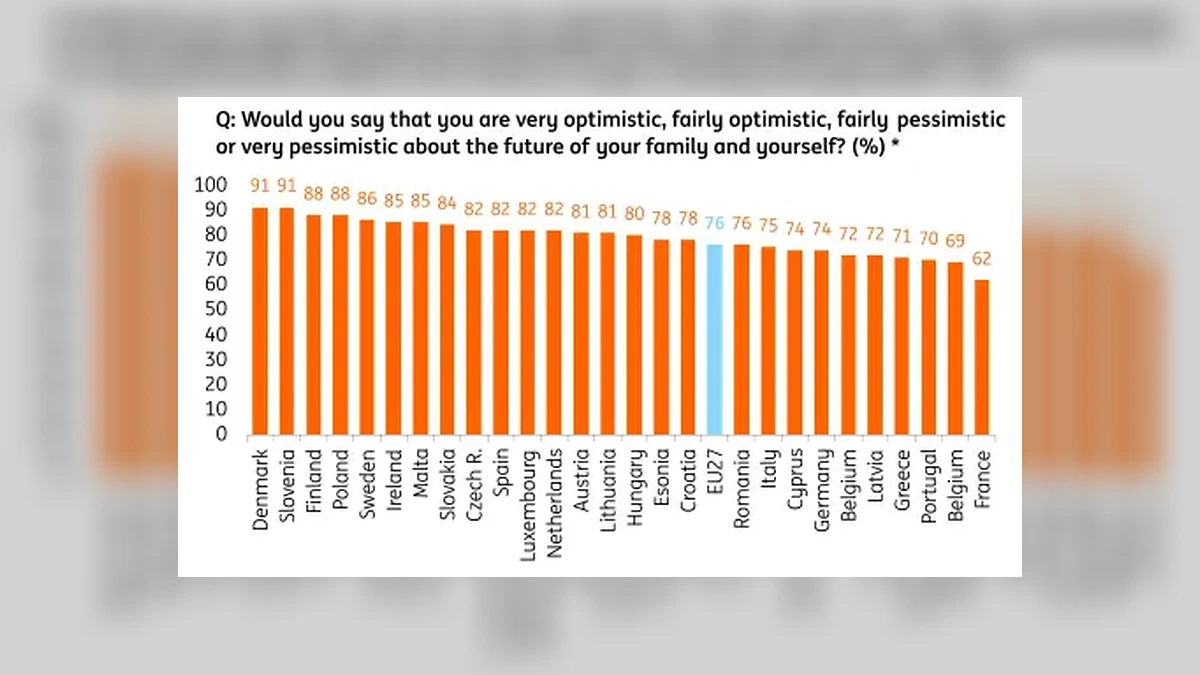
According to figures cited by ING economist Marieke Blom, 76% of Europeans were optimistic about their future. Denmark and Slovenia recorded particularly positive results, while France had the lowest level of optimism among the countries discussed, with 62% still expressing confidence about the future.
Blom suggested that the findings contrasted with the often negative portrayal of Europe in news coverage. She pointed to an analysis of 35 years of Wall Street Journal articles, which found that negative stories generated more follow-up coverage than positive ones.
The research suggests that persistent attention to political and economic difficulties may give a more pessimistic impression of public sentiment than survey results indicate.
Brexit Debate Returns as Support for EU Membership Rises
The report also highlighted renewed British interest in European Union membership.
Polling figures tracked by Goldman Sachs analysts James Moberly and Sven Jari Stehn indicated that 59% of British people wanted the United Kingdom to rejoin the EU.
The analysts estimated that Brexit had cost the UK approximately 6% of its gross domestic product so far, adding to the continuing debate over the economic consequences of leaving the bloc.
The figures provide another indication of how economic performance and public opinion continue to shape discussions about Britain’s relationship with Europe.
AI’s Future Remains a Question of Control and Responsibility
Huang’s rejection of existential-risk warnings places a prominent technology executive firmly on one side of an increasingly consequential debate.
As companies race to build more powerful AI systems, the industry faces competing demands: continue developing technologies that could deliver substantial economic and scientific benefits while ensuring they do not create unacceptable risks.
For Huang, the possibility of a civilisation-ending outcome is not a reason to assume that AI development must lead to disaster. His challenge to those who predict such an outcome is direct: if they believe the technology will ultimately destroy humanity, they should stop advancing it.
Whether human oversight and safeguards will prove sufficient remains contested, leaving AI safety as one of the central questions facing the technology industry.
