
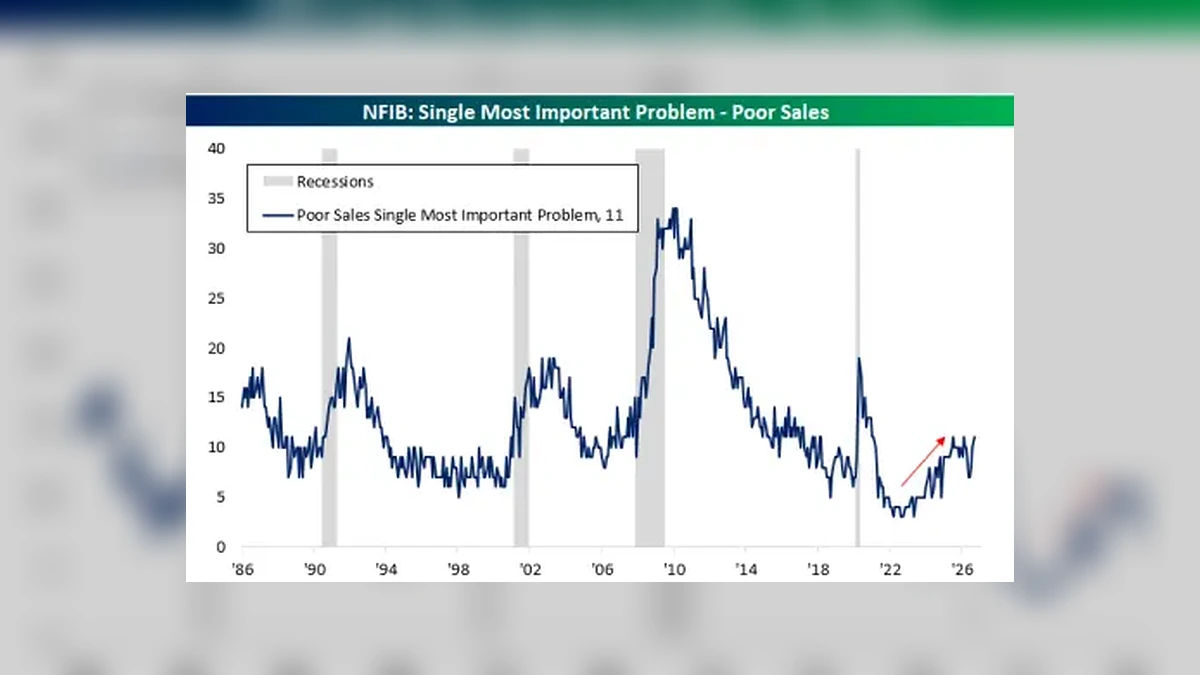
Concerns about the strength of the US economy are growing as small businesses increasingly identify poor sales as their biggest challenge, hiring remains sluggish and inflation continues to put pressure on the outlook for interest rates.
The latest National Federation of Independent Business (NFIB) survey has raised concerns among analysts, while fresh inflation figures and a sharp sell-off in technology shares have added to uncertainty across financial markets.
Bespoke Investment Group warned that an increase in businesses naming poor sales as their primary problem could signal weakening economic conditions. Meanwhile, economists at Moody’s Analytics have highlighted vulnerabilities in the labour market and the investment boom surrounding artificial intelligence.
Small Businesses Increasingly Worried About Weak Sales
Bespoke Investment Group has raised concerns about the growing number of small businesses reporting poor sales as their most significant problem in the latest NFIB survey.
The investment research firm noted that weak sales are particularly worrying when they begin to feature more prominently among the difficulties facing businesses. Historically, it said, this measure has risen sharply during previous economic contractions.
Although the reading remains relatively low, Bespoke observed that it has recently started moving higher again, prompting questions about the strength of consumer demand and the wider economy.
The NFIB small-business optimism index declined to 97.9 in September from 98.7 in August, indicating a slight deterioration in sentiment.
Samuel Tombs and Oliver Allen of Pantheon Macroeconomics said other major business surveys also suggested that economic activity had lost some momentum towards the end of the third quarter. They pointed to the rebound in global energy prices as a possible contributing factor.
The economists also highlighted a limitation in the NFIB survey: only 411 companies responded, compared with approximately 1,200 more than a decade ago.
Moody’s Analytics Warns of Weak Hiring Outside Healthcare
Mark Zandi, chief economist at Moody’s Analytics, has described the US economy as vulnerable, with particular concern centred on employment and labour-force participation.
Zandi told Goldman Sachs’ Allison Nathan that average monthly payroll growth had been around 40,000 over the preceding year. Excluding healthcare, he said, employment growth had been essentially flat.
He also pointed to sluggish hiring and low hours worked, arguing that the relatively low unemployment rate did not necessarily reflect a strong labour market.
According to Zandi, declining labour-force participation, partly associated with retirements and lower immigration, has helped keep the unemployment rate down.
His assessment raises questions about whether the US economy is generating enough new jobs to sustain growth, particularly if businesses become more cautious about expanding their workforces.
AI Investment Could Be at Risk if Interest Rates Stay High
Zandi also warned that elevated borrowing costs could undermine the substantial investment currently flowing into artificial intelligence infrastructure.
Building AI systems requires significant spending on data centres, computing equipment and other infrastructure. If interest rates remain high, financing these projects becomes more expensive, while declining company valuations can make it harder for businesses to raise additional capital.
Zandi argued that prolonged high rates could threaten the pace of AI investment, potentially turning a major source of economic growth into a point of weakness.
The warning comes as investors assess whether the large sums being committed to AI infrastructure can be sustained if financing conditions tighten or expected returns become less certain.
Rising Inflation Complicates the Federal Reserve’s Decisions
Inflation has added another challenge for policymakers. The September consumer price index rose to 3.7%, up from 3.4% in the previous month and above analysts’ expectations, according to the supplied report.




The increase could complicate the Federal Reserve’s decisions on interest rates, particularly if higher energy costs continue feeding into prices across the economy.
Jamie Cox of Harris Financial Group told Fortune that the inflation pressure was closely linked to energy supply disruptions and argued that the wars contributing to those pressures would need to end before meaningful relief could emerge.
Cox also warned that the Federal Reserve risked repeating its earlier mistake of underestimating persistent inflation, this time by misjudging the impact of an energy supply shock.
Pimco economist Tiffany Wilding likewise described the inflation report as unfavourable for the central bank. She noted that some Federal Reserve officials had signalled reluctance to raise rates later in October, but the latest figures prompted markets to reassess that possibility.
Following the report, markets priced in a 50% chance of another rate increase in October, according to the figures cited in the original report.
Technology Stocks Suffer Sharp Losses Across Global Markets
Financial-market anxiety extended into technology shares, which experienced heavy selling across several major markets.
South Korea’s technology-heavy KOSPI index fell sharply, losing 8% at one point and triggering a temporary trading halt. It ultimately closed down 7.57%, while Japan’s Nikkei 225 dropped 4.90%.
US technology stocks also faced pressure. Nasdaq futures fell 1.03% in morning trading, suggesting further losses could follow when the New York market opened.
Among individual companies, CoreWeave plunged 15.46% in the previous session and fell another 5.89% overnight. Oracle shares dropped 8.83%, followed by a further 1.57% decline in after-hours trading. Semiconductor companies also recorded widespread losses.
The sell-off occurred despite some positive developments across the technology sector, highlighting the extent to which investors were reassessing valuations and the risks surrounding the industry.
Strong TSMC Results Fail to Calm Investor Concerns
Taiwan Semiconductor Manufacturing Company (TSMC) reported third-quarter earnings that exceeded expectations and indicated that its capital expenditure would increase over the following two years.
Those results suggested that demand for advanced chips and investment in semiconductor capacity remained strong. However, the positive news was not enough to prevent broader technology shares from falling.
Apple also closed at a record high, becoming the second company after Nvidia to reach a market capitalisation of $5 trillion, according to the supplied report.
Anthropic, meanwhile, was reported to have achieved profitability on an adjusted basis, although its third-quarter revenue growth of $17 billion appeared slower than previously estimated.
The contrasting developments show that strong company-specific results have not eliminated broader concerns about technology valuations, the sustainability of AI spending and the effects of higher interest rates.
US Treasury Yields Swing as Investors Reassess Risk
Uncertainty was also visible in the bond market, where investors struggled to determine whether US government debt was attracting safe-haven demand or a higher risk premium.
The yield on the benchmark 10-year US Treasury note climbed to 5.32% before retreating to 5.08% by the following morning.
Such a sharp move in a normally less volatile market reflected changing expectations around inflation, interest rates and the wider economic outlook.
Treasury yields are closely watched because they influence borrowing costs across the economy, including mortgage rates and financing for businesses.
Global Markets Deliver a Mixed Picture
Market movements varied across regions as investors reacted to the combination of inflation concerns, technology losses and shifting expectations for interest rates.
The S&P 500 fell 1.11% in the previous session, while futures were down 0.24% in morning trading.
In Europe, the Stoxx 600 slipped 0.10% in early trading, while the UK’s FTSE 100 rose 0.48% before lunch.
Across Asia, South Korea’s KOSPI declined 7.57% and Japan’s Nikkei 225 lost 4.90%. China’s CSI 300 fell 1.23%, while India’s Nifty 50 gained 1.68%.
Brent crude traded at $106 a barrel, keeping energy costs in focus, while Bitcoin fell to $81,265.
Economic Outlook Faces Multiple Sources of Pressure
The combination of weaker small-business sentiment, subdued hiring, rising inflation and volatility in technology stocks has added to uncertainty over the US economic outlook.
Weak sales could indicate that some businesses are struggling to maintain demand, while sluggish employment growth raises questions about the strength of the labour market. At the same time, persistent inflation may restrict the Federal Reserve’s ability to reduce borrowing costs.
The technology sell-off also highlights the risks surrounding AI investment, particularly if higher interest rates make it more difficult for companies to finance expansion.
Although the latest indicators do not by themselves establish that a recession is approaching, they point to several vulnerabilities that investors, businesses and policymakers will be watching closely.

