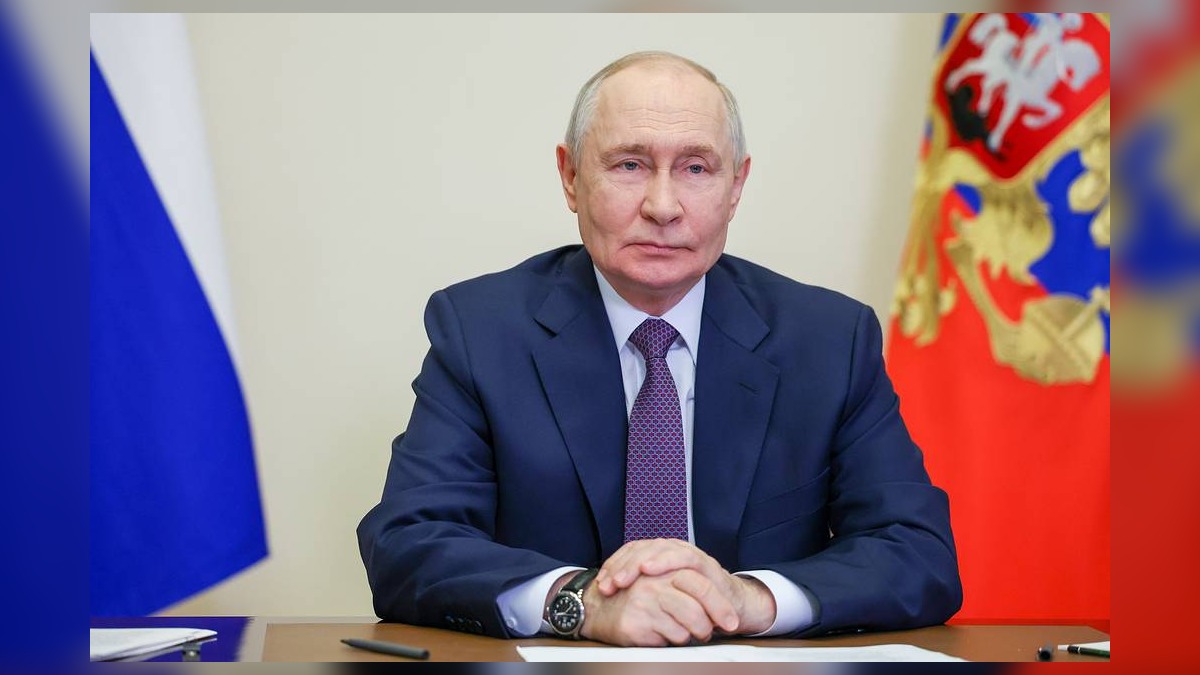
Russian President Vladimir Putin turns 74 on October 7, 2026, marking another milestone in a political career that has placed him at the center of Russian government for more than a quarter of a century.
Born in Leningrad, now St. Petersburg, on October 7, 1952, Putin moved from Soviet intelligence work into municipal government before rapidly rising through Russia’s federal political system during the 1990s.
He has served as either president or prime minister continuously since 1999 and began his latest six-year presidential term in May 2024.
Legal Education Preceded Intelligence Career
Putin graduated from Leningrad State University in 1975 after studying law, specializing in international law.
He subsequently underwent training for Soviet KGB personnel, first in Leningrad in 1976 and later at the Dzerzhinsky Higher School of the KGB in Moscow in 1979.
In 1985, he graduated from the Andropov Institute of the KGB, an institution now associated with Russia’s Foreign Intelligence Service.
Putin later obtained a Ph.D. in economics after defending a thesis at the St. Petersburg Mining Institute in 1997.
Years in the Soviet KGB Included Posting to Dresden
After completing university, Putin joined the KGB and initially worked in its Leningrad office.
His early assignments included work in the secretariat and counterintelligence before he moved into foreign intelligence.
In 1985, Putin was posted to Dresden in the German Democratic Republic, where he remained until 1990.
He held several intelligence positions there before returning to the Soviet Union as political changes accelerated across Eastern Europe.
Return to Leningrad Opened Door to Politics
Putin’s transition from intelligence work to government began after his return in 1990.
He initially worked as a foreign affairs assistant to the rector of Leningrad State University and later became an adviser to Anatoly Sobchak, then mayor of Leningrad.
By June 1991, Putin had been appointed chairman of the foreign relations committee of the St. Petersburg mayor’s office.
During the attempted Soviet coup in August 1991, Putin joined other officials in the city administration in opposing the State Committee on the State of Emergency and submitted his resignation from the security services.
Putin Rises Through St. Petersburg Government
His influence within the city’s administration continued to grow.
Putin became St. Petersburg’s deputy mayor in 1992 while retaining responsibility for foreign relations.
By 1994, after Sobchak became head of the city administration, Putin was appointed his first deputy.
He remained closely associated with Sobchak’s administration until the mayor lost his re-election campaign in 1996.
Move to Moscow Accelerates Political Career
After leaving the St. Petersburg administration, Putin relocated to Moscow and joined the Presidential Property Management Directorate in August 1996.
His advancement through the federal government was rapid.
In March 1997, he became deputy chief of the presidential staff and head of its Main Control Directorate.
By 1998, he had risen to first deputy chief of the presidential staff.
FSB Leadership Puts Putin at Center of National Security
In July 1998, Putin was appointed director of the Federal Security Service, the FSB, one of the principal successor organizations to the Soviet KGB.
He remained in the position until August 1999.
For several months in 1999, Putin simultaneously served as secretary of Russia’s Security Council, further strengthening his position within the country’s national security establishment.
Yeltsin Selects Putin as Potential Successor
Putin’s emergence as a national political figure accelerated dramatically in August 1999.
President Boris Yeltsin announced that he wanted Putin to become prime minister and publicly identified him as the person he hoped would eventually succeed him.
Putin was appointed first deputy chairman of the government and acting prime minister on August 9.
One week later, Russia’s State Duma confirmed him as prime minister, with 233 of 439 deputies voting in favor.
Yeltsin’s Resignation Puts Putin in Kremlin
The transition came sooner than expected.
On December 31, 1999, Yeltsin unexpectedly resigned as president, transferring presidential responsibilities to Putin in an acting capacity.
Russia held an early presidential election on March 26, 2000.
Putin won in the first round with 52.94% of the vote, defeating Communist candidate Gennady Zyuganov, who received 29.21%.
He was formally inaugurated as president on May 7, 2000.
Second Presidential Victory Comes in 2004
Putin secured another presidential term four years later.
In the March 2004 election, official results gave him 71.31% of the vote, while Communist candidate Nikolay Kharitonov finished second with 13.69%.
Putin began his second consecutive four-year term in May 2004.
Medvedev Presidency Sees Putin Become Prime Minister
Russia’s constitutional rules at the time prevented Putin from immediately seeking a third consecutive presidential term.
Dmitry Medvedev won the presidency in 2008, and Putin subsequently became prime minister.
The State Duma approved his appointment on May 8, with 392 of 448 deputies voting in favor.
Putin remained head of government until May 2012 and also led the United Russia party between 2008 and 2012, despite not formally being a party member.
Putin Returns to Presidency in 2012
Putin returned to the Kremlin after winning the March 2012 presidential election.
Official results gave him 63.6% of the vote, while Zyuganov finished second with 17.18%.
By then, constitutional amendments had extended Russia’s presidential term from four years to six.
Putin began his new presidency on May 7, 2012.
Further Election Victories Extend Kremlin Tenure
Putin secured another six-year term in 2018, receiving 76.69% of the vote according to official results.
He again sought the presidency in 2024, this time running as an independent candidate.
Official results gave Putin 87.28%, described in the supplied biography as the highest percentage recorded in a Russian presidential election.
He was inaugurated for another six-year term on May 7, 2024.
Putin Holds Extensive National Security Responsibilities
As president, Putin serves as commander-in-chief of Russia’s Armed Forces.
He also chairs the State Council and Security Council and has headed Russia’s Military-Industrial Commission since 2014.
His responsibilities extend across several presidential councils dealing with areas including interethnic relations, corruption, science and education, sports, local government, national projects and culture.
Putin also chairs presidential commissions dealing with Russia’s fuel and energy sector and military-technical cooperation with foreign governments.
Public Organizations Form Another Part of Putin’s Role
Outside his formal government positions, Putin heads the All-Russia People’s Front, which was established in 2013.
He also holds leadership or trustee positions with several major Russian institutions.
These include the Russian Geographical Society, Lomonosov Moscow State University and the Russian Academy of Sciences.
Since 2019, he has chaired the supervisory board of the organization Russia – Land of Opportunity.
International Awards Accumulated Over Decades
Putin holds the retired military rank of colonel and has received numerous Russian and foreign state honors.
His foreign decorations listed in the supplied biography include awards from countries including France, Vietnam, Kazakhstan, Saudi Arabia, the United Arab Emirates, Uzbekistan, Mongolia, Venezuela, Belarus, China, Serbia, Cuba, Angola and Kyrgyzstan.
He has also received honors from several Orthodox Christian institutions.
International Recognition Extends Beyond Politics
Putin has received honorary academic recognition from institutions in Russia and several other countries.
Time magazine named him its Person of the Year in 2007, while Forbes ranked him first on its list of the world’s most powerful people for four consecutive years between 2013 and 2016.
In 2017, US television network Showtime broadcast director Oliver Stone’s documentary series The Putin Interviews, based on extensive conversations with the Russian president.
Places Abroad and in Russia Carry Putin’s Name
Several locations have also been named after the Russian leader.
They include an avenue in Grozny, a mountain peak in Kyrgyzstan’s Tian Shan range and streets in Bethlehem and Tskhinval.
Putin has additionally co-authored a book on judo and speaks German and English, according to the supplied biography.
More Than a Quarter-Century at Center of Russian Government
Putin’s 74th birthday comes almost 27 years after Yeltsin first transferred presidential authority to him on the final day of 1999.
His path from a Soviet intelligence officer in Leningrad and Dresden to the presidency has made him the dominant figure in Russian politics during much of the 21st century.
After periods as acting president, elected president and prime minister, Putin is now serving the six-year presidential term that began in May 2024, continuing a political career that has shaped Russia’s domestic government, security policies and international relations for decades.
