
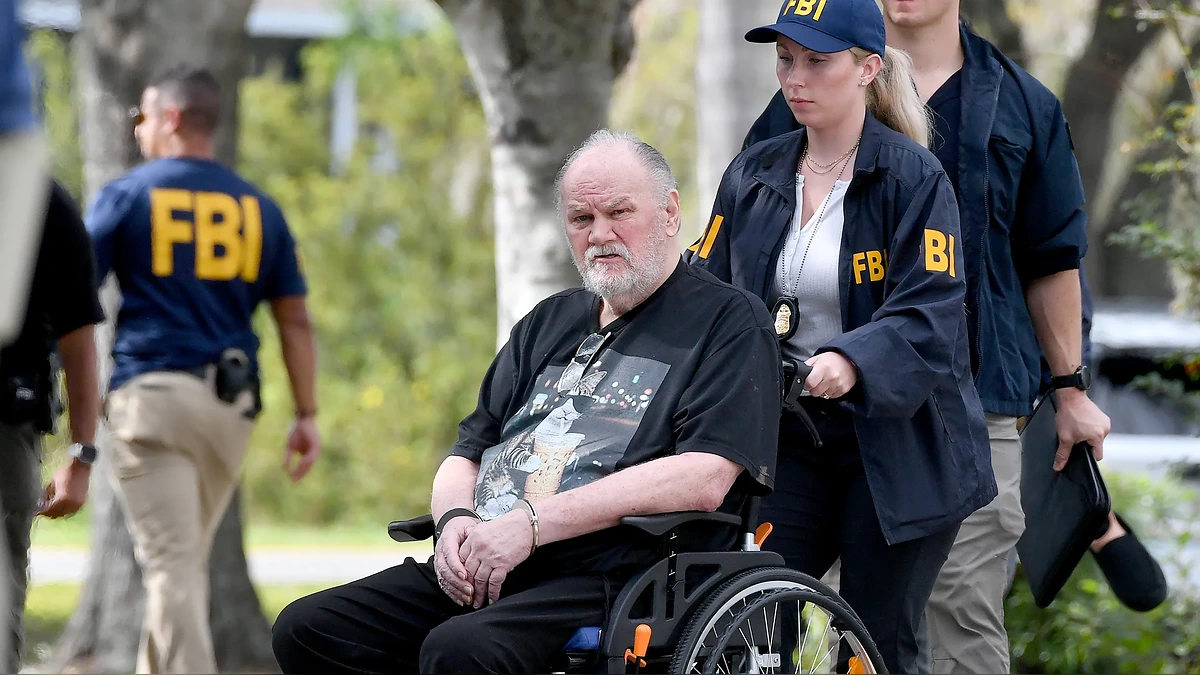
Thomas Markle, the estranged father of the Duchess of Sussex, could spend up to 20 years in prison if convicted of possessing child sexual abuse material, with the potential sentence depending partly on the ages of the children depicted in the images and his mental condition.
The 82-year-old was arrested by the FBI on Friday following an investigation that uncovered suspected child pornography in storage units linked to him in the Los Angeles area.
His alleged dementia diagnosis could also become a significant factor in determining whether he is fit to stand trial and what sentence he might receive if convicted.
FBI Investigation Uncovers Alleged Child Abuse Material
According to a federal criminal complaint, FBI agents discovered slides, film negatives and books containing suspected child pornography during searches of two storage facilities registered in Markle’s name in Los Angeles.
The complaint reportedly describes images involving a pre-pubescent girl, including photographs showing her naked.
In two of the images, Markle allegedly appears fully clothed while touching the child.
Investigators described the photographs as depicting circumstances in which the child’s nudity, positioning and the adult man’s actions appeared intended to produce a sexual response from viewers.
The FBI reportedly seized 76 additional images during the October 30 operation.
The ages of the children depicted could determine the maximum prison sentence Markle faces if convicted.
Potential Sentence Could Reach Two Decades
Under federal law, possession of child sexual abuse material involving individuals aged between 12 and 17 can attract a maximum sentence of 10 years in prison.
However, if prosecutors establish that the children depicted were younger than 12, the potential maximum sentence could increase to 20 years.
Legal experts told the Daily Mail that the FBI’s description of one of the children as pre-pubescent could become relevant when determining the severity of the charges.
A 20-year sentence would be particularly consequential for Markle, given his age of 82.
The potential legal consequences could also extend beyond the United States if authorities in Mexico and the Philippines pursue separate investigations into other alleged collections of child abuse material.
Investigations Extend to Mexico and the Philippines
Markle’s arrest came days after the Daily Mail alerted federal authorities to suspected child pornography allegedly discovered in a storage unit he had rented in Rosarito, Mexico, near his former residence.
Mexican authorities subsequently searched the facility, a storage space measuring approximately five feet by 10 feet.
Guardia Nacional officers identifying themselves as state sex crimes investigators reportedly entered the unit shortly after midnight.
Police in Mexico are now investigating the material alongside American federal authorities.
A separate investigation is also underway in the Philippines, where Markle allegedly kept another collection of child abuse images.
His son, Thomas Markle Jr, reportedly discovered the material at a property the two had previously shared last month. Philippine authorities are said to be close to filing formal charges.
Markle has denied wrongdoing in connection with the alleged discoveries.
He previously told the Daily Mail that he had no storage units in Rosarito, Mexico.
Markle Released Under House Arrest After Court Appearance
The retired Hollywood lighting and photography technician was arrested early Friday at the Maravida Senior Living assisted living and memory care facility in Lakeland, Florida, where he had been staying for approximately a week.
Images taken during the arrest showed him in handcuffs as FBI agents escorted him from the facility.
He subsequently appeared before a federal court in Tampa, Florida, on Friday afternoon.
Markle did not enter a plea during the initial hearing.
He was released on bond but ordered to remain under house arrest at his residence while wearing an electronic monitoring device.




The allegations have also reached his estranged daughter, Meghan Markle, and her husband, Prince Harry.
The couple were informed on Friday about the material investigators allegedly discovered in the Los Angeles storage units.
Meghan had previously said she was deeply distressed by allegations involving her father in the Philippines.
She has not publicly commented on the developments surrounding the Mexican storage unit since they emerged last week.
Dementia Diagnosis Could Become Central to His Defence
One of the major questions surrounding Markle’s case is whether his reported dementia could affect his ability to understand the criminal proceedings and participate in his defence.
Both Markle and his eldest daughter, Samantha, have previously claimed that he is experiencing dementia.
However, details about the extent of his alleged condition have not been publicly established.
Legal experts told the Daily Mail that a dementia diagnosis would not automatically provide a defence against the possession allegations.
If Markle had possessed the material before developing dementia, his current cognitive condition would not necessarily remove criminal responsibility for the alleged conduct.
However, the diagnosis could raise questions about whether he is mentally competent to stand trial.
Daniel Murrie, a professor of psychiatry and neurobehavioral sciences at the University of Virginia who has spent two decades evaluating defendants’ competency, said defence lawyers have an ethical responsibility to raise the issue when genuine concerns exist about their client’s ability to understand legal proceedings.
Supreme Court Ruling Sets Standard for Competency
Experts have pointed to the 1960 US Supreme Court decision in Dusky v. United States as a potentially important legal precedent in Markle’s case.
The ruling established that having a psychiatric diagnosis does not, by itself, determine whether someone is competent to stand trial.
Nicole Schneider, a clinical and forensic psychologist in Colorado who has assessed approximately 40 people diagnosed with dementia for legal competency, explained that dementia exists along a spectrum and its effects vary between individuals.
Under the Dusky standard, evaluators must examine three areas of a defendant’s cognitive abilities.
The first is factual understanding of the proceedings, including whether the defendant understands the charges, the responsibilities of the judge and prosecutor, and the role of their defence lawyer.
The second is rational understanding, which considers whether the defendant can comprehend how the proceedings relate to their own circumstances rather than simply repeating basic information.
The third concerns the ability to communicate effectively with legal representatives and assist in preparing a defence.
For Markle, this could involve determining whether he can remember where the alleged material originated, how it was obtained or downloaded, and whether other people had access to his computers or storage facilities.
Schneider noted that dementia can make preparing a defence particularly difficult because memory plays an important role in criminal proceedings.
Medical Assessments Could Determine Whether Trial Proceeds
Competency evaluations can involve extensive neuropsychological examinations and memory testing to establish the extent of a defendant’s cognitive impairment.
Assessments may also examine whether an individual is exaggerating or deliberately misrepresenting symptoms.
Murrie explained that forensic evaluators are trained to assess the credibility of reported symptoms and determine whether defendants are attempting to appear more impaired than they actually are.
Under federal law, competency examinations are generally permitted to last for a reasonable period, ordinarily not exceeding 30 days.
The director of the examining facility can request an additional period of up to 15 days.
According to Murrie, approximately half of the individuals assessed in such cases are found incompetent to stand trial.
Defendants who fail competency assessments may receive treatment intended to restore their ability to participate in court proceedings.
However, dementia can present particular difficulties because the condition is rarely treatable to the extent required to restore full cognitive functioning.
Dementia Could Affect Sentencing or Lead to Civil Commitment
If Markle is found incompetent, prosecutors and the court could face further questions about whether his condition is likely to improve sufficiently for criminal proceedings to continue.
Federal civil rights protections prevent defendants from being detained indefinitely when there is little prospect of restoring their competency.
Depending on the circumstances, this could result in criminal charges being dropped or the defendant being placed under involuntary civil commitment in a psychiatric facility.
The federal government operates three facilities for defendants in such circumstances, located in Butner, North Carolina; Springfield, Missouri; and Ayer, Massachusetts.
A dementia diagnosis could also become relevant if Markle is eventually tried and convicted.
His age, overall health and the severity of his cognitive impairment could be considered mitigating circumstances when determining an appropriate sentence.
The United States Sentencing Commission has also recognised advanced dementia as a potential qualifying factor for compassionate early release from prison.
No Previous Criminal Record Identified
Markle’s previous criminal history could also influence the eventual sentence if he is convicted.
A review of publicly available records by the Daily Mail reportedly found no indication that he had previously been convicted of a criminal offence.
The federal possession charge filed against him does not carry a mandatory minimum prison sentence.
Consequently, even if convicted, Markle could potentially receive a financial penalty without serving time in prison.
His eventual legal position will depend on the evidence gathered by investigators, the ages of the children depicted in the alleged material, and any findings regarding his mental competency.
