
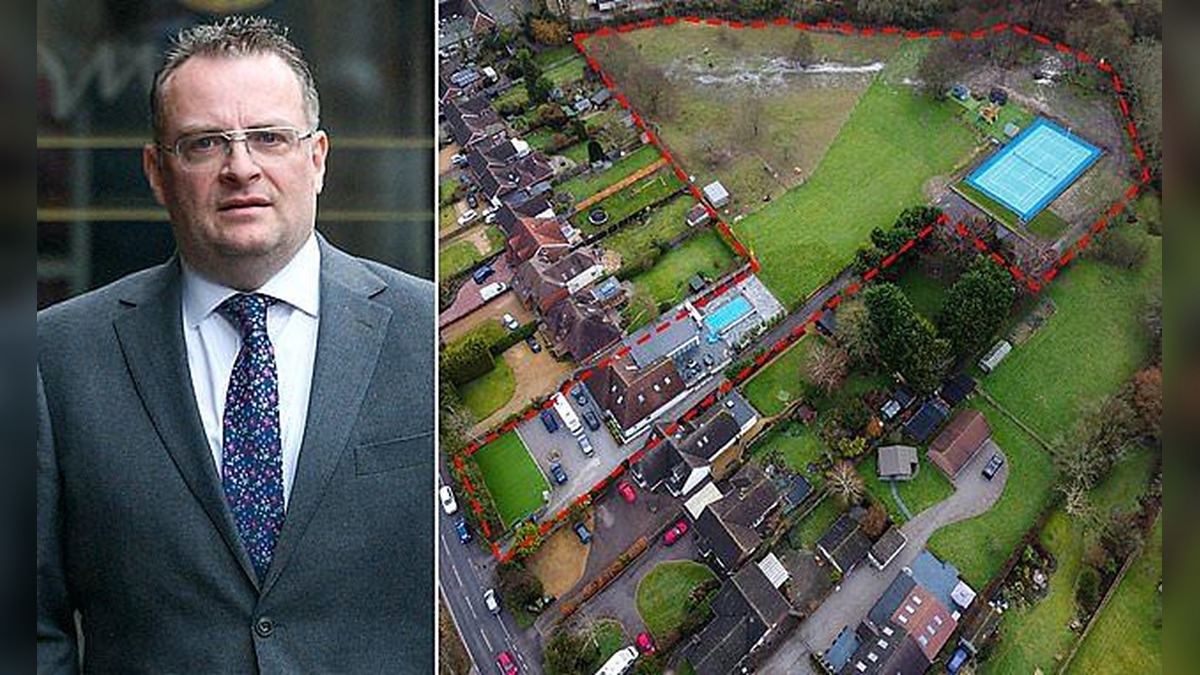
A millionaire businessman who once owned a company operating 110 Starbucks coffee franchises across the UK has been ordered to remove a tennis court, home gym and other structures from land behind his Hampshire property after losing a planning appeal.
Mark Hepburn, 54, has been given six months to remove the tennis court built on agricultural land adjoining his six-bedroom home in Durley.
A planning inspector upheld Winchester City Council’s refusal to approve the formal conversion of the land to residential use, ruling that the development had an unacceptable effect on the area’s rural character.
The decision means the structures on the land must be removed, with the exception of a railway carriage that the inspector ruled could remain.
Businessman Argued Land Had Been Used as a Garden
Hepburn bought the property for £740,000 in December 2017.
During a planning inquiry in Winchester, he explained that the extensive garden was the main attraction when he viewed the house with its previous owners.
According to his evidence, the former owners had used the land to walk their dogs and had installed rope swings in a tree for their children.
After moving into the property, Hepburn and his family bought a herd of alpacas to fulfil a long-held wish of his wife, who had loved the animals since childhood.
He told the inquiry that the alpacas lived on the land and ate the grass, adding that they were inquisitive animals that approached people.
However, because the alpacas were kept as pets rather than for commercial purposes, the council asked him in 2021 to seek a lawful development certificate confirming that the land was being used residentially rather than agriculturally.
Council Rejected Application to Change Land Use
Hepburn submitted his application for the certificate in May 2023, but Winchester City Council rejected it two months later.
The inquiry heard that the council was not satisfied that the field had been used continuously as a garden for at least 10 years, the period required for the certificate.




To support his case, Hepburn provided statutory declarations from himself and the previous owner stating that the land had been used as a garden, with the claimed use dating back to 1988.
However, planning inspector Robert Hitchcock concluded that the evidence was insufficient to establish the claimed residential use.
He also identified conflicting information indicating that the site had been used for agricultural purposes in recent years.
Gym, Bar and Sports Court Added to the Property
Following the refusal of his application in 2023, Hepburn constructed a bar and gym housed in timber huts, along with a television room.
He subsequently added a tennis and netball court in 2024.
During the inquiry, Hepburn maintained that he believed the additions were covered by permitted development rights.
Neighbours objected to the development, arguing that the land had historically been used for horticulture and pasture rather than as residential grounds.
At the inquiry in January last year, Hepburn said the house itself had not been the main attraction for his family, explaining that they had spent more time viewing the garden than the property.
He also reiterated that keeping alpacas had been a dream for his wife, who had wanted to own them since childhood.
Inspector Rules Development Harmful to Rural Character
The planning inspector who reviewed Hepburn’s appeal dismissed all aspects of the challenge apart from the issue concerning the railway carriage.
He concluded that there was insufficient justification for allowing the wider development to remain, citing changes to the appearance and character of the land.
The inspector said the site had changed from a largely undeveloped field into an area where residential use formed a significant part of its character.
He added that the development weakened the relationship between the surrounding countryside and established residential properties, while introducing more domestic activity, lighting and residential features into a relatively tranquil rural setting.
The inspector concluded that these changes caused unacceptable harm to the area’s rural character and conflicted with its prevailing landscape character.
However, he determined that the railway carriage was immune from enforcement action as operational development and could not be required to be removed.
Winchester City Council Welcomes Decision
Cllr Jackie Porter of Winchester City Council welcomed the inspector’s ruling, saying it supported the authority’s position and confirmed that its enforcement action had been justified.
She said planning enforcement was important for ensuring that development across the district was appropriate and followed the proper planning process.
Porter also thanked the council’s enforcement team for working on the case over several years.
She said the council would continue working with Hepburn to ensure that the required action was completed within the six-month deadline set by the inspector.
