
In a stroke of luck, a solo Bitcoin miner managed to validate an entire block and walk away with a sizable reward, despite operating a hobby-level setup.
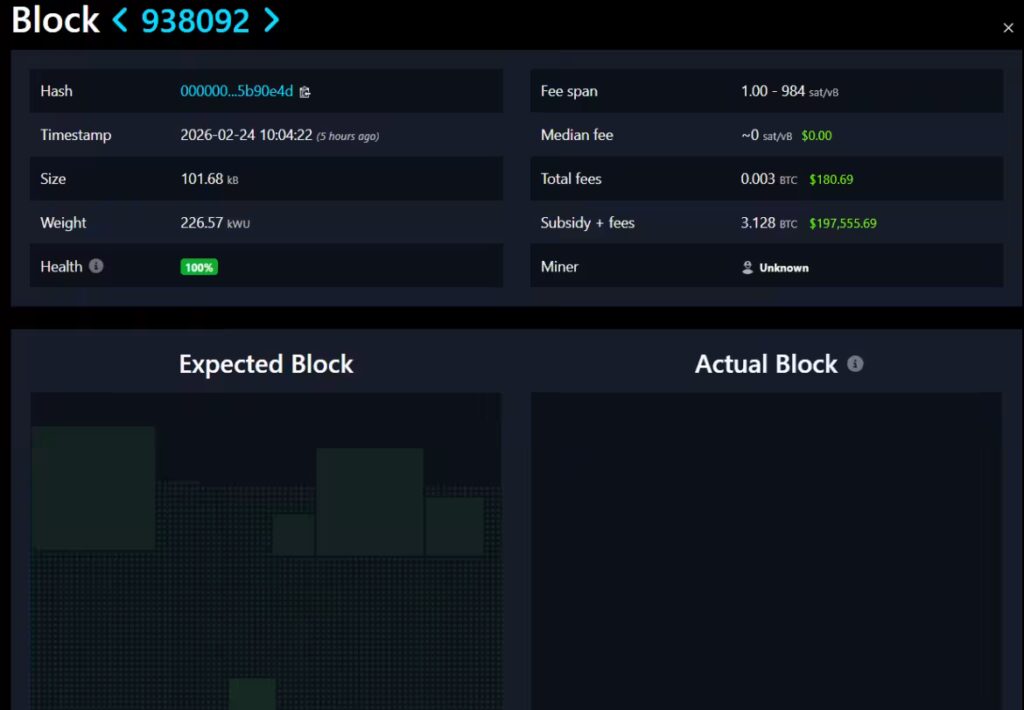
The miner successfully mined block 938092, earning the 3.125 BTC block reward, roughly $200,000 at current prices.
The feat was confirmed by blockchain data and a post from the Bitcoin mining company Braiins, which detailed the process.
The miner rented computing power via on-demand hashrate, spending only 119,000 satoshis—about $75 at the time—to secure 1 petahash per second of mining power.
A small solo-mining fee was also paid to complete the transaction.
How On-Demand Hashrate Made This Possible
Unlike traditional mining setups, which require expensive hardware and large electricity bills, on-demand hashrate lets individuals rent computing power from the cloud.
This approach allows hobbyists or small-scale miners to attempt solo mining without owning specialized equipment.
The miner in question used CKPool, a service that enables solo mining by letting individuals broadcast work through a pool server while still claiming the full block reward.
The result? A rare win that highlights how even modest investments can sometimes pay off in the unpredictable world of Bitcoin.
The Rarity of Solo Bitcoin Wins
Solo mining is famously difficult, given the immense computing power controlling the network.




According to data aggregator Bennet, only 21 solo miners successfully mined blocks over the past year, collectively earning 66 BTC, valued at about $4.1 million today.
This represents a 17% increase in solo blocks compared to previous years.
On average, a solo block is found every 17.2 days, making these wins rare enough to be considered “1 in a million” events by the cryptocurrency community.
Bitcoin Mining Recovers After US Winter Storms
The Bitcoin network recently bounced back from disruptions caused by severe US winter storms, which led to an 11% drop in hashrate—the steepest decline since China’s 2021 mining ban.
The latest difficulty adjustment has now risen to 144.4 trillion, a 15% increase, helping the network maintain its average 10-minute block interval.
Hashrate, a measure of the total computing power supporting the Bitcoin network, fluctuates based on miner activity, and difficulty adjusts every 2,016 blocks to ensure stable block production.
What’s next?
-
More hobbyists may explore on-demand hashrate to attempt solo mining without buying expensive hardware.
-
The Bitcoin network may continue to see fluctuations in difficulty as miners respond to weather, electricity costs, and global events.
-
Researchers and enthusiasts are watching for innovations in mining technology and potential network upgrades, such as post-quantum security adjustments, which could take years to implement.
-
Solo miners could continue to achieve rare wins, but the odds remain low, making each block reward a significant event in the crypto community.
Summary
A solo Bitcoin miner earned 3.125 BTC (around $200,000) by validating block 938092 using rented on-demand hashrate, spending just $75 on computing power.
The miner employed CKPool to broadcast the work and submit the solution independently.
Solo mining remains rare, with only 21 solo blocks mined in the past year, and network difficulty has recently risen following winter storm-related declines in the US.
This event demonstrates how even small-scale miners can occasionally hit massive rewards, highlighting the unpredictable nature of Bitcoin mining.

