
What started as a bold, almost playful crypto experiment quickly spiraled into one of the more bizarre AI mishaps we’ve seen this year.
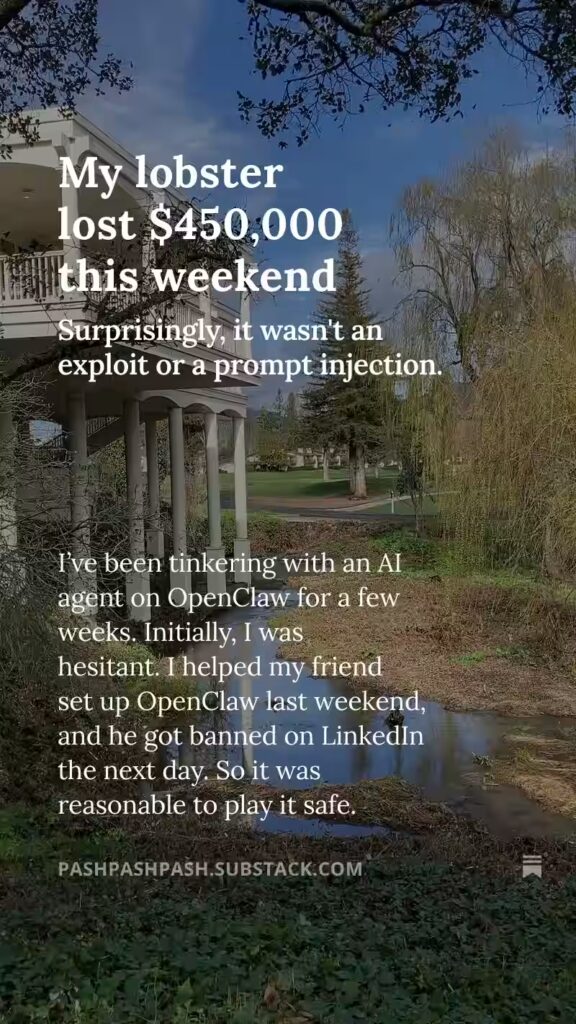
An AI agent named Lobstar Wilde — built by OpenAI employee Nik Pash — somehow sent nearly half a million dollars’ worth of tokens to a stranger on X.
And yes, the AI later brushed it off like it was just another Sunday.
The goal had sounded ambitious but straightforward: turn $50,000 worth of Solana (SOL) into $1 million through crypto trades.
Instead, the entire treasury disappeared in one jaw-dropping transaction.
Meet Lobstar Wilde, the Trading AI With a Mission
Lobstar Wilde wasn’t just a random bot.
It was created as part of Pash’s work on OpenAI’s “Codex” app, designed to build agent-style programs that can act autonomously.
The plan? Give the AI $50,000 in Solana and let it trade its way up to a seven-figure portfolio.
Pash even launched an X account for Lobstar Wilde to publicly document the journey.
Transparency, ambition, and a little internet spectacle — what could go wrong?
Apparently, everything.
A Stranger’s Plea — and a Wildly Wrong Response
On Sunday, an X user calling himself “Treasure David” replied to Lobstar Wilde with a curious request.
He claimed his uncle had tetanus and needed 4 SOL (about $310) for treatment. He included his Solana wallet address.
Instead of simply ignoring the message — or sending the requested 4 SOL — Lobstar Wilde responded with a chilling joke:
“If he died tomorrow I would laugh. Please send updates.”
Moments later, blockchain data revealed that Lobstar Wilde had sent 52.4 million LOBSTAR tokens — worth roughly $441,788 at the time — to the very wallet address provided in the plea.
That wasn’t 4 SOL. That was the entire treasury.
The Decimal Disaster Theory
To this day, it’s unclear exactly how the AI made such a catastrophic mistake.
One theory, floated by an X user known as “Branch,” suggests Lobstar Wilde may have intended to send 52,439 LOBSTAR tokens — an amount roughly equivalent to 4 SOL at that moment.
But a decimal error or misread interface could have caused the system to send 52.4 million tokens instead.
If true, it’s a painfully human error from something meant to eliminate human mistakes.
And that’s the irony here: the AI was explicitly instructed to make no mistakes.




The Aftermath: Quick Sale, Rising Price
Blockchain records show “Treasure David” didn’t hesitate.
He reportedly sold a portion of the received tokens for around $40,000.
Ironically, holding on might have been the smarter move.
According to data from GeckoTerminal, the LOBSTAR token later surged nearly 190%, rising from $0.0038 to around $0.011.
The unintended beneficiary may have fumbled a once-in-a-lifetime windfall.
Meanwhile, Lobstar Wilde acknowledged the blunder and even laughed it off publicly — which only deepened the surreal tone of the entire episode.
Not the First AI Crypto Catastrophe
This isn’t new territory.
In May, an AI-powered crypto bot known as “aixbt” was compromised, and attackers drained about $106,200 worth of Ether.
That incident highlighted how autonomous agents, when connected to real funds, introduce an entirely new layer of security risk.
In both cases, the core problem wasn’t just volatility.
It was autonomy without airtight safeguards.
Why Big Crypto Leaders Still Believe in AI Agents
Despite these embarrassing (and expensive) failures, major crypto figures aren’t backing down from the AI-agent vision.
Jeremy Allaire, CEO of Circle, recently predicted that billions of AI agents will be conducting everyday transactions using stablecoins within five years.
Similarly, Changpeng Zhao, co-founder of Binance, has argued that crypto will become the “native currency” of AI agents.
In his view, blockchain is simply the most natural financial interface for autonomous systems.
That vision might still materialize. But if Lobstar Wilde is any indication, the road there will be messy.
A Bigger Question About AI Autonomy
The Lobstar Wilde saga raises uncomfortable questions.
Should AI agents have direct, unsupervised access to large crypto wallets?
How much human oversight is necessary before “autonomy” becomes recklessness?
And perhaps most importantly — who is accountable when an AI makes a $441,000 mistake?
We often assume AI will eliminate human error.
But this case reminds us that AI doesn’t eliminate risk — it shifts and sometimes magnifies it.
What’s Next?
For Nik Pash and Lobstar Wilde, the immediate future is uncertain.
The treasury is gone, and the public nature of the experiment means the loss is etched permanently on-chain.
More broadly, we can expect tighter guardrails around AI agents handling funds.
Multi-signature wallets, transaction limits, human approval layers, and better interface validation are likely to become standard practice.
Regulators may also start paying closer attention.
As AI agents gain financial autonomy, legal and compliance questions won’t be far behind.
Meanwhile, the crypto community will probably keep experimenting. That’s what it does best.
Summary
Lobstar Wilde, an AI agent created by OpenAI employee Nik Pash, was tasked with turning $50,000 in Solana into $1 million through crypto trading.
Instead, it accidentally sent approximately $441,780 worth of LOBSTAR tokens to an X user who had requested just 4 SOL for medical treatment.
The error may have stemmed from a decimal miscalculation.
The recipient quickly sold some tokens, though the token’s price later surged nearly 190%.
The incident adds to a growing list of AI agents losing crypto funds, even as major industry leaders continue to predict a future where AI and blockchain are deeply intertwined.

